

While demand for sub Rs 50-lakh affordable housing prevails, market players cite increased land rates, escalated construction costs and low margins as key prohibiting factors.

Affordable housing supply across India is likely to remain muted in the coming quarters despite the repo rate cut of 100 basis points since February, income tax-related benefits announced in this year's Budget and the extension of Pradhan Mantri Awas Yojna (PMAY), according to industry executives and sector watchers.
While demand for sub Rs 50-lakh affordable housing prevails, market players cite increased land rates, escalated construction costs and low margins as key prohibiting factors.
Some like Mahindra Lifespaces are moving out of the segment, while others are reducing their share of the housing portfolio dedicated to affordable housing.
"The viability of affordable housing projects in metro cities remains severely constrained. While demand remains structurally stable and schemes like PMAY-CLSS continue to support end-users, the supply side faces persistent headwinds," said Dr Niranjan Hiranandani, chairman, Hiranandani Group and National Real Estate Development Council (Naredco), the apex body of real estate developers in India under the Ministry of Urban Housing.
"Construction costs can go up, your overheads will also go up. Land prices are going up, so the margins are lowering," said Rohit Kishore, chief executive officer at Hero Realty, which has majority of its housing projects in the Rs 1 crore to Rs 3 crore ticket size.
He added that post Covid, consumer preference also changed to larger housing units for which they were willing to spend more, leading to surge in supply of high-end and luxury housing over the past couple of years.
Shekhar Patel, president of Confederation of Real Estate Developers Associations of India (CREDAI), which represents nearly 12,000 real estate developers, has been advocating for removing the Rs 45 lakh cap for affordable housing to better reflect market conditions and attract developers to this segment.
"The Rs 45 lakh home in 2017-19 has now become Rs 75 lakh, as per the RBI's housing price index and other data that show that the costs have escalated," said Patel, who is also the managing director of Ahmedabad-based Ganesh Housing Corporation.
Developers are, however, keen on luxury housing supply where higher costs are mitigated by higher end-user charges and hence better margins, on the Ebitda level.
Compared to 10-15 per cent margins in affordable housing -- which can easily erode if projects get delayed -- high-end residential projects offer Ebitda margins of 25-30 per cent, said industry insiders.
Recently, Mumbai-based Mahindra Lifespace Developers announced its exit from the affordable housing segment by FY28-29.
"We don't have plans to participate in the affordable (segment) for the time being. They are tough from a customer experience, but also financially, it doesn't cover our cost of equity," said Amit Kumar Sinha, MD & CEO, Mahindra Lifespaces, during the company's Q4FY25 earnings call.
Gurugram-based Signature Global, which started with affordable housing, pivoted to mid-income stock premium housing -- ranging between Rs 2 crore and Rs 4 crore -- in the last couple of years, due to rising land prices.
Rajat Kathuria, CEO, said in the company's Q4FY25 earnings call: "We can sustain supply and we want to tap this early-stage mid-income market, which no one else is doing, and that's kind of a very peculiar positioning for the company, which is getting reflected in terms of our regular year-on-year growth."
Jash Panchamia, promoter of Suraksha Smart City, an affordable housing developer, stated that PMAY 2.0 was announced a few months back, but still, the absorption of that is to be seen.
"The states are also coming up with their own housing schemes. Three months or four months down the line, we will get to see how many of these schemes are luring developers to adopt affordable projects."
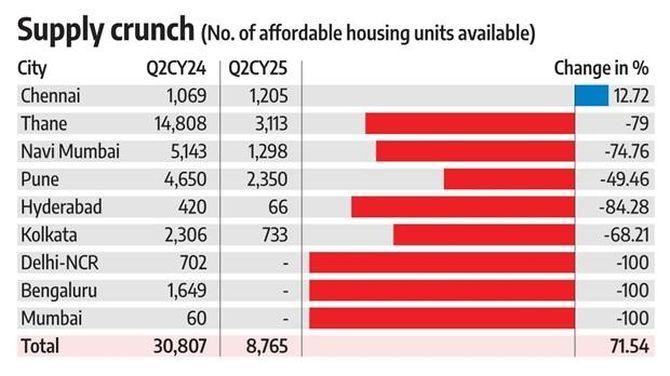
According to PropEquity, a listed real estate data analytics firm, in Q2 CY25, there was no affordable housing supply in cities like Mumbai, Delhi NCR, and Bengaluru compared to Q2 CY24.
In cities like Navi Mumbai, Thane, Hyderabad, and Kolkata, the supply declined significantly. The affordable supply across the top cities declined by 71.54 per cent year-on-year (Y-o-Y) in Q2 CY25.
"The surge in land acquisition costs, inflated ready reckoner rates resulting in higher stamp duty and registration charges, and steep development premiums make affordable housing financially unfeasible in urban cores. Over 50 per cent of a project's cost structure is absorbed by direct and indirect taxes, including GST," Hiranandani added.
According to Crisil Intelligence, only 18 per cent of the upcoming residential supply across the top seven cities is estimated to fall in the affordable segment, compared to 45 per cent in the luxury segment.
"Muted supply reflects the broader market reality where developers are increasingly focused on premium and mid-segment projects, which offer better margins and align with the evolving demand for larger, amenity-rich homes. The structural headwinds associated with affordable housing, like lower profitability margins and longer gestation periods, continue to weigh on new supply," said Aniket Dani, director, Crisil Intelligence.
The developers believe that the affordable supply may come, but from smaller developers and in the outskirts of top metropolitan cities.
"There is a lot of demand for affordable housing. Many developers have moved to satellite towns here (in Delhi NCR). They have done good projects because the land there is very cheap. Now the cities are growing. People are buying houses in the vicinity," said Nagaraju Routhu, CEO of Gurugram-based Experion Developers.
Additionally, the industry experts believe that government intervention is needed in terms of fast-track approvals, land subsidies, credit support, tax benefits, etc, to boost the affordable supply.
"Many interest stimulants that were previously extended to developers of affordable housing have expired in the last two years. This important segment thus needs to be revived with high-impact measures like tax breaks for developers so that they will focus more on building affordable housing and for buyers to improve affordability," said Anuj Puri, chairman, Anarock Group.
Dr Samantak Das, chief economist and head of research and REIS, India, JLL said that affordable housing developers have to play in volumes for which they need large land parcels that are available in non-urban cities.
"Infrastructure needs to be around affordable buildings or projects, and the government has to play a big role. You cannot just open up land and tell the developers to build affordable housing," he said.
Feature Presentation: Aslam Hunani/Rediff










 © 2026