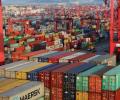
President Donald Trump of the United States has imposed 'reciprocal tariffs' on imports from various countries. With this abandonment of the policy to impose the same tariffs on imports from most countries, nearly all governments, businesses, and economists are busy examining the short- and medium-term implications of this change.

The Budget 2025-26 meets the expectations of fiscal consolidation, maintaining capital expenditure, and boosting consumption through tax cuts.

The simultaneous decline of several trade-related indicators should put policy makers on guard for a sharper slowdown.

A quick bounce back of the Chinese stocks looks improbable now.

The Reserve Bank of India (RBI) has liberalised the procedure for facilitating the import of rough diamonds (termed roughs in the trade).

The announcement left many importers and exporters wondering what he intended, when the practice in most EDI Customs stations is to carry out assessments on selected bills of entry based on risk parameters and to allow the other consignments to be cleared on the basis of the declarations of the importer or exporter.

Changing the rules of the game for developers or units who have already committed funds upsets the financial calculations that guided the investment decision. It is another matter if the government makes it clear that newcomers will be subject to taxes.

Government should make it clear as to whether the Duty Entitlement Passbook scheme will continue beyond June.

Exporters incur transaction costs not only in transportation of goods and dealing with banks, but also in complying with various laws and procedures, besides meeting documentation requirements.

President of the Federation of Indian Export Organisations, Ramu Deora, has presented some points to the finance minister

Their recommendations have something to take note by Indian exporters and policy makers.

The special economic zone scheme seems to be in trouble.

Considering the challenges, he was seen as a lightweight. One year later, his report card shows few breakthrough achievements but hardly any mess-ups.

The commerce ministry must talk to the Reserve Bank of India and see how India's view can be represented and exporters' interests best protected.

Importers may be hit by delay in receipt of documents. But, they cannot hold the negotiating bank or the nominated bank or the LC-issuing bank responsible for the delay.

The Budget 2010-11 has not done away with most excise or customs exemption notifications but, contrary to the need of the hour, added more exemptions, each with its own set of conditions that entail more paperwork and transaction costs. However, a couple of procedural improvements will bring some relief to select importers and exporters.

The Customs tariff is much too complicated with basic Customs duty, two types of additional Customs duty and two types of cess.

How will the financial crisis in Dubai affect exporters and importers in India?

It appears that the focus of commerce minister Anand Sharma, when he unveils the new foreign trade policy, will be to eliminate unnecessary paperwork and thereby help reduce transaction costs for exporters, while retaining the basic framework of the present FTP.

The Finance Bill proposes introduction of Section 26A in the Customs Act, 1962, so as to comply with the standards under the International Convention on the Simplification and Harmonisation of Customs Procedure (Revised Kyoto Convention).
 © 2026 Rediff.com - Investor Information - Advertise with us - Disclaimer - Privacy Policy - Sitemap - Feedback - About us - Terms of use - Grievances