
'Often reviled, mostly ignored, sometimes venerated, he has taken it all in his stride.' 'He has stood by the nation through thick and thin,' says Brigadier Gurmeet Kanwal (retd).

'By beheading an Indian soldier, the Pakistan army has demonstrated its proclivity for barbaric medievalism.' 'The strategies adopted and the punishment inflicted by India must be made progressively more stringent with every new act of terrorism till the cost becomes prohibitive for Pakistan,' says Brigadier Gurmeet Kanwal (retd).
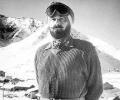
Lieutenant General Harbakhsh Singh, GOC, Western Command, disobeyed the then army chief and took on a superior Pakistani armoured column. The Indian Centurion tanks outgunned the more modern Pakistani Patton tanks in the battle at Khem Karan, that proved the turning point of the 1965 War. Brigadier Gurmeet Kanwal (retd) salutes the Soldiers' General.

The US and its allies must evolve a more comprehensive long-term plan to defeat the new danger that the caliphate poses to the world order. And India too must do its bit for course correction, says strategic expert Gurmeet Kanwal.

The allocation in the defence budget is inadequate to meet India's long-term threats, especially from China and Pakistan, says Gurmeet Kanwal.
.jpg)
The Indian Army must be given a free hand to retaliate punitively at one or more places of its choosing on the LoC. The aim should be to cause maximum damage to the forward posts of the Pakistan army, particularly those through which recent attacks have been launched, thereby raising the cost for the army, says Gurmeet Kanwal.

The military gap between India and China is growing steadily. Clearly, China's negotiating strategy is to resolve the dispute when the Chinese are in a much stronger position in terms of comprehensive national strength so that they can dictate terms, says Brigadier Gurmeet Kanwal (retd).
The military gap between India and China is growing steadily. Clearly, China's negotiating strategy is to resolve the dispute when the Chinese are in a much stronger position in terms of comprehensive national strength so that they can dictate terms, says Brigadier Gurmeet Kanwal (retd).
General Bikram Singh enjoys an excellent reputation as a professional soldier and will no doubt lead by personal example to arrest and correct the downslide in the moral standards of the Army's higher ranks, says Gurmeet Kanwal
The Madhav Godbole task force recommendations on border management are being implemented in phases. While some action has been taken, clearly much more needs to be done. It is time the report is de-classified and put in the public domain, says Gurmeet Kanwal.
India must carefully weigh its options, says strategic expert Gurmeet Kanwal.
After very hard and acrimonious bargaining they will ultimately settle for unadulterated autonomy, which will allow them the right to rule themselves, within the Indian Union, says Gurmeet Kanwal.
Despite having invested $1.2 billion (about Rs 55,000 crore) in efforts aimed at Afghanistan's post-Taliban reconstruction, India is being treated as an also ran in the ongoing Afghanistan summit at London. In the run up to the London summit hosted by Turkey a few days ago, India had not been invited to participate. This had been done in deference to Pakistan's opposition to India's presence in Afghanistan.
A full-fledged civil war in Nepal that results in a Maoist take over would be immensely detrimental to India's national security interests. Even though such a prospect is improbable at present, the present situation in Nepal does not generate any confidence in the international community about the Nepalese political leaders' ability to ride the storm and steer their country's transformation to a representative multi-party democracy successfully.
Whatever the prime minister might say in defence of his grand vision to seek peace with Pakistan, he cannot justify the oblique insinuation in the Joint Statement that India has a hand in what Pakistan calls 'threats in Balochistan'. This reference draws a parallel with Pakistan's prolonged proxy war in Jammu and Kashmir, under the shadow of its nuclear umbrella, and cannot be justified even though "India has nothing to hide".
With explosive flashpoints around India and an unstable internal security environment, the new government has its work cut out. Right on the top of its defence and security agenda should be the formulation of a comprehensive National Security Strategy, including internal security.
The international community, including India, must offer the Pakistan government all the help and encouragement that it needs to fight and root out the menace of radical extremism, or else the terrorists will spread their tentacles far and wide -- including, eventually, into India.
India cannot leap-frog to a higher plane virtually overnight. The immediate requirement is to think big in keeping with the country's growing international status and to plan for the future with a level of confidence that policy planners have not dared to do before.
'The military measures that are adopted have to be carefully calibrated to ensure that escalation can be controlled short of all out war. The aim of Indian retaliation should not be to target the people of Pakistan but to punish the perpetrators and supporters of terrorism, that is the Pakistan army, the ISI and the terrorist organisations like Lashkar and Jaish.'
Among Pakistan's neighbouring countries, India will be particularly vulnerable if Islamist terrorists and their Al Qaeda and Taliban brothers ever lay their hands on Pakistan's nuclear warheads as it is one of the nations that the Al Qaeda has named as an enemy. Being a contiguous land neighbour, it is also easier to target even if sophisticated delivery systems like ballistic missiles are not available
