
India is developing a 'Gross Domestic Knowledge Product' (GDKP) to identify and define its knowledge assets, a move aimed at safeguarding them amidst global efforts to monetise and 'weaponise' knowledge, according to NITI Aayog member R Balasubramaniam.
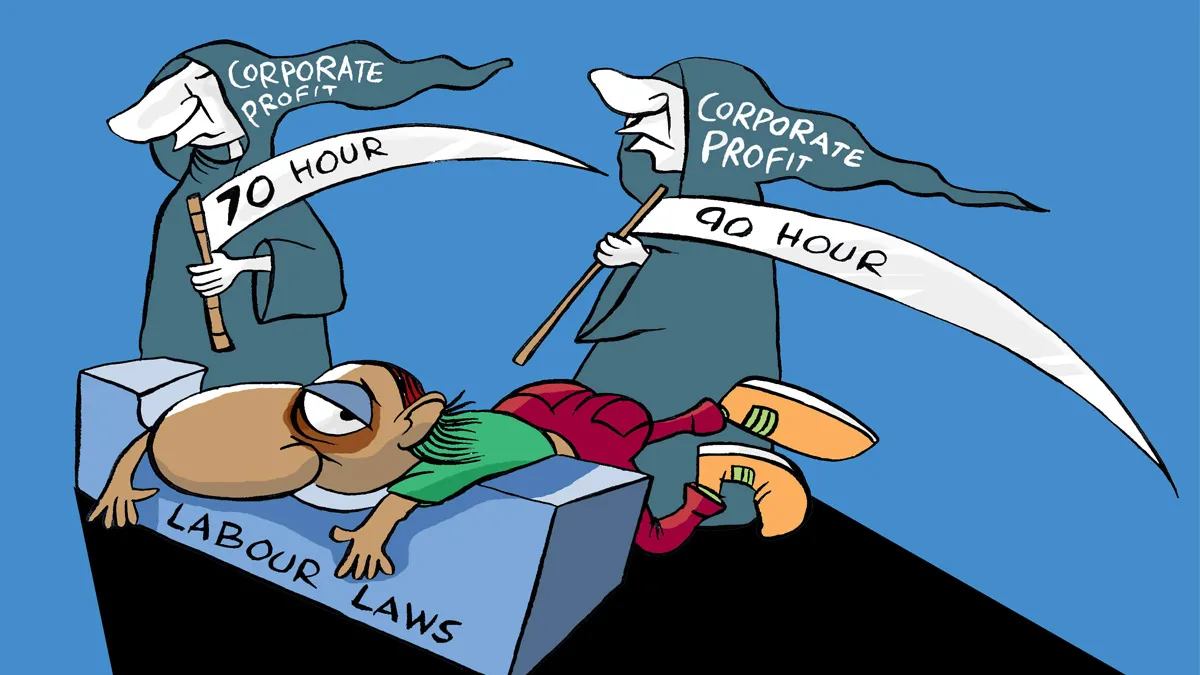
The Indian government is pressing all states and Union Territories (UTs) to publish their rules under the four new labour Codes by October 31, aiming to fully operationalise the new labour law framework. This move is crucial as labour falls under the concurrent list, requiring state-level rule-making for effective implementation.

Bankers said the impact could become more visible from September 29 as customers could withdraw larger amounts of cash, although ATM operations are increasingly managed through third-party cash-loading arrangements.

EPF wage ceiling rising to Rs 25,000 could increase employer statutory contributions by Rs 1,200 monthly per employee.

'For Indian institutions this year, global peers are outpacing in key areas such as RoI, entrepreneurship, and alumni outcomes.'

'Major unions should be included. If this goes on, decision-making will become heavily one-sided and we will be forced to continue our strikes.'

'My suggestion to Nandan Nilekani is that it would be worthwhile for him to take a holistic review in a manner in which examination is just one critical component.'

The task force's move to directly solicit views from students, parents and teachers marks a parallel effort to bring education stakeholders into the reform process.

'If a student can get a good teacher, quality content and mock tests at no cost, it becomes very hard for a mid-tier coaching centre to keep charging for the same lecture.'

Despite near gender parity in basic bank account ownership, women in India remain significantly underrepresented in the growing platform economy due to gaps in digital financial capability and access to credit, according to a joint report by the International Labour Organization and National Council of Applied Economic Research.

A working paper by the Economic Advisory Council to the Prime Minister (EAC-PM) reveals a continuous decline in the rate at which foreign-owned firms invest in fixed assets in India since the FY20 peak, contrasting with a steady increase from Indian business groups.

Employers are increasingly prioritising professionals with four to 10 years of experience.

The overhaul comes after a series of controversies surrounding the conduct of examinations administered by NTA, which has faced questions over examination security and its handling of irregularities.

A parliamentary panel flagged staffing shortages at NCERT and CBSE, inadequate education spending, falling enrolment and poor internet connectivity in government schools.

India's urban unemployment rate for individuals aged 15 and above marginally increased to 6.7 per cent in April-June, while rural unemployment rose to 4.8 per cent, according to the latest Periodic Labour Force Survey (PLFS). This rise in unemployment coincides with a notable decline in the overall labour force participation rate (LFPR) to a five-quarter low of 54.6 per cent.

'Applying AI to change the lives of Indians and at population scale -- just like we did with DPI [digital public infrastructure] -- is really where it's going to go.'

Generative artificial intelligence (AI) is beginning to alter hiring patterns in South Asia, with multinational companies (MNCs) and firms integrated into global value chains (GVCs) reducing recruitment more sharply than domestic firms, signalling the technology's early impact on the region's export-oriented services sector, according to the World Bank's World Development Report 2026.
India's largest retirement fund manager, the Employees' Provident Fund Organisation (EPFO), is enhancing its investment governance and fund management practices, following the Reserve Bank of India's recommendations.

'We can integrate AI and tech into education, but that is just a means and not an end.' 'Ultimately, we need to control what happens in a classroom and we need to let teachers innovate their teaching style to suit the needs of Gen Z and beyond.'

India's private sector activity slowed to a four-year low in July, with the HSBC Flash Purchasing Managers' Index (PMI) falling to 54.3, driven by weakened sales and output amidst renewed tensions in West Asia and rising inflationary pressures.
