
The family of Dr Raj Kumar Thapa, a JKAS officer killed in Pakistan shelling in Rajouri, remembers his sacrifice and dedication to duty a year after his death.

The National Stock Exchange (NSE) faces around 170 million cyberattacks daily, requiring a dedicated team of "cyber warriors" to work around the clock to ensure uninterrupted operations. The NSE recorded its highest-ever 40 crore (400 million) cyberattacks in a single day during 'Operation Sindoor', designed as a DDoS simulation. However, attackers failed to cause any damage due to the coordinated efforts of men, machines, and advanced technology.

A man running a community kitchen for pilgrims was rescued alive after being trapped under debris for 30 hours following a cloudburst in Kishtwar, Jammu & Kashmir. The disaster has left many dead or missing and the annual pilgrimage suspended.
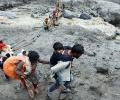
Nine-year-old Devanshi was among the hundreds of pilgrims who had gathered in Chositi for the last leg of the yatra to Machail Mata temple when tragedy struck on Thursday. Buried under mud and debris when a Maggi-point shop was hit by flash floods, she emerged hours later, rescued by her uncle and other villagers.

The shocking scenes of physical and psychological trauma unfolded on a massive scale as search and rescue operations were underway, digging out mud-buried bodies and rescuing the injured trapped in slush and rocks after flash floods triggered by a cloudburst devastated Chositi village in Jammu and Kashmir's Kishtwar district on Thursday.

Defying apprehensions of the horrific April 22 terror Pahalgam attack casting a shadow on the Amarnath Yatra this year, hundreds of pilgrims from various parts of the country lined up at the registration centre in Jammu on the first day.
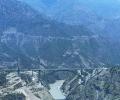
Prime Minister Narendra Modi on Friday flagged off two specially designed Vande Bharat trains between Katra town and Srinagar city, reducing travel time between the two places by two to three hours and ensuring all-weather surface connectivity with the Kashmir valley.

Following the Pahalgam terror attack, the Indian Army launched Operation Sindoor, targeting Pakistani terror infrastructure and posts in the Poonch sector of Jammu and Kashmir. Over 600 artillery shells were fired in three days, decimating 20 Pakistani posts used for infiltrating terrorists into India. The precision strikes crippled enemy logistics, material, and morale, prompting retaliatory attacks by Pakistan on civilian areas. Despite the retaliation, Indian Army officers described the operation as a success, highlighting the high morale of the troops and the effective coordination between artillery and air defense units. The article details the intensity of the artillery shelling and the impact on both sides, highlighting the strategic significance of the Poonch sector and the ongoing tension between India and Pakistan.

People along the Line of Control and International Border in the Jammu region continue to live under the shadow of death, with unexploded mortar shells fired by Pakistani troops still embedded in farmlands and residential areas even though hostilities have stopped for nearly a week. IMAGE: Kindly note that this image has been posted for representational purposes only. Photograph: / Rediff.com Despite the May 10 understanding between India and Pakistan, locals describe the border areas as a 'death trap'. Sixty-two-year-old Balvinder Singh, who returned to his home in Pargwal sector on May 14, recounted a narrow escape. "Two shells exploded in our compound, damaging our house. Three more landed on our farmland. We were terrified and told our family to stay away from the fields until the Army could help," Singh told PTI. Army engineers later came to the village and safely defused the unexploded shells, bringing a temporary sense of relief. "Fear is writ large on the faces of people to these death traps in border hamlets", he said. Scenes of destruction are evident rooftops torn apart, broken houses, windows punctured by shrapnel, and carcasses of cattle lying in pools of blood. The acrid smell of gunpowder still lingers in the air. Sardar Gurmeet Singh faced a similar ordeal. His family could not re-enter their home as a live mortar shell had sunk into the compound in a village close to the International Border. "The army's bomb disposal squad removed it after four days, allowing us to finally enter, back home," he said. Indian Army engineers have launched a sweeping clearance operation across border districts, defusing over 80 unexploded shells in the past five days -- including 6 in Pargwal, 19 in Rajouri, 42 in Poonch, and 12 along the IB. "These shells, mostly 120 mm calibre, have a range of 15 to 30 km and pose a serious threat to both civilian and military targets," an Army officer said. "Many of them were fired by Pakistan during recent hostilities." On May 7, the Indian Army launched Operation Sindoor, conducting precision strikes on nine terror hubs in Pakistan and Pakistan-occupied Jammu and Kashmir (PoJK) in response to the April 22 terror attack in Pahalgam that killed 26 people, most of them tourists. The subsequent retaliation by Pakistan pushed the region to the brink of war. From 7 to 10 of May, 27 civilians were killed and over 70 injured in Pakistani shelling in the Jammu region. Farid Din Gujjar, a resident near the border, expressed fear about returning to his fields. "Several shells created deep craters in our paddy land. We cannot resume work until all unexploded ordnance is cleared. It's a death trap," he said. Army units, in coordination with Jammu and Kashmir Police, have evacuated high-risk zones and issued stern warnings to residents not to touch any suspicious objects or unexploded shells. In one major operation, 42 live shells were safely destroyed in the Poonch villages of Jhullas, Salotri, Dharati and Salani. "All safety protocols were followed. The shells posed a serious danger to local lives," an Army spokesperson said, calling the effort a 'continued commitment to protect civilians and restore normalcy'. Poonch saw the vast majority of deaths due to shelling. Security officials said that Pakistan used a mix of mortar shells, armed drones, and missiles during the shelling spree, specifically targeting civilian habitations and border towns in Jammu, Samba, Kathua, Rajouri, and Poonch. As clearance operations continue, the border residents are slowly returning to their homes, but with caution, fear, and lingering uncertainty about shelling that may yet happen in the future.

Congress rebel Satish Sharma, who defeated the Bharatiya Janata Party's Rajeev Sharma by nearly 7,000 votes and relegated his former party's heavyweight Tara Chand to the third position in the Chhamb seat, has found a place in the Omar Abdullah government, representing the Jammu region in the dispensation.

Both candidates have shifted from their traditional constituencies - Sadhotra from Marh and Sharma from Akhnoor - after these two segments were reserved for Scheduled Castes.

So far 14 Kashmiri Pandits have filed nominations to contest from the valley for the upcoming Jammu and Kashmir assembly elections, aiming to ensure the return and rehabilitation of their fellow community members, whose number run up to 3 lakh.

She emphasised security and employment as her primary issues for the upcoming elections.
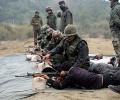
The corner shot weapon will protect members of anti-terror operation parties from coming in line of direct fire from terrorists in close-combat situations, which mostly take place in congested and populated areas of Kashmir, he said.

Slogans for his long afterlife rented the air, as coffin of Flight Lieutenant Advitiya Bal arrived at his home in Jinder Mehlu hamlet of border belt of R S Pura, where thousands of people gathered to pay their last respects to the fighter pilot.

Bala and Kumar were transferred to another school in a safer area only on Monday night. Tuesday was supposed to be the last day for Bala at her old school.

"It is not a crime to be a Hindu. It is not their (Islamic) State."
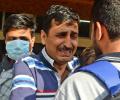
Northern Army commander Lieutenant General Upendra Dwivedi on Monday said the targeted killings of Kashmiri Pandits and non-local labourers by militants was to keep terrorism alive in Kashmir.

It facilitates shooting around corners and over the top of walls, without exposing the person using the pistol, they said.

The ceasefire along Indo-Pak border is working 'well' since February 2021 agreement, he asserted.
