
'Bank has a robust capital adequacy base. Along with balance sheet preparation, the bank is focusing on strengthening risk management for the new regime.'

Mint Road's proposals on banks' M&A funding are cautious even as entrants root for more elbow room, and weigh business models.

Last fortnight, State Bank of India Chairman C S Setty lifted the veil on a subject long spoken of in corporate corridors: Why can't our banks finance mergers and acquisitions (M&As)? Change is in the air: Indian Banks' Association (of which Setty is the chairman) is to "make a formal request" to Mint Road to make way for it. Thus far the exclusive turf of foreign banks even though its funding remains offshore - as in, it's not on these entities rupee-book (and a few select shadow banks) - a most lucrative segment in the investment banking suite, M&As, will be homeward-bound.

After a subdued first quarter of 2025-26 (Q1FY26), banks are now betting big on the festive season, rolling out attractive loan offers to boost credit growth in the second half of the current financial year (H2FY26) - a trend likely to be further accentuated by the second-order effects of the good services tax (GST) cuts.

India Inc, which is sitting on cash balances of 13.5 trillion, is using the funds to meet capital expenditure as well as brownfield expansion, resulting in 'anaemic' demand for bank loans, State Bank of India (SBI) chairman CS Setty said at an event on Monday. He added that a slowdown in corporate credit is mainly due to lack of demand.

Some public sector banks, including State Bank of India (SBI), Union Bank of India, Canara Bank, and Bank of India, are increasing the spread on home loans for new customers to protect margins.

Commercial banks in India reported 26 per cent year-on-year (Y-o-Y) growth in slippages at Rs 63,000 crore during the first quarter ended June 2025 (Q1FY26). This was predominantly due to stress in microfinance and unsecured retail portfolios of select lenders.

'Just as we cannot surrender the interests of our farmers and dairy industry, Trump is also looking for markets for the produce of the farmers in the Midwest, which are his support base.'
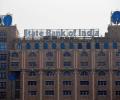
Country's largest lender State Bank of India (SBI) is looking to be among 10 top global banks in market capitalisation terms in the next five years, chairman CS Setty said on Wednesday. "The scope for value creation for the stakeholders is potentially very high. So the larger ambition is if the market supports whether we can be part of the top 10 global banks in terms of the market capitalisation (five years)," he said after listing of shares issued under Qualified Institutional Placement (QIP) at NSE.

The famous 'tareekh pe tareekh' dialogue from the Hindi movie Damini captures where we are now.
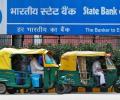
State Bank of India (SBI), the largest lender in the country, has launched a share sale to institutional investors to raise upto Rs 25,000 crore, the biggest qualified institutional placement (QIP) so far by an Indian firm, and has set a floor price of Rs 811.05, which is at a 2.5 per cent discount on Wednesday's closing price.

Education loan growth is set to halve this fiscal (FY26) because disbursements for the US decelerate following a raft of policy changes there.

State-owned banks have received guidance from the government to close Jan Dhan accounts whose beneficiaries are unwilling to keep them active, amid rising instances of such accounts being misused by fraudsters as mule accounts to defraud people, people aware of the development said.
'Bank has enabling provision to raise capital up to Rs 7,500 crore over a longer period of time.'

Despite sharp interest rate cuts expected in this financial year amid easy liquidity conditions, state-run banks are treading cautiously on their loan growth projections for FY26. Most large banks are projecting loan growth at 11-13 per cent, almost similar to the previous financial year.

'Now we have one of the best asset qualities in the industry.'

Global Rating agency Moody's on Wednesday said it was reviewing IndusInd Bank's risk management capabilities, and its leadership transition, with the private sector lender grappling with accounting lapses pertaining to its derivatives transactions. "The financial impact of the derivatives losses is quite manageable considering IndusInd Bank's strong capital.

Net profit of 19 listed banks is likely to decline by 4 per cent year-on-year (Y-o-Y) for the quarter ended March (Q4FY25) mainly due to pressure on net interest margins (NIM) as a result of rate cut by the Reserve Bank of India (RBI), according to analysts' estimates. Additionally, loan growth is expected to further slowdown amid low demand in certain secured products, stress in the unsecured segment, and a high cost to deposit (CD) ratio across the system.

Securitisation - sale of loans to investors - by lenders, including banks and non-banking financial companies (NBFCs), crossed Rs 50,000 crore during the fourth quarter ended March 2025 (Q4F25). This is a tad higher than Rs 48,000 crore during the same period of FY24.

The pace of loan growth among public sector banks (PSBs) has seen a surge in the financial year 2024-25, and this is an exception to the overall moderation in bank credit during FY25. PSU banks' share in incremental credit rose to 57.3 per cent in March from 51.7 per cent a year ago, according to the Reserve Bank of India's (RBI's) Monetary Policy Report (April 2025).
 © 2026 Rediff.com - Advertise with us - Disclaimer - Privacy Policy - Sitemap - Feedback - About us - Terms of use - Grievances