
Banned terror outfit Jamaat-ud-Dawa has officially condemned the United States' announcement of a 10 million dollar bounty on its chief Hafiz Saeed, calling it "another attack by the American government on Muslims and Islam".
The US slapped sanctions on four Pakistani militants linked to the Lashkar-e-Tayiba and Al-Qaeda, with one of them having links to Dawood Ibrahim, for their involvement in a series of terrorist activities including bombings in the Mumbai train and Samjhauta Express.

Conflicting claims were made on Wednesday about the visit of United States Agency for International Development's Indian-origin chief Rajiv Shah to a relief camp, run by a front organisation of Jamaat-ud-Dawah, in Pakistan's flood-hit Sindh province and his handing over of aid to it.
The Jamaat-ud-Dawah on Monday claimed the acquittal by an Indian court of two suspects linked to the Mumbai attacks had shown that Indian authorities had 'no proof of Pakistan's involvement' in the 26/11 terrorist carnage.
The outlawed Jamaat-ud-Dawa said on Wednesday that it would frame an "appropriate response" to the Red Corner Notice issued against its chief Hafiz Mohammad Saeed by Interpol, even as it emerged that the prime accused in 26/11 attacks was not on government's exit control list. "Our legal team is looking into the matter that has come to our notice and we will come out with an appropriate response," JuD spokesman Yahya Mujahid told PTI.
The house arrest is said to be for a month.

Saeed-led JuD is the front organisation for the Lashkar-e-Tayiba which is responsible for carrying out the 2008 Mumbai attack that killed 166 people, including six Americans.
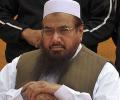
The SECP notification further warned that non-compliance with the said ruling could result in a hefty monetary fine.
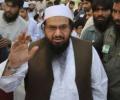
Protesting the closure of its chief Hafiz Saeed's official Twitter account, the Jamaat-ud-Dawah has alleged that the micro-blogging website took the step to oblige India.

Seeking to wriggle out of the FATF's grey list, Pakistan has imposed tough financial sanctions on 88 banned terror groups and their leaders, including Hafiz Saeed, Masood Azhar and Dawood Ibrahim, by ordering the seizure of all of their properties and freezing of bank accounts, a media report said.

Dawood Ibrahim is wanted in India to face the law of the land for carrying out serial blasts in Mumbai in 1993 in which scores of people were killed and injured.

What Headley's testimony does achieve is expose the Congress' ham-fisted attempts to taint an otherwise credible probe. That, however, does not become an assertion of Ishrat's membership of the LeT.

The board rejected the government's plea to extend his detention for another 3 months.
 © 2026 Rediff.com - Advertise with us - Disclaimer - Privacy Policy - Sitemap - Feedback - About us - Terms of use - Grievances