
A Pakistani has been convicted by a US federal jury for providing financial aid to the Sikh militant group Khalistan Commando Force, responsible for thousands of deaths in India, and could face a maximum of 45 years in prison.
The Federal Bureau of Investigation has arrested a Pakistani national with permanent legal residency in the United States on charges of supporting the banned militant outfit Lashkar-e-Tayiba. Jubair Ahmad, 24, according to the affidavit in support of the criminal complaint unsealed on Friday, received "indoctrination and training from the LeT while he lived in Pakistan" as a teenager. If convicted, he faces a maximum potential sentence of 15 years in prison.

The US and others have long complained that Pakistan provides safe haven to the Afghan Taliban and their allies, the Haqqani network.
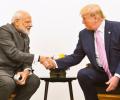
'From the Indian perspective, Trump's invitation to Imran Khan to visit the White House is a bitter pill to swallow,' points out Ambassador M K Bhadrakumar.
As many as 74 per cent of people of Pakistan consider the United States as their enemy, a figure which is higher than the previous years and the approval rating of US President Barack Obama is exceedingly low in this regard, a new survey released on Wednesday said.
The United States has welcomed Pakistan Prime Minister Yusuf Raza Gilani's statement that he would like to rebuild relationship with the US following deterioration in bilateral ties after the recent NATO air strike that killed 24 Pakistani soldiers in a cross-border fire.
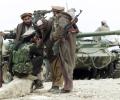
'Washington is well aware that the Haqqani group was responsible for terrorist attacks on the Indian diplomatic establishments in Afghanistan.' 'But today US self-interest dictates that Sirajuddin Haqqani's mainstreaming in Afghan political life and a potential elevation eventually to a leadership role at the national level is useful and necessary, since he can deliver peace,' notes Ambassador M K Bhadrakumar.
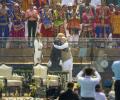
'While high-level interventions may help smoothen inter-State relationships, they cannot fundamentally change the alchemy of such relationships, which are firmly rooted in mutual benefits and mutual interests,' points out Ambassador M K Bhadrakumar.
US and Pakistani investigators have questioned Times Square bombing suspect Faisal Shahzad's father and four men suspected of having links with the banned Jaish-e-Mohammed in connection with the botched terrorist attack.
Pakistanis are objecting to Stanford University's invitation to former president Pervez Musharraf to lecture at the varsity later this week.
The United States has said that it will work with Pakistan's new government on a host of issues, including the problem of terrorism, which threatens both nations. "As is appropriate, we will now begin working with that (new) government on the whole host of issues that are there in the US-Pakistani relationship," US Secretary of State Condoleezza Rice said on Sunday.The US Secretary of State also lauded President Pervez Musharraf for taking off his military uniform.

'The US appears to think that Pakistan is highly vulnerable today due to its economic crisis and one more turn of the screw may bring about desired results,' says Ambassador M K Bhadrakumar.
India on Wednesday rubbished as "mischievous and totally baseless" reports in Pakistani media that it is planning to send troops to Afghanistan.

'Here in Delhi, the Modi government is supposedly looking at 'options' to hit back at Pakistan in any whichever way it can, while in Washington, the Obama administration is looking for ways to strengthen US military cooperation with Pakistan,' says Ambassador M K Bhadrakumar.

The United States decided not to inform Pakistan about its top-secret mission to kill Osama bin Laden in Abbottabad as it knew that elements in spy agency Inter-Services Intelligence maintained close ties with the al Qaeda and the Taliban, according to former Secretary of State Hillary Clinton.

India is not making a choice of war over peace. Rather it is at war, a war thrust on it by a sick militaristic State, says Sankrant Sanu.

New Delhi and Beijing are the only two regional capitals that have commented on US President Donald Trump's speech on August 21 outlining the way forward in Afghanistan. The Indian foreign ministry statement was effusive in praise, while the Chinese statement has been one of cautious and guarded hope. Delhi has identified itself with Trump's Afghan strategy, whereas the Chinese stance is calibrated -- observant and objective, keeping a distance, says Ambassador M K Bhadrakumar.
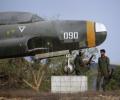
Providing military assistance in the hope that it will change Pakistan's worldview is wrong, says erstwhile ambassador to the United States Husain Haqqani
 © 2026 Rediff.com - Advertise with us - Disclaimer - Privacy Policy - Sitemap - Feedback - About us - Terms of use - Grievances