
In the 15 Union Budget presentation days of the Narendra Modi government since it came to power in 2014, the BSE benchmark Sensex has ended in negative territory eight times.

The rising goods and services tax (GST) and personal income-tax collections may bolster the Narendra Modi government's ability to announce new schemes or enhance existing ones.

Finance Minister P Chidambaram presented the Interim Budget for 2014-15 on Monday.
Presenting the interim Budget for 2009-10 in Lok Sabha, acting Finance Minister Pranab Mukherjee claimed in Parliament on Monday that every effort has been made to fulfil promises made to the common man.
Terming the Interim Budget for 2014-15 fiscal as 'very balanced', the industry on Monday said that it was 'absolutely' up to the expectations.
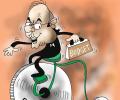
There was no law that prevented the government from presenting a sixth full Budget, or something similar to it.

Schemes like the Mukhyamantri Majhi Ladki Bahin Yojana strain fiscal resources amid rising unemployment and prices of food items.

Alloting more funds for MNREGA and PM-KISAN could wipe out the entire additional money that the Centre may have for FY25.

All eyes will be on whether Sitharaman provides the much-expected tax relief for the middle class, leaving more money in their hands, as there is tax buoyancy

Going by this Budget's estimate of government spending of Rs 48.2 trillion, the government has allocated a significantly lower percentage to defence -- 12.9 per cent.

Whether the ambitious targets are achievable is a moot question as India's earlier target was 20,000 MW of nuclear power by 2020.

Moody's Ratings on Tuesday projected general government debt to stabilise above 80 per cent of GDP over the next three years, down from 89.3 per cent in 2020-21. "General government interest payments to fall to around 24 per cent of general government revenue over the next two years from over 28 per cent in fiscal 2020-21, although this remains much higher than the median 8.7 per cent recorded by Baa-rated peers," Moody's Ratings associate managing director Gene Fang said in a post-Budget reaction.
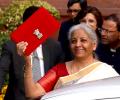
Sitharaman, India's first full-time woman Finance Minister, broke away from the colonial tradition of carrying a Budget briefcase in July 2019, opting instead for a traditional 'bahi-khata', to carry the Union Budget papers.

The government may save over Rs 70,000 crore (Rs 700 billion) on capital and revenue expenditure allocated towards new schemes in the FY25 Budget that are yet to be implemented.

Whether she will pare the fiscal deficit target of 5.1 per cent of GDP, using the record dividend received from the RBI, or expand flagship government programmes will be keenly watched.

Finance Minister Nirmala Sitharaman on Tuesday announced nine priorities in the Union Budget 2024-25 for generating ample opportunities in the economy. The nine priorities include productivity, jobs, social justice, urban development, energy security, infrastructure, innovation and reforms.

Following are comments from economists at leading financial institutions, banks and rating agencies on the interim Budget:
Presenting the Union Budget, Sitharaman announced that the government will partner with the private sector to set up Bharat Small Reactors and in the research and development of small modular reactors.

'It has also outlived its initial purpose of reducing physical gold imports.'

'Any finality in such matters requires political views. We will review it closer to the full Budget.'

So tell us, does Sitharaman's budget deserve cheers or boos?

Union Finance Minister Nirmala Sitharaman on Tuesday said the fiscal deficit for 2024-25 is estimated at 4.9 per cent of GDP.

>According to the latest RBI data, PPF receipts have already experienced a decline between April 2023 and February 2024. Other schemes like the Sukanya Samriddhi Account and National Savings Certificate are also witnessing reduced inflows.

'There is no immediate threat to the government, and they would prefer the growth agenda.'

The BJP won 37.70 per cent of votes in the 2019 Lok Sabha elections while the Congress vote share declined to 19.67 per cent.

Union Finance Minister Nirmala Sitharaman will present the Interim Budget on February 1 ahead of the Lok Sabha elections likely to be held in April-May.

If the Budget makes no big announcements on new schemes, projects, or tax giveaways, the government would face a major political dilemma as it may have to reluctantly consider shunning the practice of unveiling pre-election sops to woo voters, notes A K Bhattacharya.
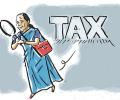
Net direct tax collection grew 19.54 per cent to over Rs 5.74 lakh crore so far this fiscal on higher advance tax payment by corporate. The first instalment of advance tax, which was due on June 15, rose 27.34 per cent to Rs 1.48 lakh crore. This includes Corporation Income Tax (CIT) at Rs 1.14 lakh crore and Personal Income Tax (PIT) at Rs 34,470 crore.

The supplementary demands for grants include a gross additional spending of over Rs 2 lakh crore, which would be matched by savings of over Rs 1.21 lakh crore.

As per the Interim Budget 2024-25 document tabled in the Lok Sabha, the government is not expected to receive any money from monetisation of public assets in the current fiscal.

Analysts and economists have hailed the fiscal projections in the interim Budget, saying the lower fiscal deficit forecast shows that the government, even in an election year, is serious about fiscal consolidation and that the numbers look achievable. According to Devendra Kumar Pant, the chief economist at India Ratings, the two broad themes of the interim Budget are fiscal consolidation and stepping up focus on agriculture/rural to course correct, to some extent, the differential benefits of the ongoing economic growth that's tilted in favour of upper-income bracket/urban households. The projected fiscal deficit numbers for FY24 and FY25 suggest that the government is serious about achieving the fiscal consolidation path of 4.5 per cent fiscal deficit by FY26, and given the nominal GDP growth assumption and revenue buoyancy, the target appears plausible, Pant said in a note.

From the word go, Bihar growled its needs out when an MP from the state said aloud: "Give something for Bihar also, Madam." Every time the Budget mentioned cities and towns in Andhra Pradesh, "Kursi Bachao" was the call from Congress MPs.

The Indian government has come out with a nice name for its tried and tested 220MW pressurised heavy water reactor -- Bharat Small Reactor.

Continuing on the fiscally prudent path, the Modi government in the interim Budget refrained from announcing populist measures, which will help it trim the fiscal deficit to 5.1 per cent of the GDP next fiscal and 4.5 per cent in FY26.
'The nominal GDP growth assumption for FY25 may be revised upwards on higher growth expectations.'

Benchmark equity indices climbed nearly 1 per cent on Wednesday on buying in HDFC Bank and Reliance Industries. Investors are eyeing the two important events lined up ahead -- the interim budget and the US Fed interest rate decision -- to derive further cues from. Recovering all the early lost ground, the 30-share BSE Sensex jumped 612.21 points or 0.86 per cent to settle at 71,752.11.

Healthcare: Good news for all ASHA, anganwadi workers

'... there are challenges to overcome and the country needs money for that.'

Union Finance Minister Nirmala Sitharaman on Tuesday announced that comprehensive development of Vishnupad Temple corridor at Gaya and Mahabodhi Temple at Bodh Gaya in Bihar will be supported by the government to transform them into world-class pilgrim and tourist destinations. These corridors will be modelled on the successful Kashi Vishwanath Temple Corridor, she said. Vishnupad Temple is one of the most ancient Hindu shrines located next to the Falgu river, while the Mahabodhi Temple is a UNESCO World Heritage Site.

Thrust on infrastructure and capital expenditure is expected to continue in the Union Budget for FY25.
 © 2026 Rediff.com - Advertise with us - Disclaimer - Privacy Policy - Sitemap - Feedback - About us - Terms of use - Grievances