
After intense pressure from the United States, Pakistan has reportedly agreed to launch a full-scale offensive against the Taliban and other extremist organisations in their stronghold North Waziristan, but has also clarified to the Obama administration that the timing of the military offensive would be decided by it.
Two top United States security officials are traveling to Pakistan on Tuesday to meet the country's civil and military leadership and press for more aggressive action against Al Qaeda-allied groups. Central Intelligence Agency Director Leon Panetta and the National Security Advisor General James Jones, who are embarking on a visit to Islamabad, will meet President Asif Ali Zardari, Prime Minister Yousuf Raza Gillani, Army Chief General Ashfaq Kiyani.
Pakistan has agreed in principle to launch a full-fledged military operation against Taliban militants in North Waziristan. But it will be a tough task for the country's army, as the terrain is believed to be the stronghold of numerous Arab, central Asian, Pashtun and Punjabi militants.The military operation may increase the flow of US aid to Pakistan, but the consequences might be unaffordable for the beleaguered country.
Pakistan's Inter-Services Intelligence agency has categorically denied any links with the Taliban.The Daily Times quoted ISI Director General Lieutenant General Ahmad Shuja Pasha as saying that the ISI is a professional agency and does not have links with any militant outfit, including the Taliban. Pasha's remarks came during a meeting with Central Intelligence Agency chief Leon Panetta, National Security Adviser Lieutenant General James Jones and other officials.
What needs to be understood is that not one, but three cancers afflict Pakistan
General James Jones (retired), President Barack Obama's national security adviser, announced his decision to step down from his position, which would be taken over by his deputy Tom Donilon.
US special forces will soon launch new operations to hunt world's most wanted terrorist Osama Bin Laden who the Americans believe is holed up in rugged terrain along the Afghanistan-Pakistan border.

Close on the heels of President Obama's announcement of the revamped Afghan strategy, Pakistan has said that it is concerned about the negative implications of the new US policy in Afghanistan.
Ahead of Prime Minister Manmohan Singh's visit to Washington in November, National Security Adviser M K Narayanan discussed with his US counterpart General James Jones the preparations for the Indian leader's trip and other issues of mutual interest.
The US may re-look its human and technical intelligence apparatus in Pakistan following the attack on seven CIA officers in Khost and the failed New York bombing plot, writes security expert B Raman

Enhanced co-operation between India and the United States on tackling terrorism particularly in South Asia and Pakistan's role in the region, dominated the deliberations of the Union Home Minister P Chidambaram with top officials of Obama Administration today.
The independent task force set up last year included Richard Holbrooke, the Special US Representatives for Pakistan and Afghanistan, and General James Jones, National Security Advisor. But both of them stepped down from the task force before the first draft was written, and as such they are not associated with the report, it says.
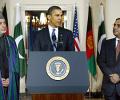
'The real purpose of President Obama writing to President Zardari,' Husain Haqqani tells Rediff.com's Aziz Haniffa, 'was to seek a turnaround on terrorism -- that Pakistan, whatever its grievances, cannot have jihadi groups operating openly on its soil.'
 © 2026 Rediff.com - Advertise with us - Disclaimer - Privacy Policy - Sitemap - Feedback - About us - Terms of use - Grievances