
Pakistan has asked India to revive the composite dialogue as soon as possible, Pakistan Foreign Secretary Salman Bashir told the media on Friday.

In his address, Sharif praised US President Donald Trump, saying his "efforts for peace helped avert a ... war in South Asia".
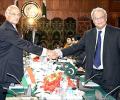
"We want to take relations forward," Menon said in his opening remarks.
Three days after the foreign secretaries meeting, Pakistan on Sunday said it is ready to participate in the composite dialogue process with India provided there are no preconditions from the other side.
Pakistan has welcomed United States Secretary of State Hillary Clinton's remarks that New Delhi and Islamabad should settle the Kashmir problem bilaterally, and said it looked forward to resumption of the composite dialogue between the two countries to discuss the issue. "The two countries have agreed to discuss this issue bilaterally by agreeing to the composite dialogue framework. And Kashmir dispute is a part of that framework," said Foreign Office spokesman Abdul Basit.
Pakistan's Foreign Minister Ishaq Dar has called for a 'composite dialogue' with India to address the contentious issues between the two sides.
Notwithstanding Pakistan's repeated insistence on resumption of composite dialogue, India today ruled it out, saying going back to the same process did "not make sense" as "we have to learn from history".
Pakistan Prime Minister Yousuf Raza Gilani on Wednesday said Pakistan will offer the Indian leadership an "olive branch" to resume the bilateral Composite Dialogue as both countries cannot afford war.
The composite dialogue between India and Pakistan will resume on May 21 and the two countries will review progress made so far in confidence-building measures, Foreign Minister Shah Mehmood Qureshi said on Wednesday. "We will review the results of the fourth round of talks (under the composite dialogue) and then plan the agenda for the fifth round to be held after this meeting," Qureshi said.
Pakistan on Tuesday said a meeting between Prime Minister Nawaz Sharif and his Indian counterpart Manmohan Singh would be useful to revive composite dialogue and fast track bilateral issues but made it clear that it is not expecting any major breakthrough.
He said, "We are not desperate. If India wants more time, it will find Pakistan ready for it". He said, "let us not discard the composite dialogue process". But included in that is the point that Kashmir continues to be the core issue between India and Pakistan, with Pakistan continuing to cater to its domestic constituency even as it has come to the talking table with India after a gap of 14 months.
Though the main focus of talks between Foreign Secretary Shivshankar Menon and his Pakistani counterpart Salman Bashir is on peace and security, Jammu and Kashmir and CBMs, other issues like release of prisoners, visa relaxation, trade and commerce will also come up for discussions.
External Affairs Minister S M Krishna will undertake a three-day visit to Pakistan from September 7 to review the second round of the composite dialogue with his Pakistani counterpart Hina Rabbani Khar, reports Amir Mir.

India is unlikely to be granted the Most Favoured Nation status before 2014 Lok Sabha elections and resumption of composite dialogue between the two nations, Pakistan finance minister has said.
Pakistan on Thursday said it would welcome any move to resume the composite dialogue process with India stalled since the 26/11 Mumbai attacks, but insisted that the talks should be 'result-oriented' and cover all outstanding issues, including Kashmir and sharing of river waters.
While India has indicated that it may restart the foreign secretary level talks with Pakistan, Islamabad maintains that it would accept nothing short of resumption of comprehensive 'composite dialogue' with New Delhi.
A week before Indo-Pak talks are slated to resume, External Affairs Minister SM Krishna said India was not restarting the Composite Dialogue and that India will have terror on its agenda when the foreign secretaries meet.
While re-vitalising these interactions, it should be our endeavour to expand the basket of issues of concern to India, which have arisen since the format of the composite dialogue was agreed upon when Atal Behari Vajpayee was the prime minister and which are not discussed specifically now, writes B Raman.

Pakistan Prime Minister Yousaf Raza Gilani on Thursday said he wants India and Pakistan to leave the Indian Premier League controversy behind and move towards building better relations between the neighbours.
In an apparent climbdown, India today dropped its insistence on refusing to hold talks with Pakistan till those behind the Mumbai terror attacks were punished but Prime Minister Manmohan Singh clarified that the "composite dialogue" will not be resumed.
Seeking resumption of the composite dialogue process with India, Pakistan President Asif Ali Zardari has said such a move is in the best interest of the region.
Describing the Mumbai terror attack as a setback that paused the Composite Dialogue with India, Pakistan on Wednesday expressed confidence that 'this hiccup' in the bilateral ties will be overcome. "This unfortunate incident has been a setback... to the extent that our Composite Dialogue is at a pause at the moment," Foreign Minister Shah Mehmood Qureshi said.
British Foreign Minister David Miliband on Thursday called his Pakistani counterpart Shah Mahmood Qureshi to exchange views on matters of mutual interest, including Pakistan's composite dialogue process with India. A statement issued by the Foreign Office said that Miliband and Qureshi, in their telephonic conversation, discussed matters of bilateral and mutual interest. India and Pakistan resumed their composite dialogue last month, during a meeting in Islamabad.
Pakistan has said it will encourage the process of composite dialogue with India 'to reduce tensions and resolve all outstanding issues' between the two neighbouring countries.In a joint statement issued at the end of formal talks between visiting Pakistani Prime Minister Yousuf Raza Gilani and United States President George W Bush on Monday, the two sides said that the Pakistan-India composite dialogue process will be encouraged "to reduce tensions and build trust".
Indian and Pakistani troops have been engaged in a stand-off along the 110-km Actual Ground Position Line on Siachen since 1984 though a ceasefire came into effect in November 2003.
Foreign Office spokesman Mohammad Sadiq compared the tense military stand-off between India and Pakistan following the terror attack on the Indian Parliament in 2001 to the current status of ties to highlight the improvement in relations. "In 2002, we had one million troops on the border in an eyeball-to-eyeball confrontation and you have to compare that with today. The tensions have lessened," he said.
Sheela Bhatt on the 4th round of the Composite Dialogue process between India and Pakistan.
Foreign Secretary Shyam Saran will head the Indian delegation at the two-day talks with his Pakistani counterpart Riaz Mohammad Khan.
Pakistan's foreign secretary has said that both India and Pakistan remain committed to solving the issue.
&K must be resolved by India and Pakistan: UK
Riaz Khan and Shyam Saran would be deliberating on Kashmir and peace and security.
Singh, who arrived in Islamabad on Tuesday evening on a three-day visit met Musharraf before meeting Prime Minister Shaukat Aziz and Foreign Minister Khurshid M Kasuri.
India said the composite dialogue will need to be carried forward to address important issues.
India and Pakistan have successfully completed two rounds of the Composite Dialogue.
The dialogue will address all bilateral issues, including Jammu and Kashmir.
Foreign secretaries of the two nations will meet in May-June to discuss various issues, they agreed.
 © 2026 Rediff.com - Advertise with us - Disclaimer - Privacy Policy - Sitemap - Feedback - About us - Terms of use - Grievances