
Renowned economist Arjun Sengupta and Congress Economic Affairs Secretary Jairam Ramesh are among the front-runners for the post of Deputy Chairman, Planning Commission, which fell vacant following the resignation of K C Pant.
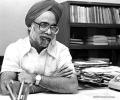
What stood out in his 15-year journey as a member of the political executive at the Centre was his glowing record as India's most successful and effective finance minister. Both as prime minister and finance minister, he understood the importance of gradualism, except when the economy or the polity was in a crisis.
The Union Cabinet has decided to refer the proposals of the ad-hoc group headed by Arjun Sengupta for granting greater functional autonomy to Cenral Public Enerprises to the Group of Ministers.
A cabinet note for setting up a fund, with initial corpus of Rs 1,000 crore (Rs 10 billion), to provide credit to businesses in the unorganised sector has been prepared, a senior government official said.
"High rate of economic growth has bypassed 77 per cent of population, which is living on a meagre income of Rs 20 per day... barely sufficient to survive," he said, while addressing the eighth Editors' Conference on social sector issues in New Delhi on Thursday.
Making a case for liberalising labour laws, the National Commission for Enterprises in the Unorganised Sector suggested on Thursday adoption of conditional hire and fire policy, while safeguarding the interest of workers.
There has been 31 per cent liquidity expansion of banks from Rs 34,67,098 crore (Rs 34,670.98 billion) in March 2007 to Rs 45,28,277 crore (Rs 45,282.77 billion) in November 2008 following the RBI's steps to tackle the crisis.
Arjun Sengupta, chairman, National Commission for Enterprises in the Unorganised Sector, talks to Business Standard about why he wants two separate Bills for the agricultural and non-agricultural workers.
The ministry of labour and employment plans to implement social security programmes only for the poorest of the poor in the unorganised sector, to begin with.
It is of course true that a lot of low-income people can indeed afford mobile phones today, as handsets cost no more than Rs 700.
Leading economist Arjun Sengupta on Tuesday defended the Manmohan Singh government's support for reservation of jobs for backward sections in the private sector saying democracy cannot afford inequality.

Had he not been a student, admirer and follower of Amartya Sen, T C A Srinivasa-Raghavan feels it might have been a Padma Bhushan.

'The government wants foreign companies to capture the insurance market.'
 © 2026 Rediff.com - Advertise with us - Disclaimer - Privacy Policy - Sitemap - Feedback - About us - Terms of use - Grievances