
A candid dialogue between India and Pakistan's security establishments and intelligence services is the only way to move forward for both countries in securing peace, said Mahmud Ali Durrani, Pakistan's former national security advisor and ex-ambassador to United States. While giving the first memorial lecture in memory of R.K Mishra, founder of Observer Research Foundation in New Delhi, Durrani sketched the plan for bridging the gap between two countries.
An Indian intelligence officer told rediff.com, "It's very well possible that when Zardari was out of the country Gilani took a hawkish stand to please the army chief General Ashfaq Kiyani. Right now, a hard stand against anyone perceived to be softer on India or America makes good politics in Islamabad."
Talking to Najam Sethi on his Dunya News programme on Sunday, Durrani said that the then Foreign Affairs Minister Zulfikar Ali Bhutto also had no idea that India would cross the international border.
The decision against imposing Emergency was taken after Musharraf met legal experts, security officials and leaders from the ruling Pakistan Muslim League.
New Delhi should constantly bear in mind that despite Major General Mahmud Ali Durrani's soft-spoken approach, crucial decisions on relations with India, particularly on terrorism-related issues, will remain in the hands of the Punjabi-dominated Pakistani military
After National Security Adviser Mahmud Ali Durrani, it was the turn of the Special Public Prosecutor in the Mumbai attacks case to be sacked by the Pakistan government for making controversial remarks on the lone captured terrorist Ajmal Kasab.

Mahmood Ali Durrani, who was sacked as the Pakistan's National Security Advisor after he acknowledged Ajmal Kasab's Pakistani nationality, has insisted that Jamaat-ud-Dawa chief Hafiz Saeed had no role in the 26/11 terror strike and has asked New Delhi not to "push" Islamabad.
Former National Security Adviser of Pakistan Mahmud Ali Durrani, who was sacked after disclosing to media the Pakistani nationality of Mumbai attacker Ajmal Kasab, has said he had written authorisation from the prime minister to speak on the evolving situation in the wake of the 26/11 strikes.
A brief statement issued by the Prime Minister's House said Yousuf Raza Gilani had sacked Durrani 'for his irresponsible behaviour (of) not taking Prime Minister and other stakeholders into confidence and lack of coordination on matters of national security'. Gilani was quoted by Geo News channel as saying that he had sacked Durrani for commenting on the issue of the nationality of Iman alias Ajmal Kasab without taking him (Gilani) or the government into confidence.
After weeks of denying the possibility, Pakistan turned around on its position -- admitting to CNN-IBN that some or all of the terrorists who carried out the 26th November attacks on Mumbai- could have been Pakistani nationals.
Mahmud Ali Durrani, Adviser to the Prime Minister on National Security, said if evidence is found of the Jamaat being involved in the attacks, it would be banned. Durrani told Geo News channel that if any evidence pointed to any other organisation during investigations, they too would be banned.
India on Monday conveyed its concern to Pakistan over the recent spurt in border ceasefire violations and the attack on its embassy in Kabul for which ISI has been blamed.
The ruling Pakistan Muslim League will field a person from each province as covering candidate for Gen Musharraf in the presidential poll, he said.
Seeking friendly ties with India, Pakistan's National Security Adviser Mahmud Ali Durrani on Tuesday said both countries need to 'remove the mistrust and put behind' the Mumbai attacks to jointly fight terrorism. "We want a nice friendly relationship with India so that we can both live in peace. This is not only good for the two countries, but good for the whole region," Durrani said.He blamed the media for creating 'unnecessary hype' about tensions in Pak-India ties.
In a tough message to Pakistan, the United States has said that it is not satisfied with what Islamabad has done so far to eradicate terrorism from its soil after the Mumbai attack, which was not an ordinary event which can be "swept under the carpet." The message was conveyed by top American officials to Pakistani National Security Adviser Mahmud Ali Durrani, who was summoned to Washington as the US government was "getting increasingly frustrated."
The deceased have been identified as a reporter of Daily Markaz, a shopkeeper at the Aabpara market Abrez Ahmad, who was just closing his shop, three passersby and two students. One body is yet to be unidentified.
Prime Minister Shaukat Aziz said the government would allow Ghazi to be held under house arrest with his ailing mother if he surrenders and frees the trapped women and children.
Pakistan's Ambassador to the US dismissed recent media reports on the nuclear reactor under construction at Khushab as being "grossly exaggerated."
Durrani said that if bin Laden were captured in Pakistan he would be turned over to the United States.
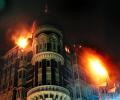
Pakistan's former national security adviser Mahmud Ali Durrani on Monday said the 26/11 Mumbai attack was carried out by a terror group based in Pakistan and called it a "classic" example of cross-border terror.

Is Nasir Khan Janjua's appointment as Pakistan's national security advisor the first step in suborning the elected civilian government?

Experts trace the reasons for the 26/11 attacks to the Pakistan's military interest in three key areas: Kashmir, Afghanistan and nuclear armaments.

'Nawaz Sharif knows a coup in 2016-2017 will not only complete Pakistan's isolation, but even a whiff of instability will frighten the world into imagining another Islamic State-zone, and this in a fully nuclearised subcontinent,' says Shekhar Gupta.
 © 2026 Rediff.com - Advertise with us - Disclaimer - Privacy Policy - Sitemap - Feedback - About us - Terms of use - Grievances