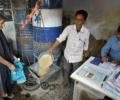
The Delhi government has cancelled over 45,000 ration cards and is considering using artificial intelligence to identify ineligible beneficiaries in its public distribution system.
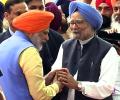
Whether it was the MGNREGS or the NFSA or the Aadhaar-based DBT scheme for cash transfer, the Modi government has built on the basic architecture created by the Singh government. Policy makers in the Modi government, instead of discarding them as products of the previous political regime, worked on them, expanded their scope and reach, and used new tools to improve their performance, explains A K Bhattacharya.
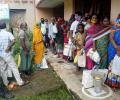
A bench of Justices MR Shah and Hima Kohli directed the Centre to submit a fresh chart with the number of migrant and unorganised sector workers registered on eShram portal.

Some UTs to start from April 1 and other transfers to be launched from January.

The fiscal deficit, estimated at 4.6 per cent of the gross domestic product, is expected to be around 5.6 per cent, mainly on account of factors like subdued revenue collection, poor disinvestment receipts, high global commodity prices and increasing subsidy bill.

On the complaint of shortage of foodgrain, the minister said lifting of foodgrain by states/Union Territories under TPDS and other welfare schemes has been less than the allocation made to them.

As part of steps to control inflation and augment availability of essential commodities, the government is considering re-allocating wheat in place of rice for the Targeted Public Distribution System (TPDS) and other welfare schemes.

Food security for all was a poll promise from the ruling Congress party before this year's general elections.
The study of the Targeted Public Distribution System, which covered 18 states, held that though the offtake per household has shown improvement yet only about 57 per cent of the below the poverty line households are covered. The information was given by minister of state for finance Pawan Kumar Bansal in the Rajya Sabha on Tuesday. Based on evaluation studies and feedback received from states, a nine point action plan has been jointly formulated.
What is ailing India's Public Distribution System (PDS)? "Corruption" is the one and only answer to that question.
Food subsidy is provided by the Centre in the budget of the Department of food and public distribution to meet the difference between the economic cost of foodgrains and their sales realisation at central issue prices.

India is expected to harvest 291.95 mt of foodgrain in 2019-20
.jpg)
According to an internal assessment of the food ministry, shared with chief ministers recently, Tamil Nadu, Kerala, Jammu & Kashmir and Himachal Pradesh will see a massive reduction in their annual grain allocation.

A marginally lower stock of 21.04 million tonnes is to be maintained in the first quarter as on April 1 as against 21.2 million tonnes.

'With the largest number of malnourished people on the planet, India is poised to be a nation that significantly under-performs as an economy.'

When KV Thomas took over as minister of state for food and consumer affairs (independent charge) on January 19, 2011, he was tasked with taking forward one single, important objective: expedite the implementation of the National Food Security Bill.

The initiative would provide double the relief announced by the states of UP and Maharashtra, the Punjab CM said.

The stock and foreign exchange markets have had a negative reaction to the government's biggest social security programme, the National Food Security Bill. Food minister K V Thomas questions the rationale behind such a response

The government had pegged food subsidy at Rs 90,000 crore (Rs 900 billion) in the 2013-14 Union Budget.
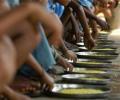
Nowhere on the planet, nowhere in mankind's history has such an idea taken the concrete shape in form of a law. The National Food Security Bill, which will come via ordinance and not after the debate in Parliament, is an incredible economic tool to tackle the hunger of poor Indians. Also, it has already been condemned widely as a political gimmick.
 © 2026 Rediff.com - Advertise with us - Disclaimer - Privacy Policy - Sitemap - Feedback - About us - Terms of use - Grievances