It is only fitting that Jean Todt should preside over the legalising of Formula One's controversial 'team orders', having triggered the ban in the first place.
The Frenchman, now head of the governing International Automobile Federation, was Ferrari boss when that team drew worldwide condemnation and outrage by manipulating the 2002 Austrian Grand Prix in favour of Michael Schumacher.
In the years since, team orders have been outlawed but they never really went away.
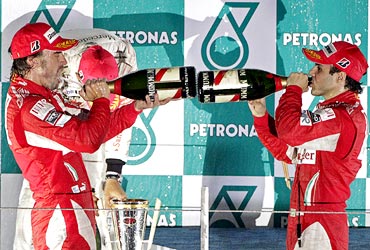
This year's German Grand Prix furore, again focused on Ferrari and their favouring of double world champion Fernando Alonso over his team mate Felipe Massa, only served to emphasise that fact.
The rule change agreed by the FIA on Friday effectively recognised that team orders are a part of the sport while also conceding that the paying public have a right not to be insulted.
"The article forbidding team orders (39.1) is deleted," the FIA said in a statement.
"Teams will be reminded that any actions liable to bring the sport into disrepute are dealt with under Article 151c of the International Sporting Code and any other relevant provisions."
What that means is that timing is everything and teams still risk heavy sanctions for blatant manipulation early in the season, as occurred at Austria 2002 and Hockenheim 2009.
Ferrari were fined $100,000 this year for effectively telling Massa to move aside and let Alonso win.
Both men were still in contention but what upset viewers far more was the fact that Massa was denied an emotional victory on the first anniversary of an accident in Hungary that almost killed him.
In 2002, when Brazilian Rubens Barrichello dominated all weekend but had to let Schumacher by at the last corner, there was nothing the FIA could do about what happened on the track as nothing illegal had happened.
Instead, Ferrari were hammered for a breach of podium protocol and fined $1 million, with half the amount suspended for a year.
The outrage festered on, mainly because Barrichello had played loyal number two on so many occasions and Schumacher had won four of the five previous races. The German ended that season with 67 points more than anyone else.
Team orders were banned after Austria by then FIA president Max Mosley but everyone in Formula One knows there are plenty of ways to get around that.
Drivers know well enough what the team expects them to do without obvious instructions. Should there be any difficulties, a team can easily reduce the revs on a car or 'fluff' a pitstop or switch their strategy.
One only has to think back to 2008, when Brazilian Nelson Piquet crashed to order at the Singapore Grand Prix to bring out the safety car and allow Alonso to win, for a particularly extreme example.
That incident only came to light a year later when Piquet, by then dropped by Renault, turned whistleblower.
Some purists will argue that deleting the team orders ban realigns the 60-year-old championship with its glorious past and the days when the likes of the late great Juan Manuel Fangio pulled rank on team-mates.
Others will argue that the teams pay the bills and the drivers' wages and how they run their operation is their own business.
Still more will be equally adamant that the sport is called motor racing for a reason and the modern spectator wants to see free and fair competition rather than the driver with the better contract being handed victory on a plate.
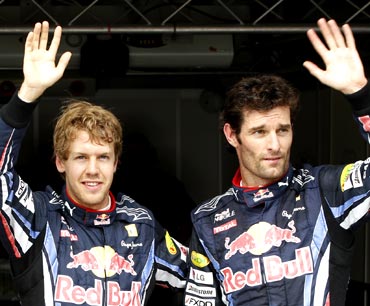
They could also argue that had Red Bull ordered Sebastian Vettel to let Mark Webber win in Brazil and Japan this year, when the German led the Australian in a one-two finish, Formula One would not be celebrating its youngest ever champion this season.
There is however nothing in the rules that says teams have to embrace team orders, and Red Bull have made clear it is not their nature to do so.
What Friday's change does do is rid the sport of the charade of teams pretending that there are no orders at a point in the season when logic dictates that there must be -- when one of their drivers is chasing the title and the other out of contention.

 © 2025 Rediff.com - Investor Information - Advertise with us - Disclaimer - Privacy Policy - Feedback - About us - Terms of use - Grievances