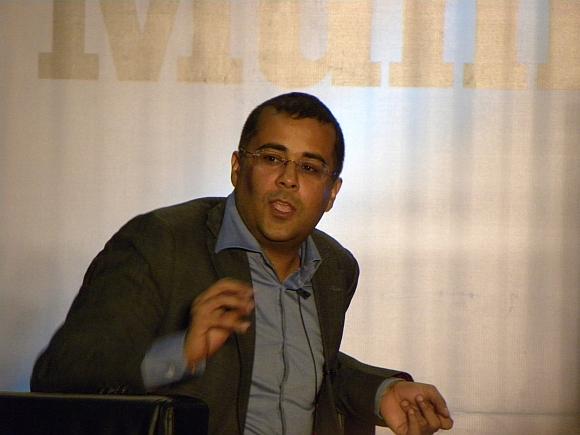
On Day One of the Times of India Literary Carnival in Mumbai, Chetan Bhagat took on his two Pakistani counterparts Mohammed Hanif and Mohsin Hamid. Here's what happened.
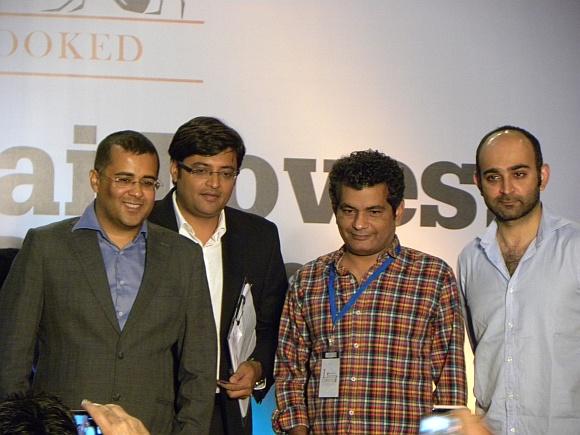
One of the early sessions at the Times of India Literary Carnival that is being held in Mumbai's Mehboob studios was one featuring two Pakistani literary greats -- Mohammed Hanif and Mohsin Hamid -- along with Chetan Bhagat.
The firebrand television news anchor, Arnab Goswami moderated the debate about whether Pakistani writers were beating their Indian counterparts 'at literature'.
The other question the session sought to answer was if 'chaos spur(s) creativity'?
In more ways than one, the session did belong to Hamid and Hanif, who Goswami spoke to most while Bhagat tried (with some difficulty) to make his point.
Goswami, who was quite relaxed, unlike his Newshour avatar, started off the session by pointing out that Pakistan has been in the news for all the wrong reasons and asked the two Pakistani writers whether the volatile political conditions have led to an explosion of creativity in their country.
Hamid, whose book The Reluctant Fundamentalist is being made into a movie, said that since Pakistan has been in the news people are more interested in knowing about the country and the explosion if any has been in the attention it has been receiving rather than in creativity.
Hanif added that a part of the reason why authors (not just in Pakistan) were getting attention was because the media has seen a large amount of growth. With 24-hour news channels and special feature supplements, authors do find themselves in the limelight in ways they never did before.
As the discussion moved towards freedom of expression, Hanif pointed out that writing fiction in Pakistan is perhaps far safer as against writing journalistic pieces in Urdu. "As writers of (English) fiction, we do not face as many risks," he said, "Because people (who read it) usually think it's not about them at all!"
Hanif added that while writing a journalistic piece in Urdu however he has to be far more conscious about what he is writing.
Hamid agreed that writing English fiction is far simpler in Pakistan but added, "Dangers of speech are everywhere. Ideas have power and sometimes they can be threatening."
...
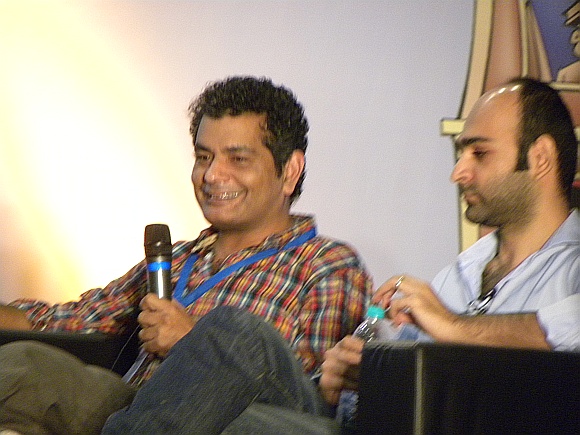
On being asked if he could write a book similar to A Case of Exploding Mangoes about a contemporary political figure (it is a fictional account of a part of General Zia's regime) Hanif said it was possible in English without a lot of repercussions but also quoted an instance when a Jehadi newspaper picked up a little joke he made about something and wrote a rather damning and threatening piece about it.
Later in the conversation, he recollected a conversation between two Indians a few years ago who told him that writing a book of this nature about Indira Gandhi would not only be impossible but rather blasphemous in India.
When I wrote A Case of Exploding Mangoes) Zia was long gone and forgotten. It isn't the case with Indira Gandhi who still has a following," he said.
It was good 20 minutes before Bhagat was invited to speak. And speak he did.
He said that Pakistani authors were the flavour of the season in the West and should they hope to succeed (commercially) they must look at home.
"Be careful when you look at the West for validation," he said adding that one of the reasons why the Indian publishing industry has grown the way it has is because publishers don't necessarily look at award-winning books all the time.
"Prizes are irrelevant," he declared, "A publisher (today) looks at commerce."
Somewhere in between all of this, he also seemed to suggest that Pakistan was perhaps playing to the Western gallery, a charge that Hamid sort of skirted.
"It's tricky not to play to the gallery," he admitted.
Hanif though was rather blunt.
"Writers don't talk about markets," he said taking a dig at Bhagat, "I feel like I am in a boardroom!"
Hanif continued, "I wrote a book about a dictator who was dead and about whom no one -- not even his family -- cared. Asking me if I was playing to the gallery (would be ridiculous). I don't know if there is a gallery to begin with.
"When you write, you first seek the approval of your close friends and people whose opinions you respect because you are trying to please someone, delight someone etc," he said.
But I wouldn't know what someone sitting in some part of the world would want. I suspect they wouldn't know it either. I don't think there is a formula possible for these kinds of things," he said.
The discussion got more interesting as Goswami brought up the other question they sought to answer -- Does chaos spur creativity?
...
Bhagat suggested that a country like Pakistan that was seeing so much upheaval was bound to produce more creative literature than relatively peaceful nations (such as Switzerland).
Hanif, who seemed rather disturbed by the notion, was rather vocal about it, "(Are you saying) a country that is fed up produces better writers? If there's an explosion in my city, (do I go to work with the feeling) 'Oh great, today I will write better...'?"
"Journalists do get excited by these things," he said rather cheekily, "But a writer like any other citizen would want peace and quiet."
He then went on to talk about a Norwegian author who 'almost won a Nobel -- whatever that means' who seemed to suggest the same thing.
"Frankly I thought it was slightly racist," Hanif said adding, "When the (Norwegian) massacre happened, I had a mean urge to call him up and ask him 'Is this what you wanted? Now can you write?"
As the discussion moved towards why authors write, Chetan Bhagat said that he wrote to 'bring about a social change'.
"I write because things are so wrong here and story needs to be told," he declared yet again. "If I write about socialism and 15 intellectuals read it (what difference would it make)? If I have to reach out to young Indians, I have to write something like 2 States."
A member of the audience asked Bhagat, who has often been criticised about lacking literary merit why he held the English language in contempt. To which Bhagat rather brazenly replied, "I don't have contempt for the English language. I am going to change the language."
The response was met with a somewhat stunned silence.
After the session, Bhagat and the Pakistani authors made their way to two separate corners of the grounds. They signed books, chatted with their fans and moved on.
 © 2025 Rediff.com - Investor Information - Advertise with us - Disclaimer - Privacy Policy - Feedback - About us - Terms of use - Grievances