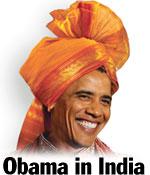
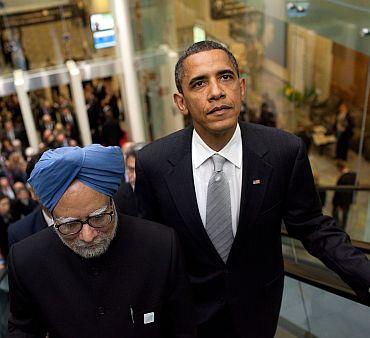
 An economically growing and stable India is confident about receiving the world leader in India.
"There is a certain fascination in Indians for President Obama," Dr Harish Khare, Dr Singh's media advisor, told Rediff.com
"He symbolises the change in America. Most Indians will want him to catch the changing India and its democratic economic vibrancy."
That said, with ten days to go before Obama's arrival in Mumbai, the buzz that preceded President George W Bush's arrival in March 2006 is missing.
Please ...
 American experts are defensive and hopeful; the Indian side is keeping a low profile. But thinkers from both sides see the absence of hype as maturing of the relationship between two giant democracies.
"It is a bit like two lovers," he quips. "When they get married, it's one big thing. But five years later, they are still together, they are so happy, but no one big thing anymore." Brajesh Mishra, India's former national security adviser, differs.
"As of today, I don't see the Obama visit being successful," he says.
The withdrawal of American troops from Afghanistan is going to impact India, Mishra continues. Pakistan and China's 'all weather friendship' is now becoming an alliance, and America's military largesse to Pakistan is weakening India.
"Its impact on India is as adverse as the impact of China-Pakistan military deals," says Mishra, a retired Indian Foreign Service diplomat, adding, "When India is facing such serious issues of security, Indo-US relations cannot be smooth."
In view of this, says Mishra, "It is imperative to know what Obama's views are."
Security is the key issue, he emphasises repeatedly -- not the economy, not trade-related cooperation.
Mishra is looking forward to Obama's speech to Parliament.
"That's the most important event," adds Mishra.
"I want to know what he has to say on the issue of India's security. Does America want India to play an important role on the global stage or will it allow Pakistan and China's attempts to bog down India in South Asia?"
"Nobody would believe this argument," fumes Mishra, adding, "In the 1965 (India-Pakistan) war, Patton tanks were used against India."
Obama, Mishra insists, has not sent signals to make New Delhi feel that he is as favourably inclined toward India as President Bush was.
Mallaby, however, disagrees.
"It is not that the Obama administration is uninterested," says Mallaby. "His visit here will tell you that. When President Obama comes here it will be part of the hope that India will play a bigger role in global governance, especially in G-20. It is US strategy to bring India in."
"Partly because India is a democracy and the US likes to have an alliance with a country having shared values, and partly because it is a balancing act against China."
New Delhi cannot overlook the ever-increasing evidence about the US looking the other way as David Coleman Headley helped carry out the Mumbai terrorist attacks.
Nor can India overlook negotiations in Washington for $2 billion in aid to Pakistan.
Mallaby agrees Headley's revelations would have an impact in India.
"I think that's unfortunate, and that shows that the relationship needs to be matured," he says, adding, "You can go to European capitals, and you will find the same kind of complaints against America -- that it is not sharing intelligence with allies and the NATO. This is not unique to the Indo-US relationship."
 © 2025 Rediff.com - Investor Information - Advertise with us - Disclaimer - Privacy Policy - Feedback - About us - Terms of use - Grievances