
Japan is expected to increase its investment target in India from the earlier 5 trillion yen ($34 billion) to almost 10 trillion yen.
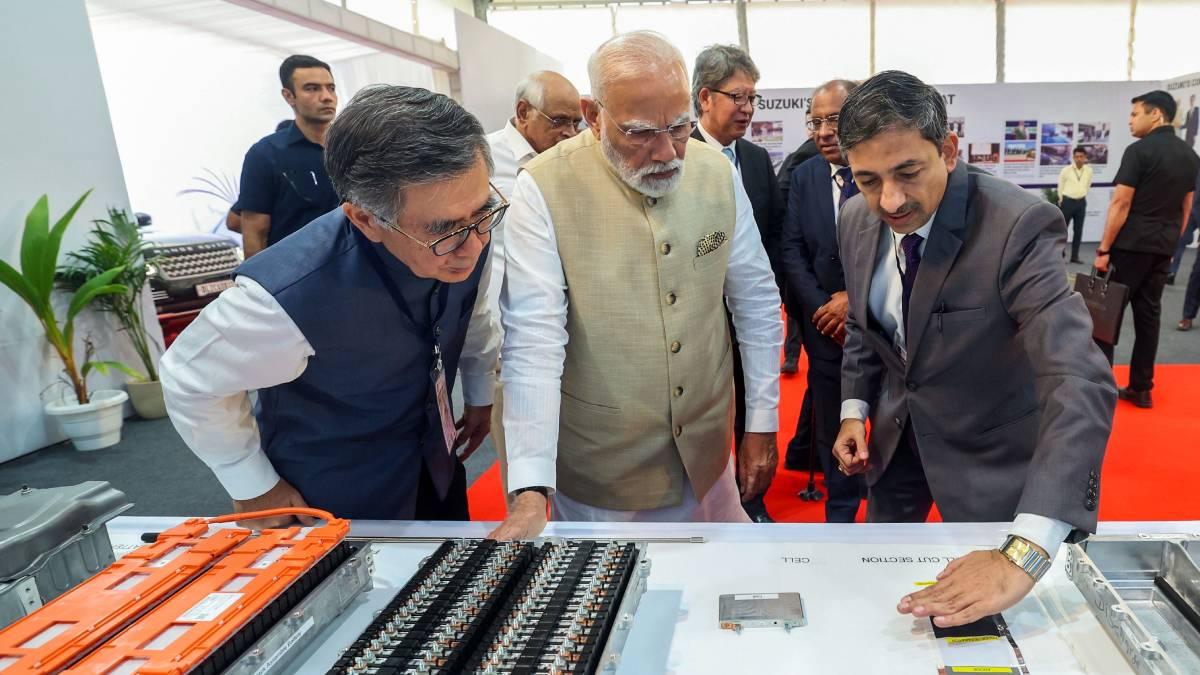
Prime Minister Narendra Modi will leave for Tokyo on Thursday evening for a two-day visit to Japan, focused on promoting his government's 'Make in India, Make for the World' initiative and highlighting the role Japanese corporations could play in it.
The visit comes as the two countries seek stronger cooperation in semiconductors, artificial intelligence, and critical minerals.
During his visit from August 29-30, the prime minister will attend a business event and meet senior executives of leading Japanese business groups, including Sony, Hitachi, Nippon, and Nomura.
Modi -- accompanied by Japanese Prime Minister Shigeru Ishiba -- will also travel by bullet train to Sendai, the capital of Miyagi prefecture, and tour a semiconductor factory operated by Tokyo Electron Limited.
Amid strained ties with the US, New Delhi will push to attract greater Japanese investment and increase bilateral trade.
During the visit, Japan is expected to increase its investment target in India from the earlier 5 trillion yen ($34 billion) to almost 10 trillion yen, said people in the know.
The sources said Modi will highlight opportunities for Japanese companies to make in India, a move which could help double the number of Japanese firms registered in the country, particularly in the manufacturing sector.
At present, 1,400 Japanese companies are registered in India, with manufacturing firms accounting for half, according to the latest joint survey by the Embassy of Japan in India and the Japan External Trade Organization (JETRO).
These companies together operate nearly 5,000 business establishments in India.
On Tuesday, Modi flagged off Maruti Suzuki's first global strategic battery vehicle, the e-Vitara, from its Hansalpur plant in Ahmedabad.
Speaking on his definition of 'swadeshi', Modi said: 'It doesn't matter whose money is invested -- dollars, pounds, black or white. What matters is that the sweat of my countrymen has gone into the production.'
The prime minister is also scheduled to meet members of the National Governors' Association, where he will interact with governors from some of Japan's 47 prefectures.
Foreign Secretary Vikram Misri said on Tuesday that engagement between Indian states and Japanese prefectures has deepened in recent years.
Modi's visit to Japan, his first standalone bilateral visit there since 2018 and his eighth overall since 2014, will also include the 15th India-Japan Annual Summit with Prime Minister Ishiba, aimed at advancing the agenda of the special strategic and global partnership between the two countries.
Sources in New Delhi said the visit is intended to send a strong signal of confidence to Japanese business groups.
Over 170 memoranda of understanding (MoUs) have been signed in the past two years, representing more than $13 billion in committed investments.
These investments span steel, automotive, renewables, semiconductors, real estate and aerospace, underscoring Japan's confidence in India's long-term economic potential, the sources said.
They added that with 'Make in India, Make for the World' as the guiding vision, the India-Japan partnership has the potential to reshape industrial, agricultural and human capital development.
Japanese investments in India include Nippon Steel's Rs 15 billion expansion in Gujarat and a Rs 56 billion integrated steel plant in Andhra Pradesh; Suzuki Motors' Gujarat plant, which Modi visited on Tuesday; Toyota-Kirloskar's Rs 33 billion expansion in Karnataka; and a Rs 200 billion new plant in Maharashtra.
Sources said Japanese industry partnerships are also helping Indian small and medium enterprises (SMEs) integrate into global supply chains.
Examples include collaborations such as Tokyo Electron and Fujifilm with Tata Electronics to build a semiconductor ecosystem, where Indian SMEs supply high-value components.
The partnership also extends to Africa.
At the ninth Tokyo International Conference on African Development (TICAD), held earlier this month, India was identified as an anchor country for connectivity and industrial corridors on the continent.
Priority areas included mineral security -- such as rare earths, lithium and cobalt -- as well as supply chain resilience in semiconductors and electric vehicles.
Discussions also explored export markets in Africa and West Asia for goods made in India using Japanese technology.
"This ensures that 'Make in India, Make for the World' is realised, with the India-Japan partnership shaping not just economies but also regional security and resilience," a source said.
The two countries have also signed an agreement on talent exchange, providing Indian students with opportunities to study in fields such as semiconductors, AI, IT, robotics, and clean energy.
From Japan, the prime minister will travel to the Chinese city of Tianjin to attend the Shanghai Cooperation Organisation summit.
He is expected to hold bilateral talks with Chinese President Xi Jinping and is also likely to meet Russian President Vladimir Putin.
Feature Presentation: Ashish Narsale/Rediff










 © 2025