
While acknowledging that they needed strong allies for a chance in the assembly polls, AIADMK cadres seemingly prefer actor-politician Vijay's Tamilaga Vettri Kazhagam to the BJP, owing to the latter's 'communal agenda' and consequent hardline Hindutva image, explains N Sathiya Moorthy.
In the long run-up to next year's assembly elections to unseat the Dravida Munnetra Kazhagam in Tamil Nadu, pressure is building on the All India Anna DMK to tell its national ally, the Bharatiya Janata Party, to put all controversial issues on the back-burner, for now.
The idea has its origins in the BJP's voluntary decision through the Chennai Declaration of 1998, when the two parties were partners in the Atal Bihari Vajpayee-led National Democratic Alliance government at the Centre.
Now, only weeks after the two hurriedly revived their broken alliance from last year's Lok Sabha polls, voices within the AIADMK are indicating to party boss and former chief minister Edappadi K Palaniswami (EPS) that in the absence of such a resolve on the BJP's part, electoral victory could become more difficult for the combine than at present.
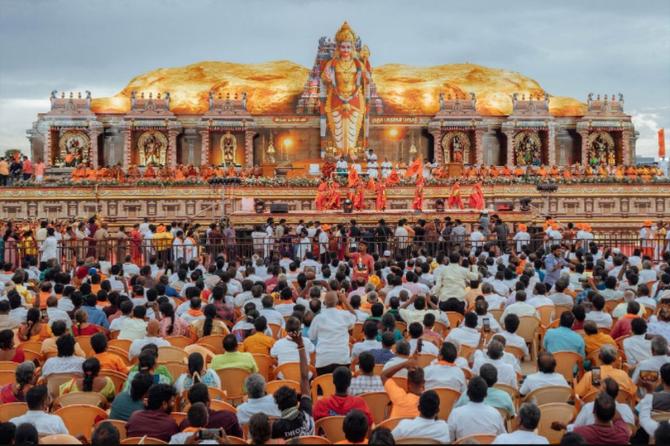
There are twin issues, rather three. One pertains to the allegation of 'new insult' to Dravidian political icons, Periyar E V Ramasamy Naicker and C N Annadurai at the Murugan Bhakthargal Mahanadu or Conference of Lord Muruga's Devotees, organised by the Hindu Munnani affiliate of the RSS, in southern Tiruparankundram, on Sunday, June 22, 2025.
EPS sent a goodwill message for the conference, in which state BJP leaders, barring incumbent president Nainar Nagendran, MLA, made fiery speeches that were more political than religious in content.
Despite being staunch believers, AIADMK cadres were upset that the mahanadu would turn away traditional party voters who might have acquiesced to the revival of electoral alliance with the BJP, after breaking it for last year's Lok Sabha polls.
Then came conference reports about the 'denigration' of EVR and Annadurai, through a video presentation -- and five AIADMK leaders, including four former ministers, sitting through it, without walking out or otherwise protesting.
The party tried to deflect the ruling DMK-led combine's criticism, saying that the five leaders attended the conference in their personal capacity.
But when cadres, and not just critics, began pointing out that then BJP state president K Annamalai's continuous denigration of Annadurai, MGR and Jayalalithaa was among the reasons that EPS cited to snap poll ties last year, the AIADMK could not but concede that it was a mistake to have participated in the conference (that was not theirs, anyway).
If these controversies counted for two, the third one was triggered by none other than the BJP's chief strategist and Union Home Minister Amit Shah, one more time.
In separate interviews to two leading Tamil dailies, published on the same day, Shah re-asserted that the combine would win the assembly polls next year and theirs would be a 'coalition government'.
Leaving out EPS' name, he said that the chief minister would come from the AIADMK.
This was the third time in less than as many months that Shah was talking of a post-poll coalition government, and the second time in a row that he did not mention EPS as their chief minister.
The last time Shah combined both the coalition government and EPS' leadership was when he rushed to Chennai, and hurriedly announced the revival of the alliance at a news conference that was delayed by hours and in instalments.
A 'sulking' EPS was present on the dais, despite Shah announcing his demand for replacing Annamalai as state BJP chief -- and did not speak on the occasion.

AIADMK cadres conceded social media claims that EPS was under some kind of a threat to accept alliance-revival without being given time to consult his second-line and more so the general council, whose authorisation/endorsement even MGR and Jayalalithaa had obtained before negotiating electoral alliances.
But now after Shah's perceived slip-of-the-tongue, if it was, on mentioning EPS' name, the AIADMK after some murmurs of protest has spoken out not just about the missing EPS name -- but the very idea of a coalition government.
Some argue that if there had to be a coalition it would have to be decided post-poll. Others say, Tamil Nadu has never ever accepted the idea of a coalition dispensation.
The second claim is only partially true. As recently as 2006, the late DMK patriarch M Karunanidhi formed a 'minority government' with only 96 of 234 MLAs -- and the Congress leader of the UPA-I dispensation at the Centre offering unconditional outside support.
Tamil Nadu thus became the only 'big state' to have a minority government through five years in office -- and without any hiccups, either inside or outside the assembly.
Even the PMK partner had unilaterally announced 'outside support' for the DMK regime initially -- but withdrew from the combine, but not over power sharing.
If early media coverage focussed on the fiery speeches, the DMK rivals and their electoral allies did not miss the opportunity when one presented itself.
They have since been taunting the AIADMK leadership, and those like the VCK's Thol Thirumavalavan has been openly urging the AIADMK to snap the party's BJP's ties.
Of course, Thiruma may have ulterior motives, as an AIADMK sans the BJP tie-up is a card that the VCK could play for a better cut in the seat-sharing talks with the DMK next year.
Just now, those like the VCK and the two Communist parties are stuck, as they cannot be seen as being an ally of the 'communal' BJP.
In context, Thiruma and also DMK spokespersons have been particularly recalling how EPS cited then BJP state president K Annamalai's repeated denigration of Annadurai, party founder MGR and the latter's charismatic political heir, Jayalalithaa, as among the reasons for snapping poll ties last year.
After taunting the DMK and allies for questioning the participation of five AIADMK second-line leaders, including four former ministers, at the Murugan conference, the latter has since been back-tracking.
Some senior leaders are already out in the open, hinting at an apology for participating in what the courts had said should 'remain a religious conference' but turned out to be hundred per cent 'political'.
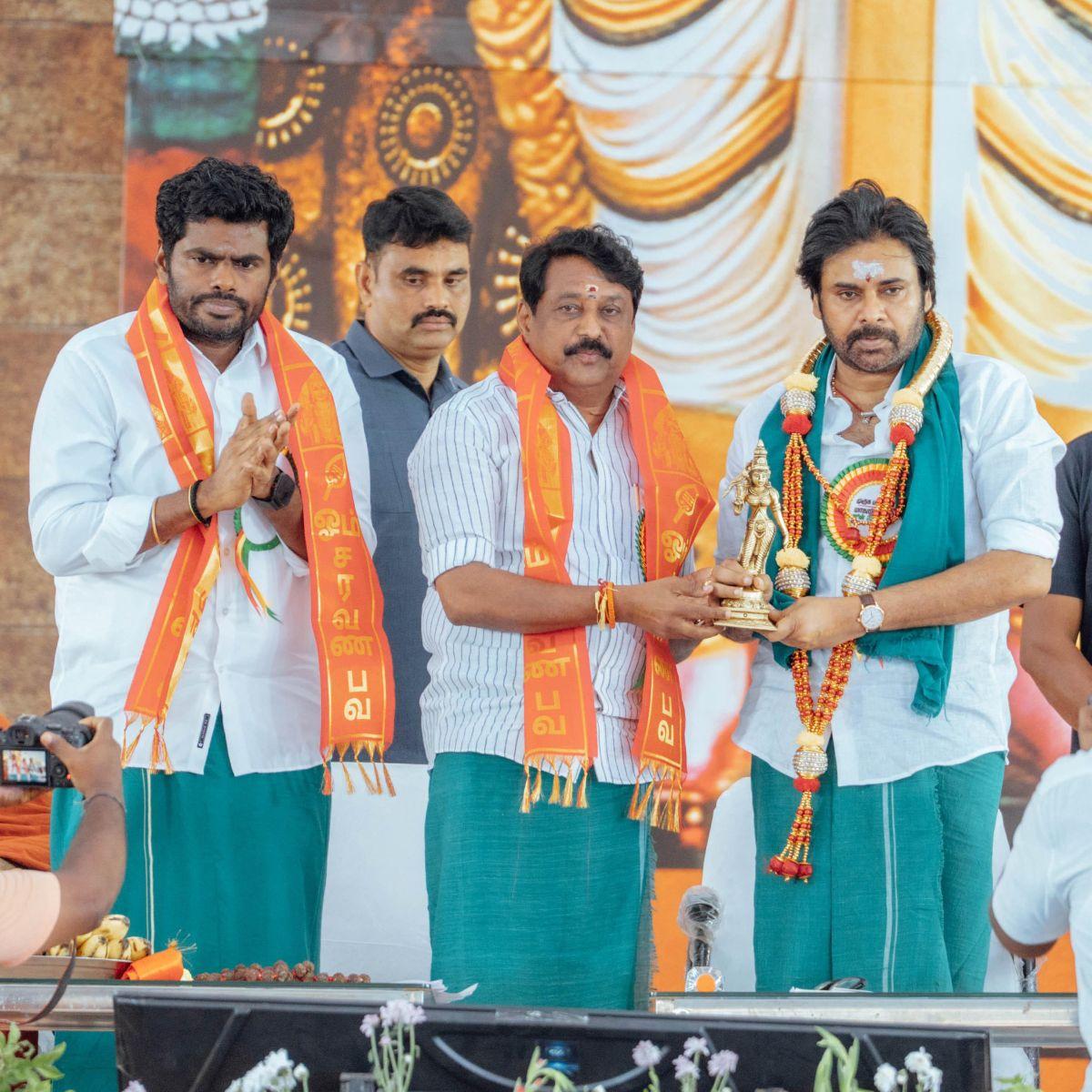
Joining state BJP leaders on the dais and speaking in defence of political Hindutva, rather than Hinduism as a religion or Muruga devotion as an ancient cult was actor-politician Pawan Kalyan, Andhra Pradesh deputy chief minister and Jana Sena Party founder.
Pawan Kalyan was addressing the target-constituents of Hindutva voters in his state, who now constituted the core of the BJP ally's traditional vote-bank.
The controversy over the Murugan Mahanadu has come when sulking sections of AIADMK cadres were coming to accept the reality of the situation, which they believed was forced by Amit Shah only months earlier.
In particular, they were upset by the hurried re-marriage of the old couple, with EPS being given no time to consult his second-line leaders, and more especially cadres.
First and foremost, the AIADMK constitution, drafted by MGR, provides for direct cadre-vote for electing the party general secretary -- EPS at present.
The implication was/is that the leader should consult the party before taking major decisions, including those on electoral alliance.
In the past, the leader was elected (of course, uncontested) at the general council but through 'voice-vote' of cheers and hand-claps.
Successive leaders, including EPS, had obtained the general council's authorisation to make or break poll alliances before every election.
Even while belatedly acknowledging that they needed strong allies for a chance in the assembly polls, the cadres seemingly preferred actor-politician Vijay's Tamilaga Vettri Kazhagam to the BJP, owing to the latter's 'communal agenda' and consequent hardline Hindutva image.
Just now, the feeling within the AIADMK second-line is that whatever traditional 'minority vote-bank' that might have returned to the party in last year's Lok Sabha polls, would have been lost because of the BJP alliance.
Over and above it, the BJP-RSS family's avoidable provocation like the Murugan Mahanadu might also upset a section of non-committed voters that might have considered voting the new alliance, owing mainly to the 'mounting anti-incumbency' against the ruling DMK.
At any given time over the past three-plus decades, the 'non-committed voters' or 'swing voters' number around a conservative 30 per cent of the state's electorate.
Their one-sided voting alone explains how Tamil Nadu has been voting with the winner in most elections in the past.
There would have been less of such apprehensions had the Murugan conference been a one-off affair, especially so if politicisation had not been planned.
That was not to be. Instead, the Mahanadu had its origins in the controversy kick-started by the Hindu Munnani in February, demanding that Muslims should not be allowed to perform animal sacrifice on special days, at the dargah of Sufi saint Sikandar Badshah, at the top of the Tiruparankundram Hill, one of the six most sacred abodes of Lord Murugan in the state.
While the Murugan temple is at the foothills, there is a Kasi Viswanathar temple also on the top of the hills along with some Jain caves.
Going by what the Madurai bench of the Madras high court's Justice J Nisha Banu observed in a split-verdict, animal sacrifice has been continuing at the dargah from 'time immemorial'.
However, after the February row, Amit Shah, during his subsequent visit to Madurai, added a new element. He endorsed the Hindutva allegations that attempts were being made to rename the hill as 'Sikandar Hill'.
That opened a Pandora's box and the leadership of the AIADMK ally is facing the avoidable heat.
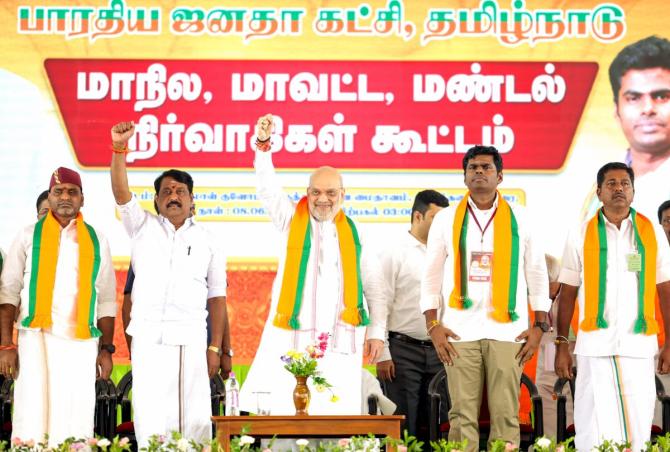
Despite successive electoral failures of political Hindutva in the state, more so for the local allies, the BJP is unwilling to give up.
The AIADMK, post-1999 and the DMK rival post-2001 polls had concluded, based on statistics, that the BJP as an ally was an electoral burden.
Hence, the DMK, along with the PMK and MDMK allies, walked out of the Vajpayee government ahead of the 2004 Lok Sabha polls. They reaped electoral benefits.
Simultaneously, the ruling AIADMK lost out in 2004, owing (also) to the BJP tie-up, but Jayalalithaa's autocratic ways of political administration was the main cause.
Hence, a decade later, in 2014, Jaya, again as chief minister coined the electoral slogan, 'Modi-ya, indha Lady-ya?' and won 37 of 39 Lok Sabha seats in the state.
Tamil Nadu has remained unbrokenly anti-BJP through successive elections.
Despite the BJP's constant claims, and those in the BJP-friendly national media, though the party-led third front did poll 18.5 per cent vote-share in 2014 and 2024, in the intervening assembly polls of 2016, the BJP's vote-share went back to the traditional three per cent.
The BJP's problem in Tamil Nadu is its insistence on whipping up sentiments against Periyar, Annadurai and the late DMK patriarch M Karunanidhi, citing their anti-Hindu, anti-god politics and policies.
Even during Periyar's time, and more so under Karunanidhi, that part of the Dravidian social justice agenda did not win or lose elections for any party or alliance.
Other aspects of the social justice scheme, especially the competitive social re-engineering that the DMK and the breakaway AIADMK successfully implemented while in power alternatively since 1967 alone has made the difference.
Yet, when the Modi era Hindutva fever failed to capture the Tamil voter-imagination, through the Ayodhya, Kashmir and UCC imageries, they mistakenly tried promoting their agenda by projecting Tamil gods and culture.
First, they tried to kick up a row over Tamil poet and film lyricist Vairamuthu allegedly denigrating Sri Andal, the eighth century Vaishnavite saint-poet, the only woman among the pantheon of 12 Alwars, or Vaishnavite seers.
In their time, which stretched from the seventh to the 12th century, the Alwars and their Saivite brethren, Nayanmars, propagated Hindu revivalism through their Tamil renderings, when Sri Adi Sankara was doing it elsewhere across the country, in Sanskrit.
Incidentally, BJP ideologues and strategists in the state have not understood this fine distinction in the Tamil mindset.
This in turn has kicked up a new enthusiasm among the new-generation Tamil youth to dig into their cultural past, especially in the face of 'Hindu revivalist history and antiquity' based on Sanskritisation, across the Vindhyas.
However, when the 'Andal controversy' did not pick up momentum, the BJP turned to Murugan, the 'Tamil god', who is also considered the 'Lord of Tamil' language and culture, after his progenitor, Irayanayar, who is equated with Lord Shiva in the Hindu pantheon.
Going deeper, there are those among the believers among Tamil orthodoxy who claim that neither is Lord Shiva of the North and South the same nor should Lord Murugan be equated with Lord Karthikeya of up North.
It's against this background that then state BJP president L Murugan, now a Union minister, failed to appeal to the Tamil voter, when he launched the Vetri Vel Yatra to the six abodes of Lord Murugan, violating the Covid curfew, after a little-known atheist YouTube group denigrated the 19th century, Tamil hymn, Kanda Sashti Kavasam.
Incidentally, minister Murugan, Annamalai and their ilk in the state BJP-RSS combo refuse to recall how in the eighties, the overnight trans-location of Maharashtra's historic Ganesh Chathurti festivities to Chennai's street-corners first and across the state, failed to capture electoral imagination in Tamil Nadu.
It was a new experience for the locals as the Ganesh festivities were traditionally confined to individual homes and local temples, not otherwise.
But when it all took a political and at times violent turn, the enthusiasm faded.
Even the footfalls at the street-corner festivities came down drastically, especially after the visarjan, or immersion, procession turned violent in the multi-religious Triplicane locality of Chennai, leading to police firing and loss of human lives.
Once the Madras high court gave the police the responsibility to decide on the procession route and other details, the saffron-clad organisers too began losing interest.
Now, those festivities remain, but as a poor shade of what they used to be four decades back.
If still some old-time BJP-RSS ideologues and strategists cite the examples of the Meenakshipuram conversions of 1981 and the Mandaikadu incidents of 1982 as among the main reasons for the BJP gaining a strong hold in the southern districts, they ignore the local political conditions, where only national parties used to thrive.
The BJP simply slipped into the shoes of the CPI-M, which was increasingly losing identity as an independent ideological entity, after it became an electoral slave of the DMK and the AIADMK alternatively.
They might have applied the same yardstick to western Tamil Nadu after the Coimbatore serial blasts of 1998, but then with the AIADMK already being a strong electoral force in the region, their dreams were only half met.
The DMK rival was the loser, but only in ways.
N Sathiya Moorthy, veteran journalist and author, is a Chennai-based policy analyst and political commentator.
Feature Presentation: Aslam Hunani/Rediff







 © 2025