
Modi's charisma may have weakened as last year's Lok Sabha poll results showed but in the eyes of the Sangh Parivar, it has not waned.
Minus a strong BJP government at the Centre for another decade and more, there is apprehension that an anti-Hindutva government could reverse many of the ideological gains that the Modi dispensation has achieved through its three terms, points out N Sathiya Moorthy.

Though the ruling BJP has near successfully diverted media/public attention away from la affaire Dhankhar, the vice president's shockingly sudden resignation is the first instance of a non-RSS loyalist's mis-step in the Modi era.
Dhankhar was in the Lok Dal and then the Congress before joining the BJP as recently as 2003, in the closing months of the Vajpayee government.
There are many more Dhankhars in the BJP who were encouraged to cross over from rival political parties in the last ten-plus years.
From within the Sangh Parivar, many BJP MPs are personally loyal to Prime Minister Narendra Modi, rather his invincibility as their electoral mascot, than to the RSS parent.
So when Sarchanghchalak Mohan Bhagwat recently reminded Modi about the 75-year-old upper limit that the latter set for his one-time godfather and saviour L K Advani in 2014, the RSS had to eat his words.
Modi's charisma might have weakened as last year's Lok Sabha poll results showed but in the eyes of the Sangh Parivar and the larger Hindutva constituency, it has not waned. Or, that is the lesson.
For the RSS that thinks about next elections more in the context of the next generation, this is a dichotomy to fight off, not fend off.
The ideological parent readily embraced Modi when he went over the head of the RSS and the BJP directly to the party cadres first and the larger electorate later, in 2014.
Today, the RSS seems apprehensive about Modi's ability to retain the national constituency in Elections 2029 even less than last year.
Minus a strong BJP government at the Centre for another decade and more, there is apprehension that an anti-Hindutva government could reverse many of the ideological gains that the Modi dispensation has achieved through its three terms.
They do not want a repeat of the Vajpayee government's failures in the face of coalition compulsions.
Modi's coalition compulsions are here -- and that's what Bhagwat seems hinting at. The BJP has the lowest-ever 240 MPs for a Modi dispensation in a 543-member House.
Together with NDA allies, the government has 293 MPs, 20 more than the 'magic figure' of 273.
It is nowhere near the two-thirds majority required for Constitutional amendments, and there is a limit beyond which the TDP (16) and JD-U (12) allies cannot be bent without breaking the tenuous coalition.
Last year, the rival, Congress-led INDIA bloc won the highest ever 234 during Modi's time -- or, 240-234, minus the BJP's 14 allies in the NDA.
Yet, most pundits wantonly overlooked the narrow gap in vote share between the two combines -- the NDA's 42.75 per cent against INDIA's 40.6.

If this is a futuristic concern for the RSS especially, they both should also be worried about the series of assembly elections in the coming months, beginning with the NDA-ruled Bihar later this year, followed by five more next summer.
Of them, three major states, West Bengal (42), Tamil Nadu (39) and Kerala (20) are ruled by non-BJP, anti-Hindutva parties or coalitions, accounting for a total of 101 Lok Sabha seats.
Together with NDA-ruled Bihar (40), Assam (14) and Puducherry (1), 156 Lok Sabha seats are at stake.
From the pre-Ayodhya days in the 1980s, the BJP has been looking at assembly elections only as a means to an end.
Law-making through Parliament is their way of doing things, as Article 370 abrogation and the rest have shown. They are too loath to do it otherwise.
With little option just now, they are doing it through Executive actions, including the Constitutionally mandated Election Commission.
This is the rationale behind the well thought-out and better-executed 'Special Intensive Revision' (SIR), beginning in Bihar, to be followed elsewhere across the country.
This is to be followed by the wantonly delayed Census 2021 and the subsequent delimitation of electoral constituencies, between next year and Elections 2029.
Together, there may be a recipe better than what the Opposition alleged in terms of manipulated ECMs under Modi and the 'Russian ink' way back in 1971, when Indira Gandhi swept the Lok Sabha polls that she advanced by a year.
In a bid to achieve a 'Congress mukt Bharat', just as the Congress wanted to eliminate the BJP as a viable national alternative, both parties while in power have nurtured regional alternatives without intending to do so.
This is Modi's major problem just now. The solution has to be 'scientific', more than 'political' -- and that is what the ongoing and upcoming exercises are expected to achieve.
Yet, BJP strategists have to find early answers as after Bihar, the party has even more ambitious goals in West Bengal, Tamil Nadu and Kerala, which face assembly polls next summer along with NDA-ruled Assam and Puducherry.
In Bihar, Modi and Amit Shah are singing alliance Chief Minister Nitish Kumar's praise without declaring him as their chosen man, post-poll too.
After la affaire Dhankhar, it is more than likely that Nitish would seek his pound of flesh and may also get it.
His camp has already fended off motivated media speculation of his becoming the NDA's vice-presidential candidate.
The other ally, the TDP's Andhra Pradesh Chief Minister Nara Chandrababu Naidu may be happy if allowed to elevate his minister-son Nara Lokesh as CM.
But allies BJP and Jana Sena Deputy Chief Minister Pawan Kalyan have other plans.
The BJP also does not want the TDP to reopen shop in Congress-ruled Telangana where it is the monopoly Opposition at present.

Elsewhere, in West Bengal and Tamil Nadu, Modi and Shah have been rephrasing their Hindutva ambitions in local dialect, and replacing Ayodhya and Ram Lalla, with Ma Durga and Lord Murugan respectively.
Ma Durga is a new recipe for Mamata Banerjee's West Bengal, but the Murugan trail failed them in the post-Covid assembly elections of 2021 in Tamil Nadu.
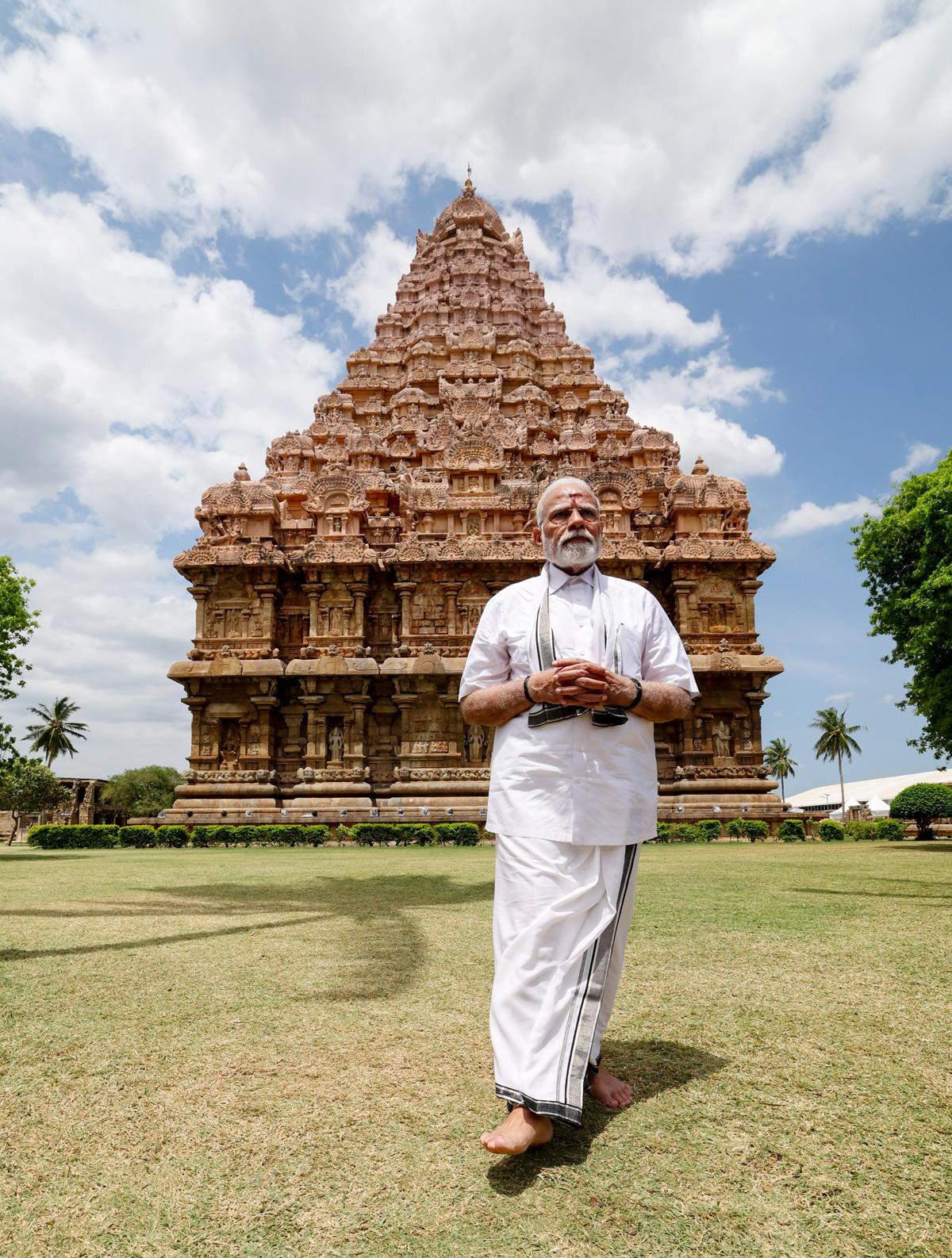
Someone in Team Modi is still fascinated by Ponniyin Selvan, Mani Ratnam's magnum opus that they have convinced Modi to talk and walk the Cholas in Tamil Nadu even after the electoral failure of his Sengol project the last time.
This time, they flew him to Gangai-konda-chola-puram in Tamil Nadu, for the Rajendra Chola's 1,000th birth anniversary, little realising that the title, Gangai Kondan derives from the king defeating rulers in the Gangetic plains, a preferred constituency of the BJP.
It is anybody's guess if Modi has the massive Sardar Patel statue in native Gujarat in mind when he promised the Tamils that he would install huge statues of Rajaraja Chola in Tamil Nadu -- so as to stun and charm Tamil voters too.
However, BJP strategists are woefully uninformed about the Tamil sentiments that go much deeper than photo ops and dazzling displays of political power.
Whether it is Ram or Murugan, they need to understand that most Tamils are tied to their village and family deities, and so are Keralites and Bengalis.
Hence attempts at superficial connects do not work, and religion as the Sangh Parivar understands is not in the public domain.
Beyond all this is the dichotomy about Modi continually celebrating Tamil language and culture through the past decade-plus, but the party's government at the Centre unwilling to concede the Tamil claims over the antiquity of the Keeladi findings.
In the 'Ideology versus Identity' contradiction facing the BJP, the Kerala unit has rushed a team to party-ruled Chattisgarh to have Christian nuns arrested for 'religious conversion', which is the party's current plank across the nation.
It's like the BJP units in Tamil Nadu and Karnataka now, and the Congress earlier, taking different views on the Cauvery waters dispute and yet want the voters in the respective states believe them, that too in this fast-paced social media era.
This should also explain the failure of the party's Sabarimala campaign in Kerala, which too was seen as an attempt to communalise the society and polity. It failed.
Today, in West Bengal, Mamata seems confident that the BJP cannot hijack the localised Ma Durga identity beyond the Hindutva voters in the Modi brigade.
She is trying her luck with the Bengali linguistic and societal identity, which the BJP, she says, is challenging through the Election Commission and party government in neighbouring Odisha, over the midnight police raid on immigrant Bengali workers.
Only the elections will tell us if her campaign can deflect the anti-incumbency factor piled up against her TMC regime, starting with the law and order situation.
But the BJP has already handed over a stick to beat them with.
Even now it may not be too late for BJP strategists to go slow on the anti-Hindutva states in the pack lest a defeat at this pace should demoralise party cadres, elsewhere too. The reasons are not far to seek.
Ahead of Elections 2029, most states, including crucial ones like the BJP-ruled UP, MP and HP, would have their assembly polls.
Last year, the BJP won only 36 Lok Sabha seats out of 80 in Yogi Adityanath's UP. The joint Opposition won 43.
Among them was the crucial Faizabad constituency, where Modi had consecrated a Ram temple at Ayodhya, only months before the election.
And now you know how precarious the BJP is placed now and in the future, at least on paper, compared to their exceptionally strong position in 2014 and 2019.
And why in turn the RSS is worried about ensuring the BJP's victory in most, if not assembly elections, followed by the Lok Sabha polls in 2029 -- that too under Modi's leadership.
In between, Modi has to connect back with the national electorate. Alternatively, if he were to step down, there is no one as charismatic and as tall as him in the party to be able to capture the voter's imagination, jointly or severally.
Names like Amit Shah, Yogi and Nitin Gadkari may cross the mind, but even if Modi campaigns for any of them personally, he may not be able to 'transfer' the non-RSS, non-BJP 'Modi votes' to the chosen man.
After all, Modi had begun by creating a vacuum at the top by eliminating Advani, Murli Manohar Joshi and others. That vacuum remains, and will remain so in the coming years too.
The Sangh Parivar will not be able to find a fitting answer to the unasked question: 'After Modi, who?' any time soon.
Not that anyone is asking that question between now and the presidential poll in 2027 or the Lok Sabha elections two years later in 2029.
N Sathiya Moorthy, veteran journalist & author, is a Chennai-based policy analyst and political commentator.
Feature Presentation: Aslam Hunani/Rediff







 © 2025