

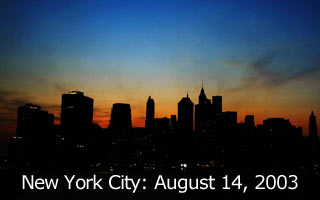
"This is the way the terrorists will strike New York City," I said yesterday afternoon to a woman in the cashier's line at a Duane Reade store in midtown Manhattan.
"They don't need to kill us or fly planes into tall buildings. They will simply disrupt our power supply, so that we will have to throw away all our refrigerated meat and milk. There will be no food to eat. With the ATMs down, people will run out of cash. It will be our end."
I was at the Duane Reade buying candles, a flashlight, couple of bottles of Evian water and Snickers bars -- that was going to be my dinner and nourishment if the city ran out of its food supply.
I was ready for the end of the world or a nuclear holocaust. It was around 5 pm -- nearly an hour after New York City and the entire northeast as well as parts of Canada had been hit with a power outage.
"Now there is no need to spread panic," the woman said to me, very curtly. And I was simply trying to make a friendly conversation with a fellow New Yorker.
When the power outage happened around 4 pm, I was in my office at 45th Street and Third Avenue. I was trying to finish a major assignment, which was due today. And with no warning -- as if these things require a warning -- our office floor went dark.
Soon we noticed people in the building across from us looking out of their windows. Maybe it was more than our floor, more than our building. Maybe the entire midtown had been hit.
| |||||||||||

Third Avenue was quite crowded, people seemed confused, unsure. No one had any idea what had happened or how long this problem would last. I figured it was time to head home, no sense in hanging around. Deadlines at work can wait.
By 5 pm -- most people were thinking the same. While the neighborhood bars were crowded, suburban commuters were heading in the direction of Port Authority and Penn Station terminals.
A colleague who lives in Chappaqua (Bill and Hillary's hometown) was trying to make arrangements on her cell phone to see if she could get a car service to her home. I do not know if she got across to anyone, since most cell phones were inoperative.
I do not know how she made it home, or what became of the commuters to New Jersey, Connecticut, Long Island or Westchester. This morning's New York Times has images and tales of thousands of people stuck for hours trying to get ferry services across the Hudson River to New Jersey; people walking over bridges to Queens and Brooklyn; and people crowding outside Port Authority -- which shut down soon after the outage.
In any case these are stories people will continue to share over the next few days and weeks, and especially on Monday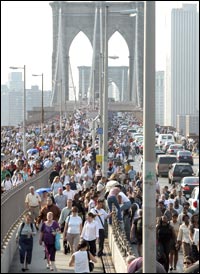 morning, when everyone returns to work -- if things are back to normal by then.
With my supplies packed in two Duane Reade bags, I decided to walk uptown. There was a gridlock on Third Avenue.
Packed buses and cars clogged the city's avenues and streets. But I had one mission -- to get to the Upper East Side and check on my 12-year-old son, who was at his grandparents' apartment. I could not connect with him on my cell phone, and I wanted the child to know that I was okay.
A few minutes later, in the sea of faces and sweating bodies, I saw a friend -- Kapil Bawa, a business school professor at Baruch College, also walking in my direction.
Kapil became my companion in the 40 blocks journey. We stopped to hear bits of pieces of news from car radios or battery operated boom boxes. Toronto, Ottawa, Ohio, Michigan, Connecticut -- all were dark. There were other pieces of details I heard. Lincoln and Hudson tunnels were shut down. The fans that run the ventilation systems of the tunnels were down.
Restaurants and bars were doing brisk business, but regular stores were pulling down their shutters. People seemed to remember the last time New York City went dark.
During the late-1970s blackout, panic and looting hit the streets of the city. And although we live in the post-Rudy Giuliani era, who knows what would happen after sunset, when it would really be dark.
We stopped to pick up cold water. I bought bread from Eli's -- a gourmet food store that had set up stalls to sell its perishable food. I picked up a box of cut watermelon from a deli that had all its food items on sale. And I also managed to connect with my son through my Verizon cell phone service.
Kapil and I parted company on 83rd Street. I spent a short while with my son. It was hot indoors, but everyone seemed well. My son was relaxed, especially since he had spoken to his mother. She had walked down from her office in the Empire State Building and was now stuck in traffic someplace midtown.
A short while later I headed home to Manhattan's Upper West Side. The next couple of hours were stressful and exhausting. I struggled through packed buses, sweating bodies, but mostly calm and cheerful New Yorkers. Along the way, at bus stops and in buses I heard people share stories. A woman was concerned about how she would reach her home in Pelham, way north in the Bronx. Two young girls wanted to know where they could catch the express bus to Throngs Neck -- another neighborhood somewhere in the Bronx.
As it was getting dark, I had decided to spend the night at friend's place near Columbia University. The commute to my apartment in Washington Heights -- some 40 blocks north of Columbia, would have taken me a lot longer.
Standing outside International House on Claremont Avenue my friend Hameer Ruparel introduced me to an Indian LLM student at Columbia Law School. Siddhartha Mehta arrived in New York City a week ago. I told him that I lived in International House in 1981, when I first arrived in the US and that in the past 22 years I had never experienced any power outage.
I grew up in New Delhi and I remember power cuts during the summer. But the US is a superpower -- supposedly the land of comfort, high speed Internet, cell phones, stadium-seating movie theatres, clean water and constant power supply.
We sat on the steps of the Low Memorial Library in the heart of Columbia University. In the dark there were hundreds of students lying there -- singing songs, playing musical instruments, drinking beer and eating pizza. We stepped into Columbia's Alfred Lerner Hall, where the university's generators had the air conditioning system working.
Hundreds of students were sleeping on the floor, or quite simply making a party out of the whole situation. I met three young engineering students from India who were going to spend the whole night in Alfred Lerner Hall.
I spent the night in Siddhartha Mehta's International House apartment, facing the Hudson River. This morning the power was back in Manhattan's West Side, and I was able to reach home.
As I sit and write, parts of the city are still without electricity. The subways are down as are most commuter trains. My cable and Internet service is dead. Banks are closed and ATMs are not dispensing cash.
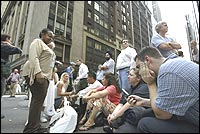 The woman at Duane Reade was right. Yesterday's power outage was no terrorist attack and perhaps I was needlessly panicking. But what happened on the afternoon of August 14 is also a sheer reminder of the fact that the citizens of the most advanced and powerful country of the world are not always immune from events that people in other parts of the globe, especially in the Third World countries, take for granted.
Perhaps we need to be a little humble and we may be able to understand the rest of the world, a lot better.




 © 2026