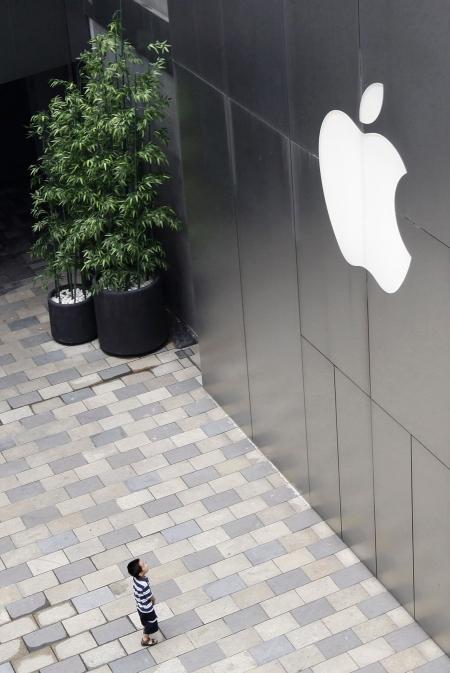
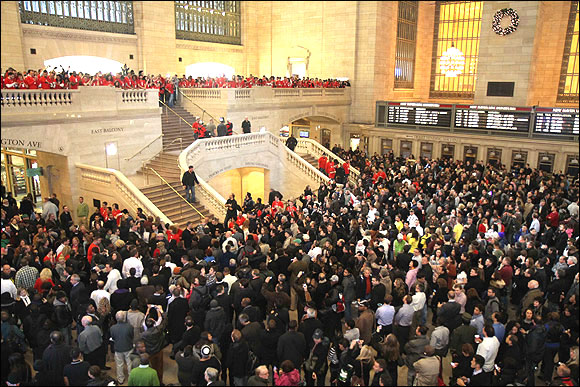
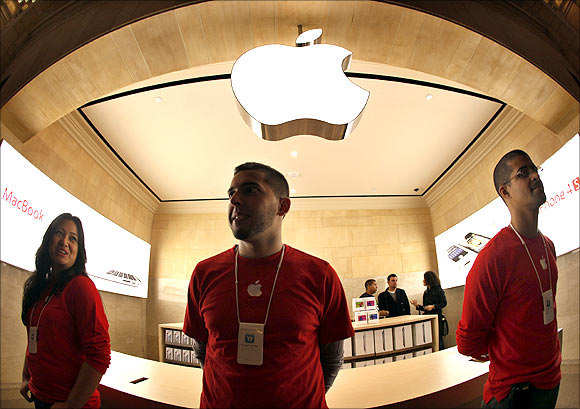
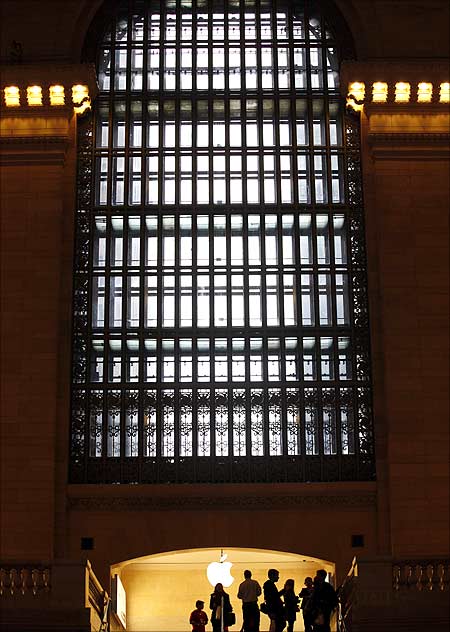
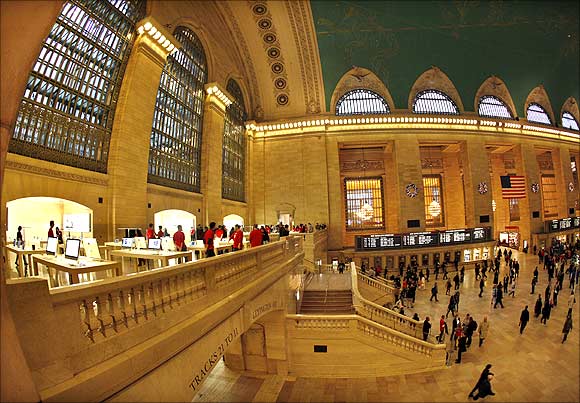
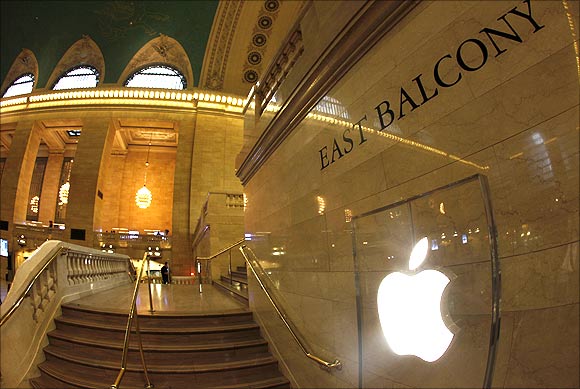
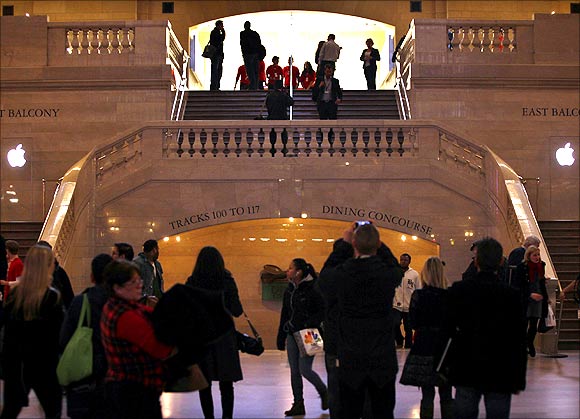
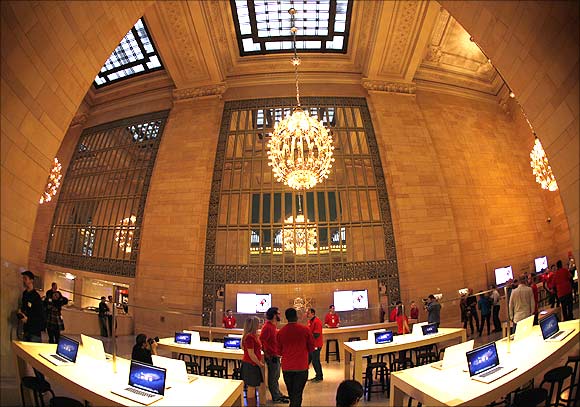
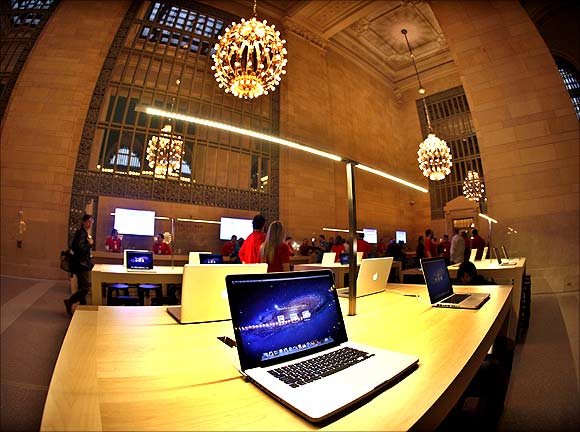
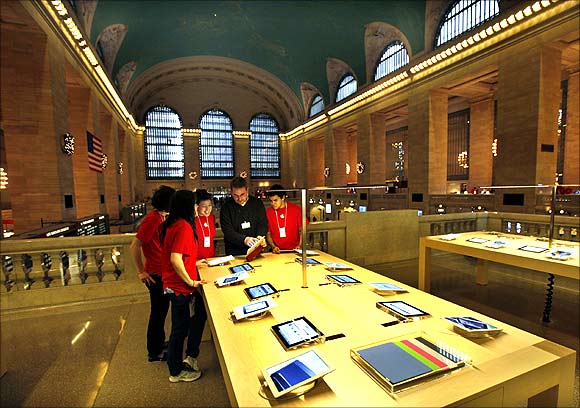
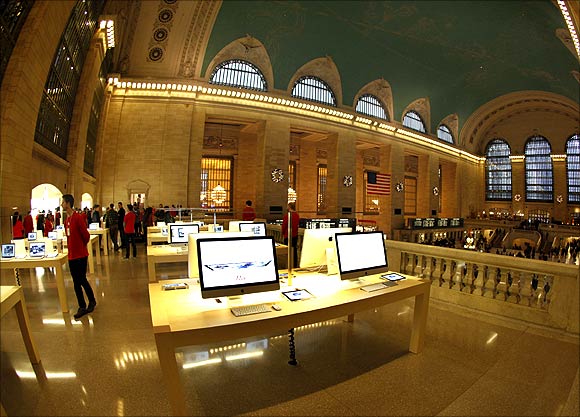
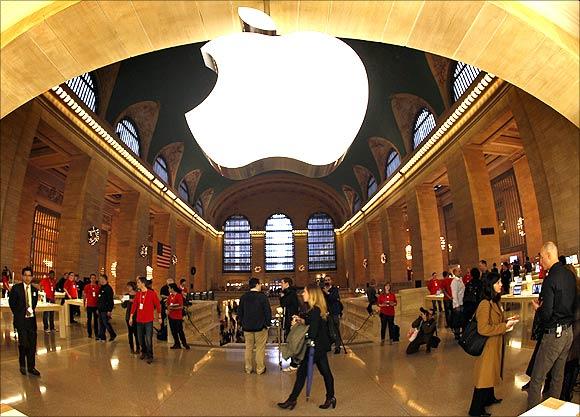
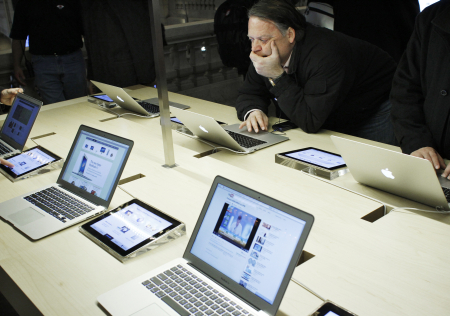
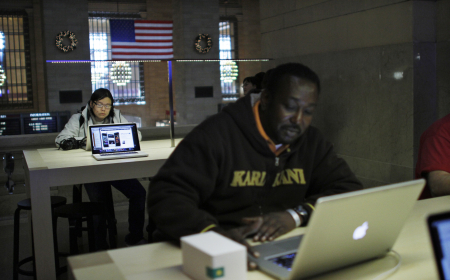
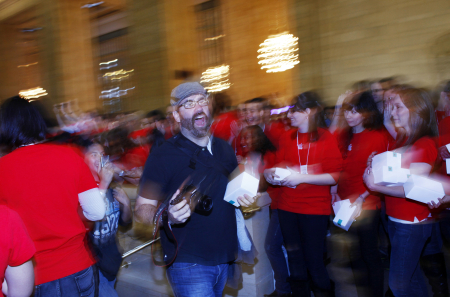
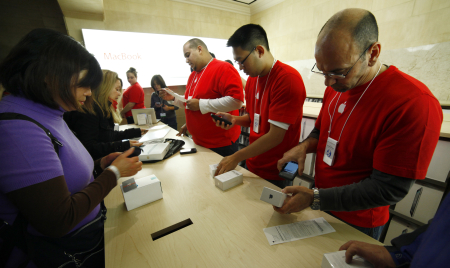
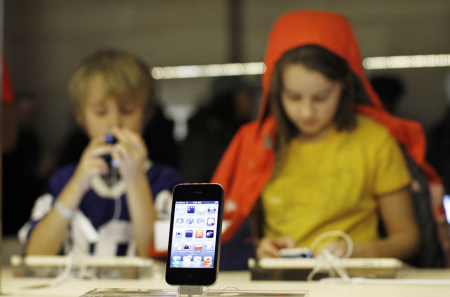
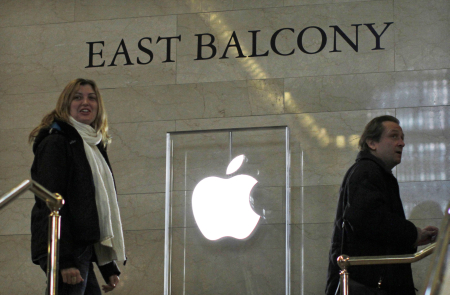
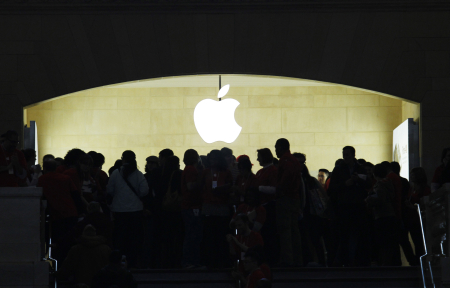
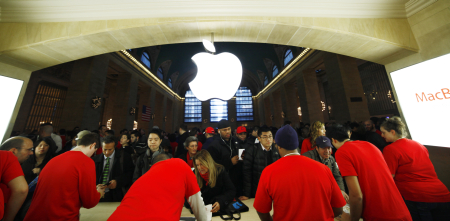
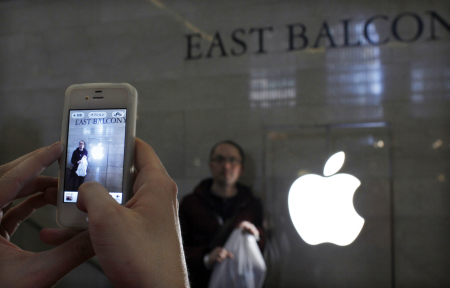
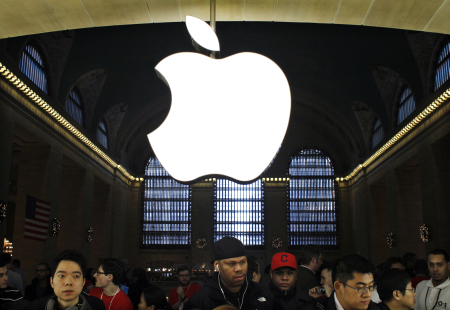
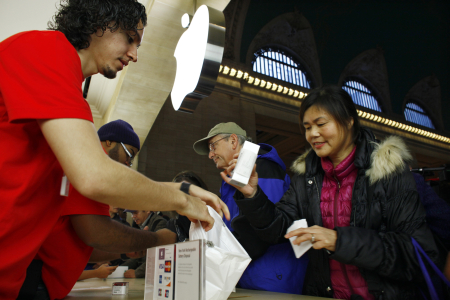
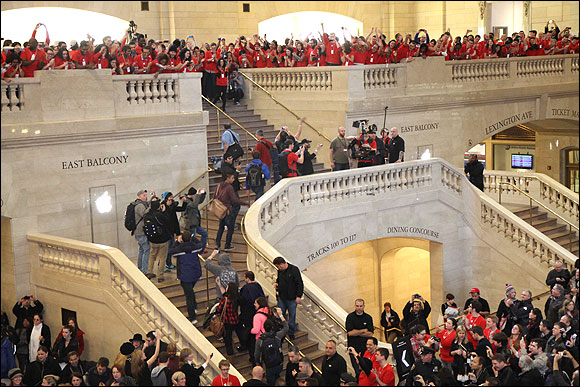
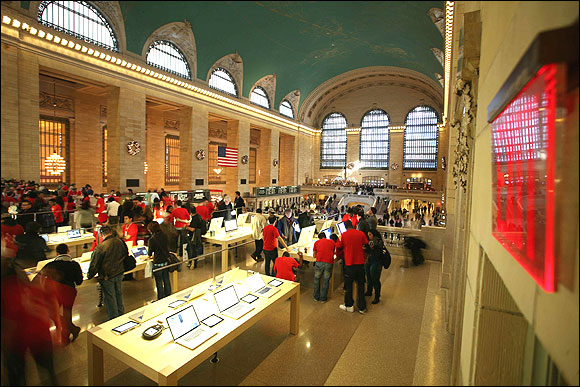
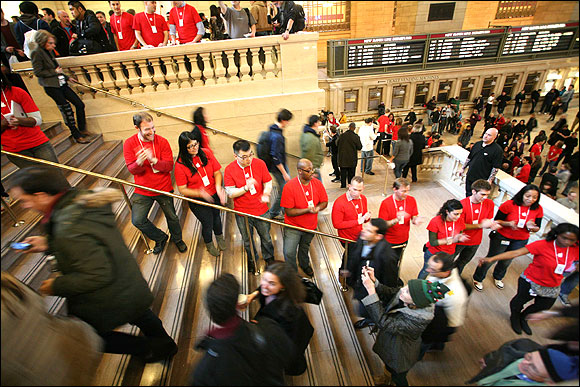
Apple opened its latest retail store in New York's historic Grand Central Terminal to hundreds of eager shoppers.
The newest store - one of Apple's largest at 23,000 square feet - brings the total tally of its outlets to more than 300 worldwide.
Let us have a look at the new store.
Click NEXT to see more...
Apple is an American multinational corporation that designs and markets consumer electronics, computer software, and personal computers.
...
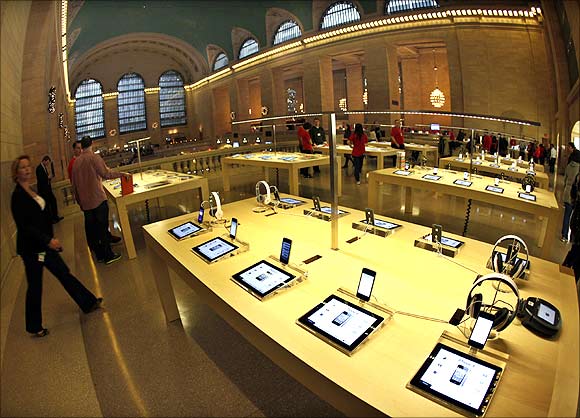
The company's best-known hardware products include the Macintosh line of computers, the iPod, the iPhone and the iPad.
...

Apple software includes the Mac OS X operating system; the iTunes media browser; the iLife suite of multimedia and creativity software; the iWork suite of productivity software; Aperture, a professional photography packa#8805 Final Cut Studio, a suite of professional audio and film-industry software products; Logic Studio, a suite of music production tools; the Safari web browser; and iOS, a mobile operating system.
...
As of July 2011, the company operates 357 retail stores in 10 countries, and an online store where hardware and software products are sold.
...
As of September 2011, Apple has recently been the largest publicly traded company in the world by market capitalization, and the largest technology company in the world by revenue and profit.
...
Established on April 1, 1976 in Cupertino, California, and incorporated January 3, 1977, the company was previously named Apple Computer, Inc, for its first 30 years, but removed the word "Computer" on January 9, 2007, to reflect the company's ongoing expansion into the consumer electronics market in addition to its traditional focus on personal computers.
...
As of September 2010, Apple had 46,600 full time employees and 2,800 temporary full time employees worldwide and had worldwide annual sales of $65.23 billion.
...
For reasons as various as its philosophy of comprehensive aesthetic design to its distinctive advertising campaigns, Apple has established a unique reputation in the consumer electronics industry.
...
This includes a customer base that is devoted to the company and its brand, particularly in the United States.
...
Fortune magazine named Apple the most admired company in the United States in 2008, and in the world in 2008, 2009, 2010, 2011.
...
Apple was also branded as the most valuable public limited company, pushing past Exxon.
...
The company has however received widespread criticism for its contractors' labour, environmental and business practices.
...
Apple was established on April 1, 1976 by Steve Jobs, Steve Wozniak, and Ronald Wayne, to sell the Apple I personal computer kit.
...
They were hand-built by Wozniak and first shown to the public at the Homebrew Computer Club.
...
The Apple I was sold as a motherboard (with CPU, RAM, and basic textual-video chips) - less than what is today considered a complete personal computer.
...
The Apple I went on sale in July 1976 and was market-priced at $666.66 ($2,572 in 2011 dollars, adjusted for inflation.)
...
Apple was incorporated on January 3, 1977, without Wayne, who sold his share of the company back to Jobs and Wozniak for $800.
...
Multi-millionaire Mike Markkula provided essential business expertise and funding of $250,000 during the incorporation of Apple.
...
The Apple II was introduced on April 16, 1977, at the first West Coast Computer Faire.
...
It differed from its major rivals, the TRS-80 and Commodore PET, because it came with character cell-based colour graphics and an open architecture.
...
While early models used ordinary cassette tapes as storage devices, they were superseded by the introduction of a 5 1/4 inch floppy disk drive and interface, the Disk II.
...
The Apple II was chosen to be the desktop platform for the first "killer app" of the business world - the VisiCalc spreadsheet programme.
...
VisiCalc created a business market for the Apple II, and gave home users an additional reason to buy an Apple II -compatibility with the office.
...
By the end of the 1970s, Apple had a staff of computer designers and a production line.
...
The company introduced the ill-fated Apple III in May 1980 in an attempt to compete with IBM and Microsoft in the business and corporate computing market.
...
Jobs and several Apple employees, including Jef Raskin, visited Xerox PARC in December 1979 to see the Xerox Alto.
...
Xerox granted Apple engineers three days of access to the PARC facilities in return for the option to buy 100,000 shares (800,000 split-adjusted shares) of Apple at the pre-IPO price of $10 a share.
 © 2025 Rediff.com - Investor Information - Advertise with us - Disclaimer - Privacy Policy - Feedback - About us - Terms of use - Grievances