
At a time when the World Bank terms its relevance to India as a risk factor, its newly appointed vice president for South Asia Region Praful Patel is bringing to the table unlimited IBRD loans for investment in the infrastructure sector.
Patel is slated to meet Finance Minister Jaswant Singh on Wednesday and present a new partnership strategy.
Praful Patel, who is on his first visit to India in his current profile, told Business Standard, "My challenge is to lift the game to the next level."
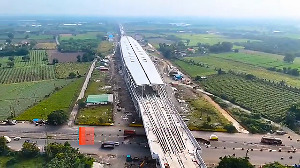
The strategic area of engagement for the bank with India would be infrastructure. "The most critical gaps that need to be addressed for taking India to a 7-8 per cent growth path include power, ports, Railways and telecom," he added.
According to Patel, an Ugandan national, who has been with the bank for almost three decades, the main worry for India was its cost competitiveness.
Even as a debate ensued in India about reining in the fiscal deficit and depending less on borrowings, he felt that investment in the infrastructure sector should not suffer.
"The cost of doing business in India and increasing exports should not be a constraint in achieving a 7-8 per cent growth path," he said.
While a prudent debt management strategy is an integral and crucial part in managing the economy, it should mean that a country does not borrow at all or have any debt, Patel said.
If you look at India's debt strategy, during the last fiscal and even during the current year, a significant part of India's budget is funded through external borrowings.
His mission would be to present the right mix of lending for infrastructure sectors where there is lot of pent up demand.
Second, Patel said, he would ensure that the access to World Bank loans was not underpitched towards the goal of an 8 per cent growth as outlined in the Planning Commission's Tenth Plan document.
As far as World Bank lending is concerned, there should be a distinction between International Development Association funding and IBRD loans, Patel points out.
Although the association provides highly concessional loans carrying an interest of 0.75 per cent and need to be repaid over 40 years, the quota for India is only $ 850 million a year.
However, IBRD loans are different, where the cost of borrowing is higher. While accessing foreign loans, the government has to look at the other conditionalities too.
"India has to look at minimising the cost of borrowing," he said, adding that it was very important to justify borrowings from a particular source.
Patel said that India's share of global trade can increase significantly and actually impact on the gross domestic product growth rate favourably if the infrastructure sector concerns were given due emphasis.



 © 2025