
'Today, we have 2 million active drivers earning through our platform every month.'
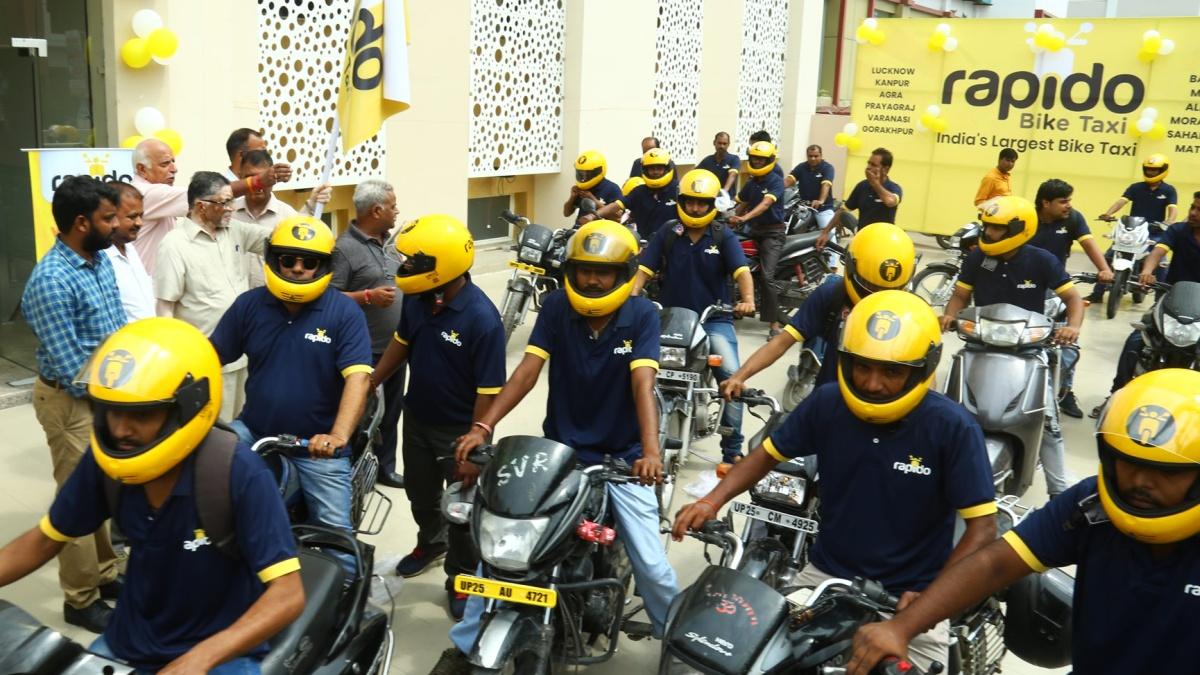
Bengaluru-based startup Rapido, which joined the unicorn club last year, has disrupted the mobility business by shifting from a commission to a subscription model for drivers across vehicle categories.
It recently added taxis, prompting rivals Ola and Uber to follow suit.
Rapido cofounders Pavan Guntupalli and Aravind Sanka, in an interview with Surajeet Das Gupta/Business Standard in Bengaluru, discuss their push to become a mass-market mobility player, ongoing goods and services tax (GST) and regulatory challenges, and the government's electric vehicle (EV) drive.
Eighteen months after introducing the subscription model for drivers, replacing the earlier commission-based system, what's been the impact -- especially since Uber and Ola have now followed suit?
We moved to the new model in December 2023, which Namma Yatri in Bengaluru had already been experimenting with cars.
Before we launched this model, we had around 700,000 drivers across platforms.
Today, we have 2 million active drivers earning through our platform every month, making us the largest gig worker employer in the country.
Rides have increased 3x -- from 1-1.5 million a day to 4 million a month -- in just 18 months.
For instance, in Hyderabad, every third person takes a Rapido ride at least once a month, and in Bengaluru, it's every fourth person. These numbers are only going to rise.
What does the model mean for drivers? It clearly affects your revenues. How do you make up for that?
Compared to the 20 per cent commission system, platform revenues have dropped by about 90 per cent.
Drivers now pay an average of Rs 20 a day -- and that too only if they actually take a ride, not just for being online.
This works out to around 2 per cent of their income versus 20 per cent earlier.
High commissions were a major barrier to drivers coming online.
We'll make up through scale and growth, which are already strong, by expanding to more cities and adding cars to the platform.
Our operating costs are also low -- the same team that launched bike taxis and autos also launched our taxi services.
We rely on word-of-mouth marketing, address our existing customer base, and use the same tech.
Because of this lean model, we're already operationally profitable and expect to turn net profitable at a platform level by the next financial year.
From bike taxis to autos to car mobility -- what's your larger game plan across platforms?
We're currently in over 35 cities with taxis and aim to be present in every district headquarters.
Of 2.5 million cabs in India, only around 500,000 are online.
We want to bring them all onto platforms. At present, we have 300,000 cabs, and 15 per cent of these are online for the first time.
Of course, the cab business is still dominated by seven to 10 major cities.
For bike taxis, we're already in 250 cities and aim to be in 500 by end-2025.
Our goal is to serve an addressable market of 600 million people -- a threefold increase from current levels -- within three years.
That also means doubling our driver base to 4 million.
Do you have enough capital to fund this expansion?
Yes, we're well-capitalised. Over the past six to eight months, we've raised over $200 million -- enough to reach 500 cities and expand the cab business.
How is revenue from rides split across vehicle platforms?
Currently, cars account for 25-30 per cent of gross order value (GOV), three-wheelers are the highest at 40-45 per cent, and the rest is from two-wheelers.
However, under a subscription model, GOV doesn't directly matter to us.
We expect ride volume to grow across all segments.
You've been pulled up by tax authorities for alleged GST violations. The Karnataka Authority for Advance Ruling has asked you to pay 5 per cent service tax on cab services. What's your defence?
Our model is different -- drivers pay a subscription fee to use our platform.
We don't control pricing; customers can quote what they're willing to pay, and drivers can accept or reject it.
Prices are set through direct negotiation. That's unlike the commission model where aggregators fix the fare and deprioritise drivers who don't accept rides.
Also, the user pays the driver directly -- we're not involved in the transaction.
What we provide is the infrastructure and ensure the safety of the ride, which we do proactively.
So does the government's Gig Workers Act apply to you?
Ideally, no -- it's not applicable to our model. But we still provide services like insurance, even though it's not required by law.
Also, there's no clear definition yet of a gig worker. The key element is flexibility -- and no model is more flexible than the software-as-a-service setup we offer.
Many states haven't legalised bike taxis, and those that have -- like Delhi -- are pushing for a quick shift to EVs. How do you plan to deal with that?
Ten states have already allowed bike taxis. The Motor Vehicles Act permits them, and the Centre has repeatedly asked states to frame guidelines.
Rapido has data on 10 billion rides since launch, which we're sharing with the government to show how it works and the employment it generates.
As for electrification, the transition will take time. Most people can't afford an EV today, financing options are limited, and supply needs to increase dramatically to meet demand.
EV adoption is still slow -- of the 200 million two-wheelers on the road, less than 1 per cent are electric.
Of the 2 million two-wheelers in our mobility fleet, only 100,000 are EVs.
We're urging the government to adopt an aggressive policy for new vehicles, with a clear four-to-five-year time frame to reach 100 per cent EV adoption.
Feature Presentation: Aslam Hunani/Rediff.com











 © 2025