

It's a tough time in the stockmarket now. The Dow Jones Industrial Average has lost over 23 per cent from the top, and the BSE Sensex is down 35 per cent from its all-time high of 21,206.77 on 10 January 2008. The market will continue to remain at lower levels as the macroeconomic conditions have turned negative and adjustments may take a considerably large amount of time.
Brokerage houses have started revising the earning estimates. Angel Broking, in its first quarter result preview, says: "We expect the Sensex companies to deliver a healthy 16.6 per cent CAGR in net profit over FY2008-10E (E denotes estimates). However, this is lower than our previous estimates (21.1 per cent CAGR over FY2008-10E) on account of two reasons.
One, the Sensex EPS actual was higher than our estimates for the full year FY2008. And we have also factored in the new challenges that Indian companies will face going forward." The report further adds, "Our Sensex EPS estimates of Rs 970 for FY09 face a risk of downgrade following the quarterly results."
And the winners are...The price data of the Sensex stocks has some interesting hidden facts. The three stocks from the Sensex that managed to break the trend in the falling markets are from the FMCG and pharmaceuticals space (Hindustan Unilever, Cipla and Ranbaxy Laboratories).
Similarly, 11 out of the 13 stocks that moved up in the BSE 500 are from pharma and FMCG. These stocks did not post great positive returns, but when everything else came tumbling down, these managed to protect the invested capital.
Be the defensive champ. When things are not going well, it is time to return to tested investment strategies. Look around you. High inflation and interest rates have not prevented people from falling ill. We may complain about the high prices of medicines, but we still buy them. We may not pick up the box of Oreos from the supermarket, but we will buy Marie biscuits and toothpaste, razors and health supplements.
So why not follow our shopping cart from the supermarket to the stockmarket. When your investments are down, get defensive. Demand in the pharmaceutical and FMCG sectors is relatively inelastic and companies in these sectors will remain largely unaffected by higher interest rates.
| Interactive |
|
1st Person: My stock portfolio is down 40 per cent this year. I don't know what to do? 1st Person: Real estate and construction companies were buzzing last year. So, I bought them. 1st Person: What shall I buy now? Do you think banking is a good sector to be in? 1st Person: My broker told me this is a good time to buy IT stocks again. What do you think? |
Also, when there is pain in the market, you must look for stocks that have high visibility of earnings compared to the rest of the universe. These sectors remained under-owned in past four years, as the market was busy catching the high growth space like capital goods.
As a result, the BSE Capital Goods Index jumped over 700 per cent between January 2004 and January 2008, while the BSE Healthcare Index gained only 75 per cent during the same period. But now, as things have become uncertain, the focus has shifted back towards the latter sectors.
And the losers are. Let's compare these sectors to the losers. Last year's buzzwords were infrastructure and real estate. This year, Omaxe saw its market cap being eroded by about 78 per cent, Ansal Properties & Infrastructure by 77 per cent and Parsvnath Developers by 76 per cent.
Sectors like real estate are unlikely to bounce back in the near future due to a number of reasons. In the case of real estate, for example, rising interest rates and high prices of inputs such as steel and cement will act as roadblocks on the recovery path.
These factors will cause an escalation in the cost of the ongoing projects and will bring the margins down. High interest rates are reducing demand for housing units, which is pulling prices down, and hurting the real estate sector. The price-to-earnings (PE) ratio was very high in this sector and stocks went up broadly because of PE expansion.
Though real estate is the worst hit, several other sectors have also been affected rather badly. Companies in the capital goods, construction, banking, and automobile sectors are also reeling under the pressure of high interest rates and slowing demand.
Higher cost of money is expected to slow down the expansion plans of corporate India. This will affect the capital goods and construction sectors, while earnings and margins of the automobile sector will be hit by slowing demand in this space and high input prices.
Earnings in the banking sector are likely to get affected by fall in credit offtake and other incomes. While rising interest rates will hurt the treasury income, lower activity in the capital markets will reduce the fee-based income of banks. These sectors will not be able to recover till interest rates start moving down, which does not appear very probable with inflation at a 13-year high. The Reserve Bank of India will continue to pursue a tight monetary policy to control inflation. Till it is reined in, earnings and PEs will remain under pressure.
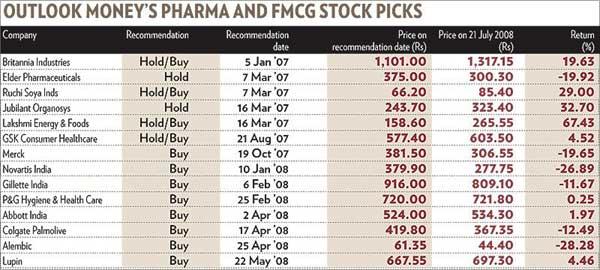
We told you so. Anticipating this, Outlook Money had started focusing on pharma and FMCG at the beginning of this year and a large proportion of our stock recommendations since then have come from these two sectors (see Outlook Money's FMCG and Pharma Stock Picks). We believe that stocks in this space will continue to attract investors in these turbulent times.
Apart from pharma and FMCG, information technology is also likely to benefit going forward. The IT sector will be helped by the weakening of the rupee. It has depreciated over 8.5 per cent against the US dollar since beginning of this year and is likely to fall further due to adverse macroeconomic conditions.
Says V. Balakrishnan, chief financial officer, Infosys Technologies, "The rupee could be volatile and chances are it will depreciate. Macroeconomic numbers, inflation, current account deficit and fiscal deficits suggest this. Everything is against us, and in this kind of environment, chances of rupee depreciation are higher than those of appreciation."
It would be advisable for investors to look at large companies in the IT space because they will have a diverse clientele, both in terms of business segment and geography. A small company may not have this edge and loss of the few clients it will have may cause steep falls in revenue.
In these uncertain times, when protection of wealth is a major issue, we believe that FMCG and pharma are the spaces to be in. These will not remain completely unaffected, but the adverse impact on the earnings of companies in these sectors will be muted.We will continue to look for value in this market both inside and outside these sectors and mark them in our pick of the fortnight segment. If you are still not convinced about parking a lot of money in equities now, read on to find out how you can invest in a small, yet systematic way.
| Chandrakant Sampat, Stock Investor |
|
"Social awareness lacking"
He quit his family business in 1955 and started investing in the stockmarket. Today, at 80, he is one of the oldest investors in Indian equities. He shares his views on investing...
How have the markets changed in the last 43 years that you have been an investor?
Markets are totally different now. I went to the market in 1955. Earlier, the Controller of Capital Issues decided the price at which a public issue could be priced. Secondly, it was compulsory for any foreign company to get into India to offer at least a portion of its total issue to the public. It was very economical to go to the market then. All you needed was a cheque book and a slip book and, most importantly, merchant bankers did not have a say on what the price of a public issue would be.
In 1979, Hindustan Lever went public. The shares were offered at Rs 16 each and the total distribution of dividend was Rs 32 crore - that was Rs 2 per share. This means that we were offered a share at 11 or 12 per cent yield. Today, the index yield is 0.85. The only question then was how do you choose which company to invest in.
This was great not only for the Indian shareholders but also for the Indian society. Institutions like LIC (Life Insurance Corporation) could afford to build a substantial amount of corpus on their retirement funds. Think of Reliance Power now.
Rupees ten became Rs 450 in six months and the public bid at Rs 900. For a company that will go into production in 2016. If this instrument lies on the balance sheet of institutions that provide retirement funds and pension money, can they ever make up the loss? The capital market has lost its social awareness.
Has your stock selection process changed over the years?
No, it has not. I have a four-fold process of stock selection. First of all, it must be a business that I am able to understand. If it is an industry that I have no idea about, then I will not look at the company. Secondly, it should have zero or very little debt. Third, it must be earning 30 per cent on the capital employed. And it should be available at a price-earning ratio of 13-14 times the current year's earning. Ideally, it should be at 3.5-4 per cent yield.
There are very few such opportunities left, but whenever they come, I like to participate.
Are you optimistic about the future of the Indian capital markets?
I cannot say I am. Machiavelli said that if the law permits anyone to do anything they want, society will be destroyed. This capital market permits anyone to do anything. The result of this freedom will destroy this society. I am 80, I am not worried. But what about younger people? What will happen when you retire?
Today, mutual fund managers are rewarded on the basis of their performance and not on the basis of value. This triggers them to chase momentum and not value. Chasing momentum is nothing but gambling. You must remember that a history of good dividends is more valuable than how quickly the share price has gone up in the last few months.
There are no profits, there are only accrued costs not incurred. I don't have any accrued cost not incurred. Younger people have tremendous accrued cost not incurred. Are you saving enough to take care of this? If you are not, you are not getting any remuneration, you are losing, and so is society.
What is your advice to today's retail investors?
The big issue today is inflation. In my view, frugality can beat all inflation. I still don't own a car, I don't have a mobile. Ours is now an economy based on waste. If you change that, other factors will correct themselves. I am now only 30 per cent in equity, the remaining is in liquid instruments. Veena Venugopal |
With reports from Kumar Gautam





 © 2026