As part of an ongoing series, we bring you stories of young Indian Americans who came looking for the Real India and found their real selves instead. Esha Khurana speaks to Arthur J Pais
Winning essay competitions and fellowships has become second nature to Esha Khurana, a sophomore at Northwestern University in the Honors Program for Medical Education. Esha, who wants to go into medicine and journalism spent a few weeks as a Radulovacki Fellowship Winner in Rohtak in August, staying with Dr Markanday Ahuja, the head of the Sri Baba Mast Nath colleges.
The patient histories she collected, she says, showed that many patients suffer from eye injuries while cutting crops or from livestock. The injuries go untreated for years, and the corneal or lenticular abrasions are exacerbated by dust particulates, harsh ultra violet light, and age.
You may be surprised to hear that during the filming of the Bharat Yatra documentary, I was producing my own documentary. In fact, 14 unique documentaries were produced in tandem with the Bharat Yatra documentary. As you may have guessed, I speak of a very different type of documentary a documentary where the lens is the human eye, the reel is human memory, and the audience is the human heart. So, what did our documentaries capture, which perhaps could not make it the actual screen?
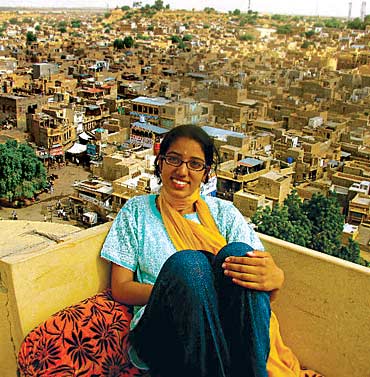
It couldn't quite capture the wave of humidity and smells that hit you when you first walk off the plane; it couldn't capture the exhilaration of bargaining in a Jaisalmer, Rajasthan, market or the peace of riding a camel through the Gobi desert at dusk. It couldn't capture the changes and growth we felt in ourselves as we immersed ourselves in the culture and experienced the flood of raw humanity, its unwavering strengths, its crippling weaknesses, its unparalleled beauty condensed, clarified, and dilated.
I have to admit, our technology puts the technology of the most expensive and advanced cameras to shame. I almost forgot to mention one of the most powerful features of our cameras: We possess the ability to switch the perspective of our lenses from ourselves to another, and, if only briefly, experience another life, another lens.
You cannot fully realise the appreciation we felt then for our beautiful country and its incredible people. But we also felt the pain of the forgotten and shunned sufferers of leprosy, the pangs of hunger among starving children, the desperation of waiting patients in an overcrowded hospital. We experienced the full extent of human suffering and human poverty.

The Bharat Yatra documentary beautifully offers a taste of all our experiences, our reactions, our thoughts, in 22 minutes. However, it also poses a question to all of us as viewers -- what can we do?
I've spent the last few months trying to answer that question for myself, and I've come to realise that my post-yatra life is truly just beginning. Before returning to the United States, I spent a few additional weeks working in an eye hospital and completed a project for the Radulovacki Global Health Fellowship on the risk factors for major eye issues in Indian villages. My hope is that this research and other similar projects will help raise awareness on the inequities plaguing Indian health care. Furthermore, today I complete my schoolwork with increased fervor, I read articles on public health with heightened interest, and I've joined GlobeMed, a student group that raises awareness on global health issues.
Every week, I lead student volunteers to work with health clinics in Chicago, which provide free health services to the uninsured and especially patients of South Asian descent. So, my documentary would include the realisation that without question, mera dharma, my duty, is to return to India one day as a physician to help alleviate the pain and suffering we witnessed.
It is impossible to visit India and remain indifferent when immersed in a culture whose religions, whose values, and even whose Bollywood movies revolve around that most powerful of forces, love. It was this infectious love of family and life, which inevitably beckoned all of us back to India. And now that that culture is under attack, it is that love which drives us forward and inspires us to return to our home and our people, armed with the sole idea that we can make a difference.
Fortunately, the documentaries I've described are years in the making and not nearly over. The tapes are still rolling, and, if we pay close attention, we will realise that they pose a similar but markedly different question every moment of our lives: What are we doing now?

 © 2025 Rediff.com - Investor Information - Advertise with us - Disclaimer - Privacy Policy - Feedback - About us - Terms of use - Grievances