

England head to the Oval for the final Test of the summer against India on Thursday as the world's top side courtesy of a rankings system which is now widely accepted but not generally understood.
The International Cricket Council (ICC) rankings are the brainchild of former Wisden almanac editor Matthew Engel.
"Test cricket crucially depends on context," Engel wrote in the 1995 edition. "It needs a five-Test series (six is too long) for the personalities to emerge and the battle to capture the public imagination. These half-hearted one-off Tests rarely work."
Photographs: Getty Images
'Matthew's advocacy of Test rankings was great'

Engel's proposal, which was adopted by the ICC, awarded points on the basis of home and away series between each of the Test-playing nations.
It was replaced in 2003 by the present system designed and introduced by English actuary, scorer and cricket statistician David Kendix.
"What you had, unfortunately, was a situation some years ago when South Africa were top of the table and yet it was clear intuitively to anyone following the game that Australia was the number one team," Kendix said this week.
"Indeed, Australia had just beaten South Africa comprehensively home and away. This was clearly not sustainable," he added in a telephone interview.
"And the reason you had that situation was that South Africa at that point had just beaten Bangladesh and Zimbabwe home and away, whereas Australia had not recently played them at all.
"So you basically had four series victories for South Africa which counted for just as much as victories over the likes of England, India or Pakistan.
"Since Australia happened not to have the played the two weakest teams at the time, their series points were only enough for second place in the rankings.
"At that point it became difficult to believe it was a fair reflection of the relative strength of the teams.
"Matthew's advocacy of Test rankings was great and I have huge admiration for him as he started the process.
"He had the great idea of trying to establish a league table that gives that context to test cricket and I said to him soon after my system was adopted by the ICC, how many prototypes of anything ends up being the final version?
"He had the idea of having a ranking system, the ICC recognised that this was something they ought to make official, but they also realised that to be accepted, it needed to give sensible results all the time."
'Your rating will move up if you win and fall if you lose'
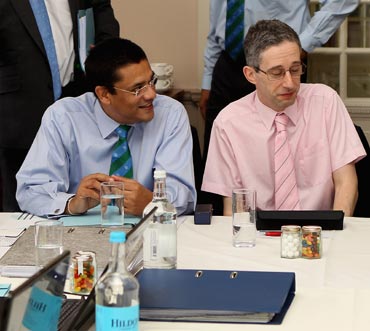
Kendix's system awards points for individual matches in a series as well as a bonus for the series winners. The model is based on results over the previous three to four years, weighted to give greater relevance to more recent results.
"That reflects the reality that in a Test series people are looking to win each match and they are also looking to win the series," he said.
"I wanted a points mechanism that reflected the aims of the competing teams and what they are actually trying to achieve.
"They are trying to win the match and win the series and therefore it seemed appropriate that the points system reflected those twin goals."
The next step in the process depends on the current ratings of the two sides.
"If you are playing a team that have a similar rating to you then they are by definition around the similar strength and therefore the points you get for beating them will be roughly the same as the points they get for beating you," Kendix said.
"But if you are playing a team that has a rating considerably higher than yours, you get more for beating them than they would get for beating you.
"The reason this is important is because, unlike a lot of other leagues in many other sports where everyone plays everyone else over a fixed period, there is a lot of inequality in the Test fixture list.
"Therefore you needed a system that removes any bias from the mix of fixtures, so that the ratings of the teams aren't unduly influenced by whether they have played more or fewer matches against stronger or weaker teams.
"There's no secret formula. If you plug in the result of a series and the rating of your opponent, that gives you the points you score for that series. The total number of points earned divided by the total number of matches gives your rating.
"It's like a batting average. If you have good innings your batting average will go up, if you have a bad one it will fall.
"Similarly, your rating will move up if you win and fall if you lose, with the size of the change depending on the strength of your opponent."
'I am an actuary by profession, cricket is my hobby'
Kendix, 45, who has been the official scorer for all internationals at Lord's since 1995 and a member of the ICC Cricket Committee for the past five years, said he became a scorer because he was hopeless at cricket.
"I was so appalling that when I first stepped on to a cricket field my schoolmaster decided very quickly that being good at maths I should sit on the boundary and count the runs," he said.
"I am an actuary by profession, cricket is my hobby. In my spare time I take holidays to score cricket matches."
Whatever debate may remain over the rankings, there is no doubt that they have added extra excitement and context to a glorious summer for the English national team.
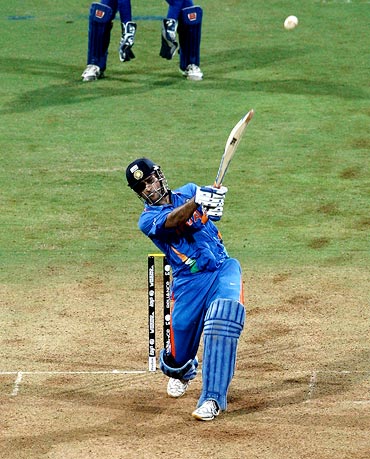
England's Ashes triumph in Australia this year was quickly followed by India's unstoppable surge to the 50-overs World Cup title, celebrated by a six off the final ball of the tournament by India captain Mahendra Singh Dhoni.
Dhoni's team were already the world's top-ranked Test side and their four-Test tour of England was given an added boost when the ICC announced the home side would take over as the number one side if they won by a two-Test margin.
England duly delivered with a 3-0 lead after an innings victory at Edgbaston in the four-Test series.
"I must admit when I was doing the calculations to determine what England would need to beat India by to take over as number one I was quite excited myself," Kendix said.
"I think the way that happened to work out with such a high profile series gave a bit of an extra incentive.
"I'm pleased it had that level of coverage because after eight years of feeling that it wasn't unloved, but certainly wasn't attracting much interest, it was pleasing to me that my work from many years ago was now something that people were taking an interest in."

Comment
article