...
...
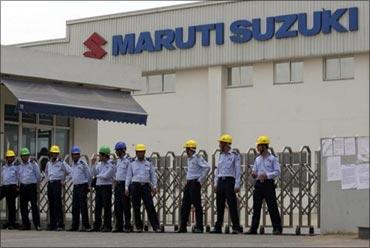
The curious aspect of this strike is that while both sides have dug their heels in and refuse to budge from their positions, the impasse is costing a boatload of money for the car company - at least Rs 500 crore (Rs 5 billion) so far by one account.
Yet, Maruti would rather bleed cash than give in. Today, reports suggest that workers at the company's Gurgaon plant are also thinking of striking in solidarity with their Manesar brethren. Politicised Unions...
...

Others in the auto sector have also wrestled with their own union problems. In April 2009, at Hyundai Motor India in Tamil Nadu, workers went on an eighteen-day strike to demand recognition of the employees' union.
Similarly, tire maker MRF's Arakkonam unit was closed for 185 days in 2009. Its workers subsequently went on strike in October 2010 as well as June 2011. The lure of contract labour...
...
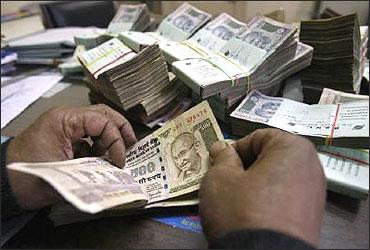
Workers at the Maruti plant say the working conditions between the permanent and contractual workers differ vastly.
Maruti employs close to 2,500 workers, of which 1,100 are permanent and the rest consist of workers on contract, apprenticeship and training. According to Shiv Kumar, president, Maruti Suzuki Employee Union who is a permanent worker, an unskilled contract worker is paid Rs 5,500 a month and a skilled contract worker (with an ITI diploma) gets Rs 7,000; a permanent worker's pay is around Rs 18,000....

In Haryana, the minimum wage of an unskilled worker is fixed at Rs 4,348. Other than salary, a contract worker is not entitled to medical benefits that a permanent worker gets, or the bus service, again which only the permanent worker can use.
Even difference exists, workers say, between the uniform of a permanent and contract worker. To become a permanent worker, a skilled worker has to work for a year as an apprentice and another three years as a trainee before he is made permanent. Yet, there is apparently little difference in the specific nature of the job for both categories....

Exploiting the masses
Workers say working conditions at the Maruti plant are, in general, 'difficult'. According to workers, the eight-hour shift that they are required to work usually gets extended by an hour.
The company provides a 30-minute lunch break, ten minutes of which goes in travelling to the canteen. A seven-minute break is given for tea and using the bathroom. Going on leave becomes almost impossible as Rs 1,500 is deducted for every day on casual leave from their salary. "Last year, we exceeded the targets by working more in the morning and evening. For every hour that we worked extra, we were paid Rs 20. What part did we get of the profit that the company earned by exceeding the targets?" wonders factory worker Nehra....

Naturally, say the workers, striking for a union was the only option left to them. Maruti Suzuki refutes these allegations and says that its workers are treated fairly.
Tapan Mitra, head of Human resources at Apollo Tyres says that most manufacturing companies exploit contract labour. "The management of any company needs to understand that workers are not commodities," says Mitra. "Many times the HR department of the company doesn't address the grievances of the workers. However, they want workers to work more when the company desires so. In such a situation, the workers reach out to either unions to press their demands," adds Mitra....
According to him, increased communication between workers and management, and also trust and confidence between the 'white and blue collars' would ensure minimum friction in any company.
Sanjay Upadhyaya, fellow at the VV Giri National Labour Institute, says that there are laws to ensure that the rights of the contract labourers are protected but they are seldom implemented. "The labour law mandates that any company that has to employ contract labour needs to obtain a license from the labour department. The labour department can cancel the license if the rights of the contract labourers are abused. But, these laws are very rarely implemented," says Upadhyaya....
Numbers don't add up
Curiously, the numbers collected by the labour department show a large decrease in strikes and lockouts in the past five years or so but some say that these numbers are misleading. Tapan Sen, General Secretary, Centre of Indian Trade Union, says that though the number of strikes have decreased over the years, it doesn't mean that the workers are a happy lot."Most of these are figures reported and should be treated with caution. The number of strikes is decreasing, but not lockouts and closures.
Most of the times the lockouts and closures are not reported, as they are not a law and order issue unlike strikes," he says.
Click on NEXT for more...


 © 2025 Rediff.com - Investor Information - Advertise with us - Disclaimer - Privacy Policy - Feedback - About us - Terms of use - Grievances