This article was first published 14 years ago
Home »
Business » Is the US relinquishing its superpower status?
Is the US relinquishing its superpower status?
Last updated on: April 5, 2011 15:11 IST
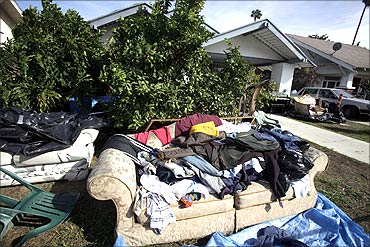
Image: A pile of clothes and a sofa sit outside a foreclosed home in Los Angeles.
Photographs: Lucy Nicholson/Reuters.
Paul Kennedy had cautioned more than two decades back in The Rise and Fall of the Great Powers, that, at some stage, great powers suffer from "imperial overstretch".
Referring specifically to the US, he noted "the awkward and enduring fact that the sum total of the United States' global interest and obligations is nowadays far larger than the country's power to defend all simultaneously it simply has not been given to any one society to remain permanently ahead of all the others".
Britain experienced this in the twentieth century, and one wonders whether the US, too, is gradually relinquishing its traditional role. One sign of this is the loss of dollar's status as a safe haven currency.
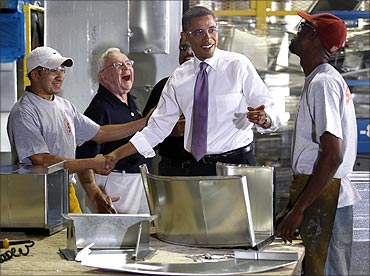
Image: US President Barack Obama shares a laugh with workers during a tour of Stromberg Metal Works.
Photographs: Jim Young/Reuters.
Another came last week when the US ceded leadership of the Libyan operation to The North Atlantic Treaty Organisation, more specifically, France and Germany, and eschewed an invasion of the country.
In a recent speech, US President Barack Obama reminded the audience that the US had gone "down that road in Iraq", where "regime change took eight years, thousands of American and Iraqi lives, and nearly a trillion dollars.
That is not something we can afford to repeat in Libya". Clearly, he is a far more sober and mature president than his juvenile predecessor.
Image: A boy sells air fresheners on a street in Baghdad.
Photographs: Saad Shalash/Reuters.
However, he should have referred to the untold miseries inflicted on millions of Iraqis as a result of the invasion in 2003 on spurious grounds, in pursuit of the "neocon" agenda.
A couple of years before the turn of the century, the so-called neo-conservatives in the US (a group of right-wing conservative Republican intellectuals, who later dominated the Bush Jr Administration and were the architects of the Iraq invasion) promoted what they described as The Project for the New American Century.
The first manifestation of the New American Century was the regime change in Iraq by invading the country.
Afghanistan and Iraq have since exposed the limitations of American military and economic power, and the surprising incompetence manifested in the post-war occupation.
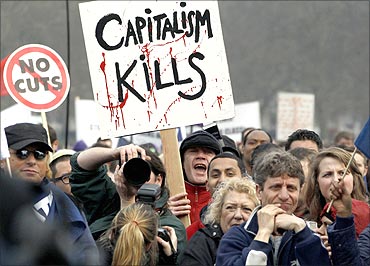
Image: Demonstrators attend a rally in Hyde Park, during a protest organised by the Trades Union Congress.
Photographs: Kevin Coombs/Reuters.
Nor is the record of the Anglo-Saxon model of laissez-faire states and finance capitalism, as practised over the last three decades, any better: stagnancy of real wages, increasing income inequalities, intractable twin deficits, fiscal and current account, and a huge and fast-growing public debt, even before factoring in the present value of future social-security obligations.
President Obama has merely recognised the limitations in giving up the leadership of the Libyan operation.
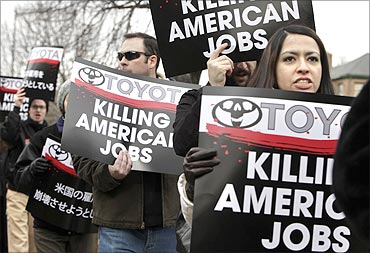
Image: United Auto Workers (UAW) activists protest against Toyota outside the Japanese Embassy.
Photographs: Yuri Gripas/Reuters.
"An era can be said to end when its basic illusions are exhausted," wrote playwright Arthur Miller.
Has such a moment arrived? Dani Rodrik of Harvard University argued some time back, "The US, the world's sole economic hyper-power until recently, remains a diminished giant. It stands humbled by its foreign-policy blunders and a massive financial crisis. Its credibility after the disastrous invasion of Iraq is at an all-time low, notwithstanding the global sympathy for President Barack Obama, and its economic model is in tatters. The once-almighty dollar totters at the mercy of China and the oil-rich states."
Image: A pair of housing units are shown for sale in San Francisco.
Photographs: Robert Galbraith/Reuters.
Recent economic data from the US support this possibility.
The prospects for global inflation have obviously not improved by the continued volatile situation in West Asia and North Africa and its implications for oil prices. (To be sure, some of the western countries and Japan would, in a way, be relieved if inflation reignites as it would be a less painful way of reducing the ratio of public debt-to-nominal GDP than increasing taxes or cutting expenditure.)
Image: A woman shops for groceries at a Whole Foods supermarket in New York.
Photographs: Shannon Stapleton/Reuters.
Global economic recovery is still fragile and, though growth in the US is much stronger, it is still very much a jobless recovery.
Stagflation may well be on the cards. One sign of the times is that PIMCO, the world's largest bond fund, has reduced its exposure to US treasuries to zero - it obviously expects yields to go up.
The US monetary policy makers focus on "core inflation" (exclusive of fuel and food prices).
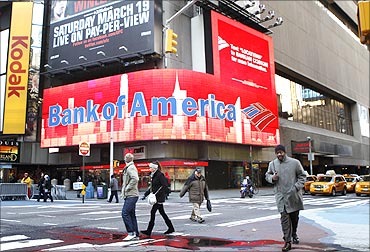
Image: Pedestrians walk past a Bank of America sign on a building in Times Square in New York.
Photographs: Lucas Jackson/Reuters.
Global economic recovery is still fragile and, though growth in the US is much stronger, it is still very much a jobless recovery.
Stagflation may well be on the cards. One sign of the times is that PIMCO, the world's largest bond fund, has reduced its exposure to US treasuries to zero - it obviously expects yields to go up.
The US monetary policy makers focus on "core inflation" (exclusive of fuel and food prices).
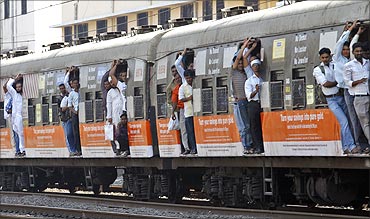
Image: Commuters stand at the open doorways of a suburban train during the morning rush hour in Mumbai.
Photographs: Reuters.
The ostensible reason is that these are too volatile. I wonder whether the real reason for the exclusion is that monetary policy can do little to control them, and discretion is obviously the better part of valour.
Tailpiece: Dani Rodrik, when questioned about India, said recently that it is "a thriving economy.
It has a huge potential. I hope it doesn't make the mistakes that other emerging market economies have made - in particular by giving in to the Siren Song of financial globalisation." (The Economic Times, March 25.) I have often argued in this column that we seem to be doing exactly this in terms of capital flows and the exchange rate.
Source:





 © 2025 Rediff.com - Investor Information - Advertise with us - Disclaimer - Privacy Policy - Feedback - About us - Terms of use - Grievances