This article was first published 14 years ago
Home »
Business » What is the KEY to India's economic success?
What is the KEY to India's economic success?
Last updated on: August 22, 2011 11:50 IST
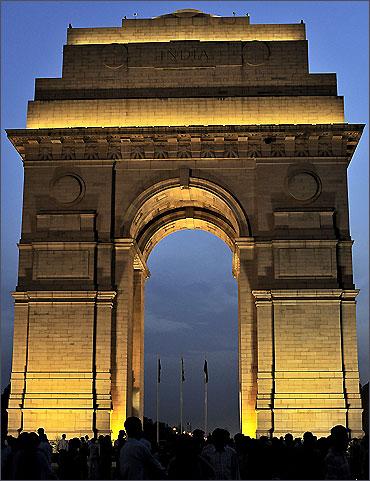
Image: India Gate.
India, that is Bharat, is a Union of states.
It goes without saying that in an essentially market-based economy like India's, where the share of the state sector has been declining, where the fiscal capability of the Centre has been circumscribed and its political authority has waned, the growth rate of the economy is increasingly a sum of its parts.
This is a sobering thought on the eve of the launch of India's 12th Five-Year Plan (2012-17).
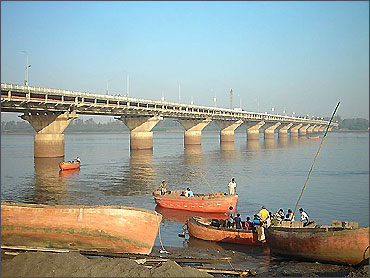
Image: Magdalla Bridge over Tapi River, part of NH6.
Even in 1950, the introduction to the first Five-Year Plan (launched by Jawaharlal Nehru with the introductory chapter written by the late Professor K N Raj) ended with the observation:
"The fulfillment of the Five Year Plan calls for nation-wide co-operation in the tasks of development between the Central Government and the States, the States and the local authorities, with voluntary social service agencies engaged in constructive work, between the administration and the people as well as among the people themselves."
But then, between 1950 and today India has traversed the curve with the Centre's ability to implement a national plan first having waxed and then waned.
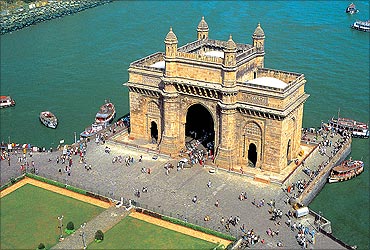
Image: Gateway of India.
If in the period since 1980 states like Andhra Pradesh and Karnataka have caught up, Maharashtra has slipped and Bihar is now picking up, all this reflects the changing competencies, capabilities and interventions at the state level.
In celebrating the 20th anniversary of the economic reforms of 1991, much of the commentary has been on what the central government did in 1991-92.
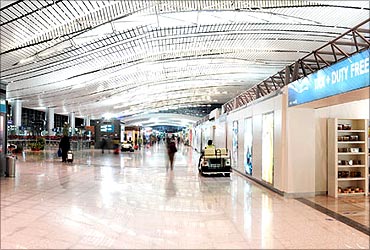
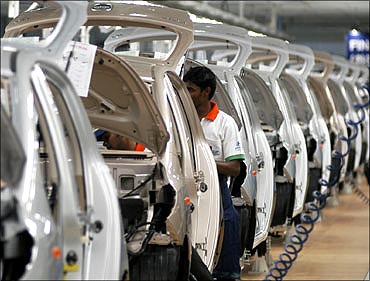
Image: Hyderabad International Airport.
There has been very little recognition of how states responded to the Centre's initiative.
The fact is that the central government made itself less intrusive in the economy and ended a regime of controls that inhibited market forces and the "animal spirits" of domestic enterprise and kept the Indian economy locked up, preventing external impulses of trade and investment from impacting the economy.
Image: Reuters.
When those fetters were removed, each Indian state responded to the new opportunity based on its own capabilities.
If the pre-1991 policy regime was in fact inhibiting some regions from growing and favouring others, one would have expected to see a new regional pattern of growth. To an extent one did.
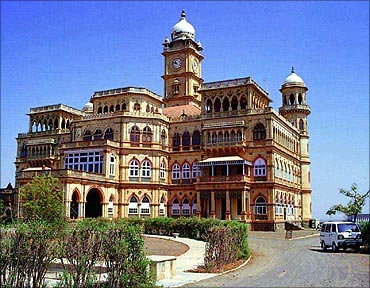
Image: A heritage hotel in Gujarat.
The acceleration of growth in states like Andhra Pradesh, Karnataka and Gujarat would suggest that 1991 had liberated the bottled up "animal spirits" of local enterprise.
This is a view I took in a 1995 paper on the emergence of regional enterprise and regional political parties/leadership.
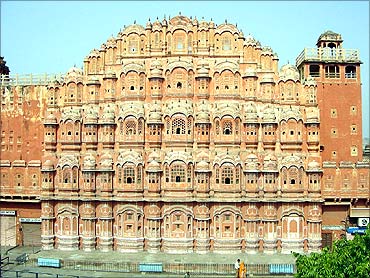
Image: Hawa Mahal, Jaipur.
In an important intervention in the debate on regional economic performance, Montek Singh Ahluwalia published a paper that effectively made the point that post-1991 liberalisation had not increased the distance between regions.
Rather, there was greater convergence in the growth process. This result now appears stronger with the improved performance of Bihar and Rajasthan in the past decade.
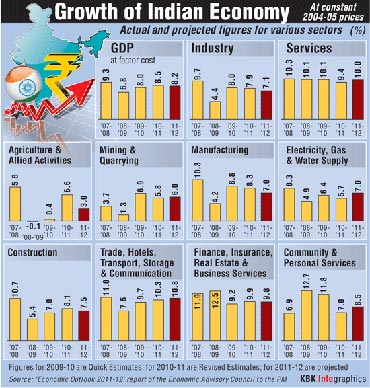
Image: Growth of the economy.
What has shaped this regional performance is, however, regional political leadership and interventions at the state level in education, agriculture and infrastructure.
In the 1950s central planning sought to create a national framework for growth and development that initially delivered impressive results (India's growth in the 1950s was superior to that of China and much of Asia).
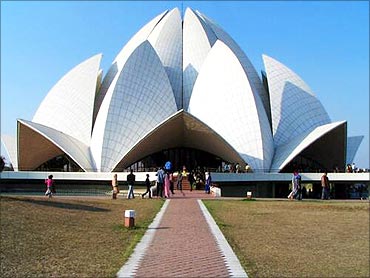
Image: Lotus Temple, New Delhi.
The 1960s and 1970s were the lost decades when India slowed down and east and south-east Asia marched forward.
After 1980 the Indian economy regained speed, initially in a manner that was not fiscally sustainable and subsequently on surer footing.
The importance of 1991 was that it removed the shackles on growth and created new institutions (especially in the financial sector) that facilitated more efficient growth.
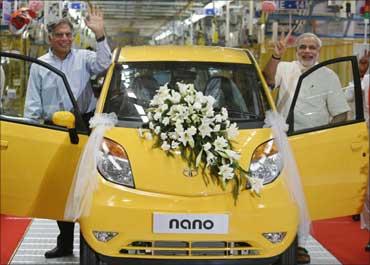
Image: Narendra Modi with Ratan Tata.
In the past two decades the Indian growth process has been shaped less by central planning and more by state-level initiatives.
What this means for the 12th Five-Year Plan is that its aim of registering nine per cent growth would depend less on what the Centre does and more on what Nitish Kumar does in Bihar, Mayawati does in Uttar Pradesh, Jayalalithaa does in Tamil Nadu, Mamata Banerjee does in West Bengal and so on.
Narendra Modi has already shown the way forward in Gujarat.
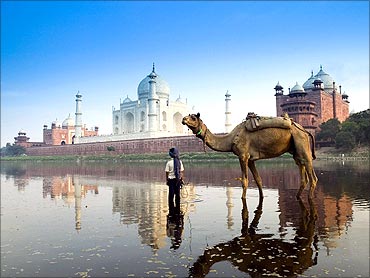
Image: Agra.
The ability of state governments to improve agricultural productivity and rural infrastructure, literacy and enrolment rates, power supply and urban infrastructure will shape the outcome of the next Plan more than any other in the past.
Some states will perform better than others.
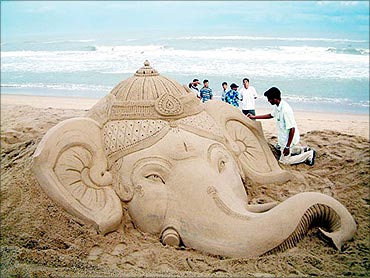
Image: A sand sculpture of Lord Ganesha at Puri beach, Orissa.
What can the Centre do on its part? Quite a bit. The most important policy intervention that must come from the Centre in the 12th Plan period is to ensure that the global economic slowdown does not limit India's growth prospects too much. It already has.
Second, the Centre's finances need to be improved. Third, there is a need to integrate the Indian market, through reduced inter-state economic barriers to trade and the introduction of a nationwide goods and services tax.
Fourth, there is a need for greater national investment in infrastructure like railways, highways and waterways, and power.
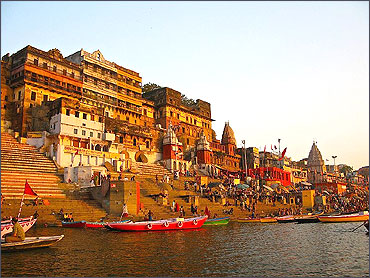
Image: A view of Varanasi by the Ganges.
Finally, get out of the states' way. Let the state governments experiment - be it with land acquisition or labour market policies.
The recent trend of centralising policy initiatives and creating central legislation on state subjects must be reversed.
Some states will move faster and show others the way forward. Nine per cent growth will come out of that race, and the wash!
Source:


 © 2025 Rediff.com - Investor Information - Advertise with us - Disclaimer - Privacy Policy - Feedback - About us - Terms of use - Grievances