
TRAI Chairman Anil Kumar Lahoti has called for robust safeguards, human oversight, and intervention capabilities as Artificial Intelligence becomes increasingly integrated into telecom networks. While acknowledging AI's potential to transform network management and threat detection, Lahoti stressed the need for responsible AI deployment, risk assessments, and clear accountability to ensure consumer trust and prevent misuse, especially in combating online fraud.

Telecom industry body COAI and the British High Commission signed an MoU to boost cooperation in AI, connectivity, and digital trust, fostering responsible tech innovation. The pact, signed at the CO.AI 2026 event, focused on AI's role in intelligent networks, security, and public services. Discussions highlighted AI's importance in combating fraud, improving network efficiency, and ensuring secure digital services. TRAI Chairman Anil Kumar Lahoti and Acting British High Commissioner Ben Mellor emphasised the need for balanced governance and international collaboration to ensure secure, inclusive, and responsible digital transformation.

The Telecom Regulatory Authority of India (Trai) has mandated that service providers offer voice-and-SMS-only tariff plans, without bundled data, with a minimum validity of 30 days or less, aiming to provide more affordable and shorter-duration options for consumers who do not require data.

India's government has implemented stringent new regulations under the Telecommunications Act 2023, mandating that all communication infrastructure providers, including those utilising cloud-based networks, must store telecommunication data exclusively within the country, a move expected to significantly impact domestic data centre demand.

India has achieved its highest-ever annual Foreign Direct Investment (FDI) inflow of USD 94.53 billion in FY 2025-26, with cumulative FDI reaching USD 843 billion since 2014-15, announced Commerce and Industry Minister Piyush Goyal. Production Linked Incentive (PLI) schemes have also significantly boosted investment, production, exports, and job creation.

The portfolio could be split between listed and unlisted investments, or structured along sectoral lines.

Bharti Airtel's homegrown cloud platform, Airtel Cloud, has acquired approximately 40 customers within a year of its launch, with a significant portion coming from the manufacturing sector. The platform, designed for Indian companies, offers sovereign, telco-grade cloud infrastructure, connectivity, and GenAI-based provisioning, addressing the growing demand for secure, India-hosted data solutions, particularly for sensitive workloads and regulated sectors.
The Department of Telecommunications (DoT) has introduced a new authorisation regime, replacing multiple licences with a single permission for principal telecom services, aiming to simplify compliance and accommodate evolving technologies. This move is expected to ease business operations, enhance fraud prevention with AI, and expand connectivity, especially through satellite networks.

India is making a significant push to establish itself as a global semiconductor manufacturing hub, driven by strategic investments and policy support. The upcoming SEMICON India 2026 event will showcase the country's advancements and ambitions in this critical industry, which underpins virtually all modern electronic devices and has faced global supply chain vulnerabilities.

The telecom industry has condoled the death of former Communication and IT Minister and BJP leader Pramod Mahajan, while describing him as one of the dynamic and charismatic leaders.

The Indian government has introduced a 0.4% transaction fee on Unified Payments Interface (UPI) payments exceeding Rs 2,000 for merchants, effective October 15, marking the end of nearly six years of free service. Person-to-person transfers and small-value transactions below Rs 2,000 remain free. The new Merchant Discount Rate (MDR) is capped at Rs 300 for transactions above Rs 75,000, with differentiated rates for essential sectors and investments, and safeguards to prevent costs from being passed to consumers.

The Indian government has introduced a 0.4 per cent Merchant Discount Rate (MDR) on UPI payments exceeding Rs 2,000 made to merchants, effective from October 15, with a comprehensive framework set to take full effect by October 15, 2026. This policy aims to regulate transaction fees while protecting small merchants and person-to-person transactions.

The National Payments Corporation of India (NPCI) stated that the Merchant Discount Rate (MDR) "is distributed only amongst the UPI ecosystem, to further invest into infrastructure resilience, innovation, cybersecurity (protecting the UPI infrastructure with banks and non-banks) and customer service."

The government is introducing a 0.4% Merchant Discount Rate (MDR) on UPI person-to-merchant payments above Rs 2,000, effective October 15. This move ends the zero-MDR regime, aiming to fund UPI infrastructure and sustainability, as the previous government subsidy was insufficient to cover operational costs. Payments between individuals and most everyday merchant transactions will remain free.

Reliance Jio's reintroduction of Jio Prime membership with a price lock until September 2027 and the retention of its entry-level daily unlimited data plan at ~299 rupees are seen by industry analysts as strong indicators of imminent tariff hikes across the Indian telecom sector.

'UPI has been free since Covid, so why is the government charging us now?'

The Indian government has introduced a 0.4% Merchant Discount Rate (MDR) on UPI person-to-merchant (P2M) transactions exceeding Rs 2,000, effective October 15. This move ends nearly six years of fully free UPI payments, though person-to-person (P2P) transfers and small P2M payments remain free. The charges aim to bolster investment in UPI infrastructure, with specific exemptions and caps for essential sectors.

'The large number of tariff lines in the 90-99 per cent band highlights how deeply embedded Chinese sourcing has become in India's electronics imports.'

Tata Consultancy Services (TCS) has announced a global partnership with AI major Anthropic to help enterprises accelerate their adoption of artificial intelligence, including equipping 50,000 TCS employees with Anthropic's Claude AI models.

Digital money is gradually starting to behave like software. It's no longer inert -- sitting passively in accounts. In the not-so-distant future, your money could become 'smart' and 'active,' understanding your preferences, paying your bills automatically, optimising your returns, and managing your risks -- all without you having to manage the details.
BRICS leaders, in their New Delhi Declaration 2026, have called for wider access to Artificial Intelligence resources and stronger international cooperation to ensure the technology is safe, secure, inclusive, and reliable. The declaration outlines a broad technology agenda covering AI, cybersecurity, digital public infrastructure, telecom, quantum technologies, and advanced manufacturing, committing to implement the grouping's statement on 'Global Governance of Artificial Intelligence'.

Telecom services providers have urged the Ministry of Finance to suspend the universal service obligation (USOF) till the existing corpus is exhausted. In their Budget recommendations, they have also pressed for an exemption from the service tax on "assignment of right to use natural resources" and the slashing of Customs duty on telecom equipment to zero. The Cellular Operators Association of India (Coai), which represents private sector telecom operators Reliance Jio, Bharti Airtel, and Vodafone Idea, called for abolishment of USOF levy.

Flash floods in Tibet's Gyirong County, near the China-Nepal border, have resulted in five deaths and 558 missing individuals, including 260 foreign nationals. The disaster also caused significant casualties in Nepal and disrupted infrastructure. Rescue operations are underway, and concerns are rising over a newly formed barrier lake that poses a risk of further flooding.

Devastating flash floods near the Tibet-Nepal border have led to the evacuation of over 1,000 people, including tourists, from Gyirong County. The floods caused casualties in both Tibet and Nepal, disrupted infrastructure, and prompted a Level-IV alert due to a rapidly forming barrier lake with a high risk of breaching and causing further downstream flooding.

Reliance Industries shares rose over 1 per cent after the company reported record quarterly core profit and EBITDA for the June quarter, driven by strong performances in its oil-to-chemicals and telecom businesses.

'Wages have not risen. Rural wages have stagnated. The growth was 0.7 per cent last year. For casual and irregular labour, the wage growth is negative.'

The search for N Chandrasekaran's successor as Tata Sons Chairman has reportedly narrowed to Tata Steel CEO T V Narendran, Tata Sons Executive Director Saurabh Agrawal, and NSE MD & CEO Ashish Chauhan, with Chauhan emerging as a potential 'dark horse' candidate.

Vodafone Idea (Vi) significantly reduced its losses in Q1 FY27 to approximately 3,754 crore, driven by an exceptional gain and increased average revenue per user (Arpu). The company also reported its first net subscriber additions since its 2018 merger, indicating a positive shift in its operational trajectory.

TIA said it is very concerned over the discriminatory policy proposals that India is contemplating.

The telecom industry has come out in support of new Communication and IT Minister Kapil Sibal for his observation that the sector should not be viewed as source of revenue for the Finance Ministry.

Telegram CEO Pavel Durov has accused Reliance Group, which has a partial Meta stake, of lobbying for a ban on Telegram in India and sabotaging its access for users outside India through BGP hijacking. A senior telecom industry source dismissed these claims as 'fake news,' stating Durov confused Reliance Communications with Reliance Industries Ltd. The allegations come as the Indian government has ordered Google and Apple to delist Telegram temporarily and disable its message-editing feature in India due to concerns over paper leaks in the NEET-UG examination.

In the next 36 months nearly 25 to 40 per cent of jobs will be under threat from AI and job losses are inevitable.

Chandra's tenure also saw a big jump in Tata Sons' other income, such as brand fee from group companies, treasury gains, and other non-recurring income.

Reliance Industries (RIL) delivered a better-than-expected operational performance in Q1FY27, driven by a recovery in its oil-to-chemicals (O2C) business and robust gains in the telecom (Jio) segment, though its retail arm missed estimates. Analysts highlight the upcoming Jio Platforms IPO and execution in new energy and consumer businesses as key triggers for the stock's future growth.

'... that work is done. The task is to reallocate what has been built, with the courage of a founder and the discipline of an owner.'

Instant messaging platform Telegram has been restored in India after a week-long government ban, imposed due to its alleged role in circulating leaked NEET examination papers, expired. The Delhi High Court had upheld the ban as lawful and necessary.
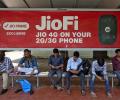
In the latest move, the telco has reduced validity for its Rs 309/509 packages from 84 days to 56

Bharti Airtel, India's second-largest telecom operator, reported a 37.3 per cent rise in consolidated net profit to 8,167 crore for Q1 FY27, driven by the addition of high-paying premium customers, despite missing Bloomberg consensus estimates.

Bharti Airtel's first-quarter (April-June/Q1) performance for 2026-27 (FY27) surpassed estimates across most metrics, fuelled by robust growth in both its India and Africa operations, with significant increases in average revenue per user (Arpu) and subscriber additions.
