
Bajaj Finance was the top gainer in the Sensex pack, surging around 5 per cent, followed by Bajaj Finserv, HDFC, Tech Mahindra, HDFC Bank, UltraTech Cement and Tata Steel. On the other hand, HUL, Nestle India, ICICI Bank, Axis Bank, SBI, TCS and ITC were among the laggards.

There is widening gap between what the government's premier retirement fund makes on its investments and what it offers to employees. The Employees' Provident Fund Organisation (EPFO) makes the bulk of its investments in government-related securities. In other words, it lends to central and state governments and related entities. The interest it gets from these instruments is largely what it uses to pay interest to its subscribers.
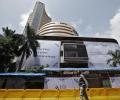
BSE Midcap and BSE Smallcap indices hit their fresh lifetime highs for the second day in a row

Companies spent less money buying back their shares from the public last year than at any time since 2015. They announced buybacks of up to Rs 14,341 crore, show numbers from primary market tracker Prime Database. The total amount spent was Rs 13,597 crore. Both the amounts are lower than what was offered (Rs 39,564 crore) and spent (Rs 36,517 crore) in 2020.

The market breadth, indicating the overall health of the market was strong
On BSE, 1,469 shares fell and 1,200 shares rose. A total of 190 shares were unchanged.

His portfolio was worth Rs 12,333 crore at the end of June 2018. It was worth Rs 10,633 crore at the end of the September quarter. Smallcaps account for the largest number of his stock-picks. Such a fall has now happened for the third quarter in a row.

The S&P BSE Midcap and S&P BSE Smallcap indices hit a new lifetime high
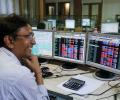
Aptech, Lumax Industries, Vedanta, Indian Bank, Venky's India have appreciated over 200% in a year

The Dow has never lost more than 800 points in a day.
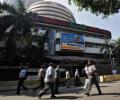
Broader market outperformed the frontline indices with the Smallcap and Midcap gaining up to 1%

The value of unclaimed securities and other assets was nearly Rs 20,000 crore in March 2020.

Post partnership with S&P, the exchange is looking at launching a slew of international products, too.

Sahai, who did his master's in economics from the University of Delhi, is currently head of Citi's Securities and Fund Services business.

East European countries have better rating than India though their economies are not as stable as the latter.

'Favourable product mix, sales recovery, and cost saving initiatives are expected to support margins going ahead while focus on debt reduction (target of debt free by FY24) will aid balance sheet strength'
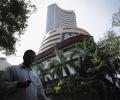
Broader gains were capped as investors awaited corporate results from major firms

The 30-share BSE Sensex surged by 477.24 points or 0.83 per cent to close at more than one-week high of 57,897.48. As many as 28 of its constituents closed with gains while two declined. The broad-based Nifty of the National Stock Exchange rose by 147.20 points or 0.86 per cent to settle 17,233.45, tracking gains in Sun Pharma, Asian Paints, and Reliance Industries.
India deserves a rating upgrade in view of improvement in macro-economic situation, the conservative outlook of Standard & Poor's notwithstanding, Finance Minister P Chidambaram said.
S&P in November ruled out an upgrade in the country's rating for some considerable period, citing India's low per capita GDP and relatively high fiscal deficit.

How did marquee Dalal Street investors fare in the Jan-Mar quarter that saw the BSE Sensex tank 10 per cent?

IndusInd Bank was down nearly 1% even after it reported a 21% rise in its fourth-quarter profit

It believes that there had been "little progress" in structural reforms.

India's sovereign credit ratings do not reflect the economy's fundamentals, the Economic Survey said on Friday and nudged the global agencies to become more transparent and less subjective in their ratings. The Economic Survey 2020-21, tabled in Parliament, said that sovereign credit ratings methodology must be amended to reflect economies' ability and willingness to pay their debt obligations, and suggested that developing economies must come together to address this bias and subjectivity inherent in sovereign credit ratings methodology. "Never in the history of sovereign credit ratings has the fifth largest economy in the world been rated as the lowest rung of the investment-grade (BBB-/Baa3). While sovereign credit ratings do not reflect the Indian economy's fundamentals, noisy, opaque and biased credit ratings damage FPI flows," the survey said.

S&P warned about spending on subsidies and heavy government debt.

There is immense pressure on Biyani to go ahead with the RIL offer after FRL defaulted on its interest payments of Rs 100 crore on July 22.

IPO-bound mobility platform Ola, said it has successfully raised $500 million via a Term Loan B (TLB) from marquee international institutional investors. This term loan has no impact on the valuation of Bhavish Aggarwal-led Ola. The Bengaluru-based firm recently raised $139 million. This is part of a $1 billion funding round for which the company is in talks with investors, increasing its valuation to about $7.5 billion, according to the sources.
For stock market investors, things have turned worse.

Market breadth depicted strength. There were almost 3 gainers against every loser on BSE
The market for Shariah funds is set to grow with Benchmark Mutual Fund launching the first-ever Shariah Benchmark Exchange-traded scheme in India. It's an open-ended listed index scheme.

Nifty could fall to 9,500 levels; not a good time to bottom fish, say experts

S&P also cut China?s GDP growth forecast to 7.5%t and that of rest of Asia.

Analysts caution against volatility and recommend buying stocks of companies that are on strong fundamental footing that have been beaten down badly in the recent carnage.

L&T was the top gainer in the Sensex pack, rising over 3 per cent, followed by Bajaj Finance, Reliance Industries, IndusInd Bank, SBI and HDFC Bank. NSE Nifty surged 168.05 points to 14,653.05.
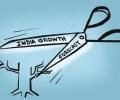
Global forecasting firm Oxford Economics on Monday revised downwards its India GDP growth forecast for 2021 to 10.2 per cent from 11.8 per cent previously, citing the country's escalating health burden, faltering vaccination rate and lack of a convincing government strategy to contain the pandemic. Oxford Economics also said that notwithstanding the likelihood of further mobility restrictions, it expects India's targeted lockdown approach, less stringent restrictions, and resilient consumer and business behaviour to mitigate the economic impact of the second wave.

In the Sensex pack, HDFC, ONGC, Bharti Airtel, Titan, Asian Paints, Mahindra and Mahindra and TCS were the prominent gainers. On the other hand, ICICI Bank, IndusInd Bank, NTPC, UltraTech Cement, Tech Mahindra and SBI were among the major laggards. On the other hand, HCL Tech, Tech Mahindra, HUL, Bharti Airtel and ICICI Bank were trading in the red.

Sensex's 3 per cent average performance over the last 5 years can be considered as sleeping.

The Indian markets are poised on a knife's edge testing the pivotal level of 5950, this time from the topside. Should the level hold, expect further rally to the topside, says Sonali Ranade
These choices are going to be made available to Indian fund houses by S&P's index services division through India Index Services. ETF is a passive fund wherein investments are made in index companies as per their individual weightage. In times of uncertainty, betting on indices rather than individual companies helps. Index-based products thus become popular.
