
Mahindra & Mahindra (M&M) Ltd reported a significant 34 per cent year-on-year increase in Profit After Tax (PAT) to Rs 5,455 crore for the June quarter, driven by strong performance in its Auto and Farm segments despite challenging macro-economic conditions.

Mahindra & Mahindra's Q1FY27 results missed consensus estimates due to declining gross margins, but strong demand for its SUV portfolio and strategic price hikes are expected to drive near-term gains, particularly in the auto segment, despite headwinds in farm equipment.

Upcoming Mahindra Scorpio Lifestyler 2027: Expected Price & Features!

When we took the aaram se test, we found that it did offer huge head and leg room and a wee bit more space than what the prevailing autorickshaws offer.

Mahindra & Mahindra Ltd reported a significant 48.5 per cent jump in consolidated profit after tax to Rs 5,259.91 crore in the March quarter, primarily attributed to strong performance in its auto and farm sectors, alongside ambitious plans for new SUV and EV launches.

Indian benchmark indices, Sensex and Nifty, closed lower on Wednesday, reversing early gains due to profit-taking and weakness in sectors like IT, FMCG, and consumer durables, despite support from lower crude oil prices.

koda Auto Volkswagen India is actively exploring various approaches to penetrate India's burgeoning electric vehicle (EV) market, including importing global models, local assembly, and developing highly localised products, as EV penetration is expected to reach 17-18% by the end of the decade.

Indian benchmark indices, Sensex and Nifty, experienced a significant downturn, with Sensex tanking 778 points and Nifty closing at a five-month low, driven by surging crude oil prices, geopolitical tensions, and fears of further interest rate hikes by major central banks.

Leading automakers in India, including Maruti Suzuki, Tata Motors, Mahindra & Mahindra, and Hyundai, reported increased vehicle dispatches to dealers in February, driven by sustained domestic demand.
Leading automakers in India, including Maruti Suzuki, Tata Motors, Mahindra & Mahindra, and Hyundai, reported increased vehicle dispatches to dealers in February, driven by sustained domestic demand.

Indian equity benchmarks Sensex and Nifty surged nearly 1 per cent, driven by strong earnings reports from FMCG and auto sectors, alongside a rally in Asian markets and signs of de-escalation in geopolitical tensions.

Indian passenger vehicle manufacturers are significantly increasing production and stocking dealerships in anticipation of strong festival season demand, with new launches planned and supply bottlenecks being addressed. However, the industry faces potential moderation in growth during the second half of FY27 due to a high base from last year's post-GST surge, commodity inflation, and elevated inventory levels.

Indian benchmark equity indices closed higher on Thursday, with the Sensex gaining 273.55 points to 77,928.15 and the Nifty rising 66.95 points to 24,317.15, driven by bargain hunting and short-covering in IT and auto sectors.

In the next 36 months nearly 25 to 40 per cent of jobs will be under threat from AI and job losses are inevitable.
Indian benchmark indices, Sensex and Nifty, rebounded in early trade after two days of decline, driven by positive global market trends and strong buying in auto stocks. This recovery follows a robust performance in US markets and a rally in Asian markets, particularly Japan's Nikkei, fueled by AI-driven technology optimism. Track Sensex, Nifty on July 1.

India Inc's first-quarter earnings season was significantly impacted by the West Asia conflict, leading to rising costs, calibrated price increases, and margin pressures across various sectors including FMCG, automotive, steel, and cement. Companies are implementing price hikes to protect profitability, with many anticipating further escalations if input costs remain elevated.

The market capitalisation of these 41 companies ranged from Rs 30 crore to around Rs 1.26 trillion, as on August 7.

The Nifty and Sensex outperformed Asian peers in South Korea, Japan, Taiwan and China.
The Reserve Bank of India (RBI) maintained its key policy rates for the fourth consecutive time, keeping the repo rate at 5.25 per cent, while the benchmark BSE Sensex closed 152 points higher in a volatile session, recovering from an intraday dip.

Indian stock markets this week will be primarily influenced by a series of corporate Q1 earnings, the evolving geopolitical situation in West Asia, and fluctuations in crude oil prices, according to market analysts.

Indian benchmark indices Sensex and Nifty rallied in early trade, driven by a significant decline in crude oil prices and positive developments on the geopolitical front, alongside strong performance in blue-chip IT stocks. Track Sensex, Nifty on July 2, 2026

Indian benchmark stock indices Sensex and Nifty rallied for the second consecutive day, closing nearly 1 per cent higher, driven by gains in metal and auto sectors and positive global market trends.

Indian benchmark stock indices, Sensex and Nifty, advanced for the second consecutive day, driven by softening crude oil prices and a positive trend in global markets. Despite some profit-taking in IT and metal shares, auto stocks outperformed, contributing to the overall gains.
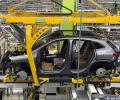
Automobile manufacturers are increasingly vocal about the mounting paperwork and delays associated with India's Production-Linked Incentive (PLI) scheme for the automotive sector, arguing that compliance requirements are becoming as challenging as meeting technical eligibility conditions. They are pushing for a simpler, faster, and more predictable certification and compliance framework.

Indian benchmark stock indices, Sensex and Nifty, recorded their fourth consecutive day of declines, driven by selling in FMCG, financial, and auto sectors. The downturn is attributed to fresh tensions in the Middle East, uncertainty surrounding the US-Iran 60-day ceasefire, and elevated crude oil prices.

The India-EU free trade deal could help Indian-made cars enter Europe at lower costs and challenge Chinese dominance.

Electric passenger vehicle retail sales in India surged by 81.2 per cent to 26,682 units in May, with Tata Motors leading the segment, while electric two-wheeler sales also saw a substantial 62.76 per cent increase, according to the Federation of Automobile Dealers Associations (FADA).

Mahindra & Mahindra on Tuesday posted a 28 per cent year-on-year increase in its consolidated profit after tax to Rs 3,673 crore for the second quarter ended September 30, 2025, driven by robust performance of the farm sector, while also seeing the impact of the GST transition on the auto sector. The company reported a profit after tax (PAT) of Rs 2,867 crore for the July-September period of the last fiscal.

Three additional vehicle makers and five more auto component makers will begin availing financial incentives under the production-linked incentive (PLI) scheme for the automobile sector from 2026-27 (FY27) onwards, Hanif Qureshi, additional secretary at the Ministry of Heavy Industries (MHI), said on Wednesday.

Non-banking financial companies (NBFCs) reported encouraging results for Q4FY26 with improved asset quality and earnings, but analysts maintain a cautious near-term outlook due to geopolitical tensions, monsoon risks, and specific portfolio concerns.

Accenture's revised annual revenue growth forecast and weaker-than-expected fourth-quarter guidance have sent shockwaves through the Indian IT sector, causing major IT stocks and the Nifty IT index to tumble significantly.

Sensex gains over 400 points while Nifty trades above 23,800 amid strong IT sector buying.

Among the Sensex constituents, Eternal, Tata Steel, Kotak Mahindra Bank, UltraTech Cement, Maruti Suzuki India, Sun Pharmaceuticals, Tech Mahindra, HDFC Bank, Tata Motors Passenger Vehicles, Infosys, Trent, Mahindra & Mahindra, Reliance Industries and HCL Technologies were the gainers. However, Asian Paints, Bharti Airtel, Bajaj Finance, PowerGrid, Axis Bank, ICICI Bank and Titan were among the laggards.

Indian carmakers, including Maruti Suzuki and Kia India, reported robust sales growth in May 2026, with both companies achieving their highest-ever monthly sales despite rising fuel prices. Maruti Suzuki's domestic sales surged to 1,93,535 units, while Kia India recorded 27,586 units, driven by strong demand in mini and compact segments and a shift towards electric and CNG vehicles.
Indian benchmark equity indices, Sensex and Nifty, rebounded on Wednesday, recovering intraday losses, primarily driven by strong fag-end buying and a significant rally in blue-chip Reliance Industries.

Fuel prices have risen by about Rs 7.5 per litre since May 15, as global crude oil prices surged due to the ongoing conflict in West Asia and supply concerns around the Strait of Hormuz.

After a record-breaking year, India's automobile industry is entering 2026 on a relatively strong footing, with sales growth expected in the 6-8 per cent range. The outlook is underpinned by policy support, including GST rationalisation, easing monetary conditions, and income tax relief, which together are likely to improve affordability and sustain consumer demand across vehicle segments.

Mahindra & Mahindra (M&M) is implementing a comprehensive, multi-layered strategy to fortify its supply chains against geopolitical volatility, logistical challenges, and regulatory risks, drawing lessons from recent global disruptions.

Mahindra & Mahindra (M&M) is stepping beyond vehicle manufacturing to build a national electric-mobility ecosystem.

Mahindra has officially taken the covers off the BE 6 Formula E Edition, and let's just say it's loud, it's orange, and it's absolutely unapologetic, reports Rajesh Karkera/Rediff.com
