
'Once you're wrestling with making a merger of that scale value-accretive, you're also under pressure to keep growing the balance sheet and chasing liabilities, and other things start to slip as a consequence.'

Canadian billionaire Prem Watsa's Fairfax Financial Holdings will utilise the expertise of Deepak Parekh and Paresh Sukthankar, former HDFC leaders, as it moves to acquire a 60.72 per cent stake in IDBI Bank for 52,878 crore, with N S Kannan proposed as chairman.
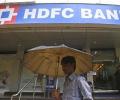
HDFC Bank has initiated an internal enquiry into the alleged leak of confidential information by two senior executives, with investigators examining whether the disclosed information was misused.
Indian benchmark indices Sensex and Nifty saw an early rebound, driven by strong performances from blue-chip HDFC Bank and major IT firms like HCL Tech, which reported a significant rise in net profit. Track Sensex, Nifty on October 13.

HDFC Bank has announced the appointment of Anup Bagchi as its new Managing Director and Chief Executive Officer for a three-year term, effective October 27, 2026. Bagchi, currently leading ICICI Prudential Life Insurance, will succeed Sashidhar Jagdishan, whose term concludes on October 26, 2026. The Reserve Bank of India has approved this significant leadership transition.
HDFC Bank reported a 5.55 per cent increase in consolidated net profit to Rs 20,700 crore for the September quarter, with incoming MD and CEO Anup Bagchi indicating a focus on strengthening the balance sheet and addressing retail vertical concerns post-merger.

India's leading private-sector banks, including HDFC Bank, Axis Bank, and Kotak Mahindra Bank, reported robust deposit growth in the July-September quarter (Q2FY27), significantly aided by the Reserve Bank of India's concessional FCNR(B) swap window.
Anup Bagchi, the incoming MD & CEO of HDFC Bank, is set to become India's highest-paid bank CEO with a proposed target annual compensation package of approximately 35.9 crore, including a significant variable pay component and a one-time joining bonus.

Potential external candidates include Anup Bagchi, Rajiv Sabharwal and CSB Bank's Pralay Mondal.

'The changes in its leadership team will help address the scepticism that has engulfed the bank over the recent period.'

Sashidhar Jagdishan, the managing director and CEO of HDFC Bank, has announced his decision not to seek reappointment and will retire at the end of his current term on October 26, concluding a six-year tenure marked by significant regulatory and governance challenges, including RBI restrictions, a major merger, and scrutiny over alleged illegal payments.

HDFC Bank has submitted two names to the Reserve Bank of India for the managing director and chief executive position, following incumbent Sashidhar Jagdishan's decision not to seek reappointment. The bank also announced board changes, increasing whole-time directors to four and appointing Jimmy Tata as an executive director. This move comes as Jagdishan's term ends in October, creating a tight timeline for succession.
'The sales pressure on the ground, a board and CEO not fully aligned, and a senior team that isn't pulling together -- that's when these things surface.'
Indian stock markets witnessed a significant rebound, with the Sensex rallying 1,109 points and the Nifty closing above 22,720, driven by strong performances in IT and financial sectors, a recovering rupee, and Finance Minister Nirmala Sitharaman's comments on long-term capital gains (LTCG) tax.
Shares of HDFC Bank rose nearly 3 per cent after its Managing Director and Chief Executive Sashidhar Jagdishan decided not to seek reappointment after his current term concludes on October 26.
Sashidhar Jagdishan, the managing director and chief executive of HDFC Bank, has opted out of being considered for reappointment after his current term ends on October 26, choosing to retire after nearly three decades with the lender.

Indian benchmark indices, Sensex and Nifty, experienced declines in early trading, primarily due to selling pressure on blue-chip HDFC Bank and ongoing geopolitical uncertainties.
Indian benchmark indices, Sensex and Nifty, experienced a sharp decline at the close of trade, with the Sensex dropping 539 points and the Nifty falling below 24,100, primarily due to selling pressure in HDFC Bank and ongoing geopolitical uncertainties.

Leading private banks in India, including HDFC Bank, ICICI Bank, and Axis Bank, experienced a decline in net interest margins (NIMs) during the second quarter of the financial year due to significant deposit mobilisation under the Foreign Currency Non-Resident (Bank), or FCNR (B), scheme. However, banks anticipate a recovery in margins in the coming quarters as these funds are deployed and the interest-rate cycle supports lending yields.

Indian benchmark equity indices, Sensex and Nifty, ended sharply lower, with the Sensex tumbling 876.37 points and the Nifty dropping below 22,900, primarily due to a decline in private bank stocks like HDFC Bank and Axis Bank, alongside weak global market trends.
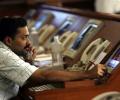
Indian benchmark indices, Sensex and Nifty, recovered early losses on Wednesday, driven by strong buying in IT stocks and HDFC Bank, sustaining the previous session's recovery despite FII outflows. Track Sensex, Nifty on October 14.

Jio Platforms' initial public offering has garnered an overwhelming institutional demand of approximately Rs 2.5 lakh crore, significantly exceeding its Rs 8,110-crore anchor book, with global and domestic investors vying for a stake in the Reliance Industries subsidiary.
Indian benchmark equity indices, Sensex and Nifty, significantly recovered from sharp early losses, driven by buying in State Bank of India and Reliance Industries, alongside fresh foreign fund inflows, despite declines in Axis Bank and HDFC Bank.
Indian equity benchmarks Sensex and Nifty experienced a decline in early trade, primarily due to a sell-off in power and metal stocks, mirroring a broader downturn across Asian markets. Elevated crude oil prices and firm US bond yields further dampened investor sentiment, while an expert warned of an impending correction in overvalued mid and small-cap segments. Track Sensex, Nifty on October 22.

Investors are set to monitor quarterly earnings, crude oil prices, the Jio Platforms initial public offering, and foreign investor activity in the upcoming holiday-shortened week, according to market analysts.

Over a dozen mutual fund houses in India have temporarily suspended fresh subscriptions in their gold fund of funds (FoFs) and gold-silver FoFs, a move believed to be influenced by directions from the Securities and Exchange Board of India (Sebi) ahead of the festive season.

Indian benchmark indices, Sensex and Nifty, extended their losses for a second consecutive day, primarily due to HDFC Bank's disappointing quarterly earnings and escalating tensions in West Asia, coupled with persistent foreign fund outflows.

Indian benchmark indices, Sensex and Nifty, saw a significant rebound in early trade, with the Sensex jumping 726 points and the Nifty climbing over 200 points, primarily driven by strong performances in IT stocks, HDFC Bank, and renewed foreign fund inflows. Track Sensex, Nifty on July 29.

Indian benchmark indices Sensex and Nifty saw a significant rebound in early trade, with the Sensex surging over 700 points, driven by a decline in crude oil prices, easing concerns over Federal Reserve tightening, and the appointment of Anup Bagchi as the new MD and CEO of HDFC Bank.
Shares of major private lenders, including HDFC Bank, Axis Bank, and Kotak Mahindra Bank, experienced a sharp selloff after their June-quarter results indicated persistent pressure on net interest margins (NIMs), despite healthy credit growth. This decline overshadowed gains in ICICI Bank and Punjab National Bank (PNB), which reported resilient or stronger-than-expected earnings.

HDFC Bank's board is actively discussing the appointment of its new managing director and chief executive officer (MD & CEO) as incumbent Sashidhar Jagdishan's three-year term concludes in October, with the Governance, Nomination and Remuneration Committee (GNRC) expected to finalise the process soon.

Indian benchmark indices Sensex and Nifty saw a rebound in early trade, primarily driven by a more than 4 per cent surge in Tata Consultancy Services (TCS) shares following its robust Q2 net profit announcement. Track Sensex, nifty on October 9.

The 200-DMA is a closely watched indicator of a stock's long-term trend and can serve as an early warning of trouble.
Indian benchmark indices Sensex and Nifty experienced a downturn in early trade, primarily influenced by a dip in HDFC Bank shares, persistent outflows from foreign funds, and escalating geopolitical tensions between the US and Iran. Track Sensex, Nifty performance.
HDFC Bank's board has imposed a monetary penalty of Rs 1 lakh each on its Managing Director and CEO Sashidhar Jagdishan, CFO Srinivasan Vaidyanathan, and Group Head (Retail Assets) Arvind Vohra for divergence from RBI directions in the Maharashtra State Road Development Corporation (MSRDC) case.
Indian equity benchmarks Sensex and Nifty extended their losses for a third consecutive session, with the Sensex declining 460.30 points and the Nifty dropping 123.70 points, primarily due to surging crude oil prices driven by escalating tensions in West Asia and weak global cues.
Indian benchmark stock indices, Sensex and Nifty, rallied significantly, with Sensex jumping over 1,500 points and Nifty reaching a nearly three-week high, driven by strong buying in banking, IT, and Reliance Industries stocks, alongside easing crude oil prices.
Indian benchmark indices Sensex and Nifty experienced a significant tumble in early trade, primarily driven by heavy selling in HDFC Bank following its quarterly earnings and a sharp spike in Brent crude oil prices due to escalating tensions between the US and Iran. Track Sensex, Nifty
Indian benchmark indices, Sensex and Nifty, closed lower due to significant selling in HDFC Bank and Axis Bank shares, driven by margin-related concerns and escalating US-Iran tensions, which also pushed crude oil prices higher.
The Indian rupee has achieved its longest winning streak in nearly eight years, appreciating for eight consecutive sessions to close at a six-week high. This rally is attributed to strategic central bank interventions, healthy foreign capital inflows linked to the Jio Platforms IPO, and profit-taking in the US dollar.
