
Even the Central Statistical Office has started using GDP as the main measure of economic activities since January 15 this year

Maintaining a balance between growth and fiscal discipline will be the Finance Minister's key challenge. Will he deliver?

Advance estimates of national income growth released today by the Central Statistical Organisation (CSO) project it at 7.2 per cent in 2009-10, pegging it a notch below earlier forecasts of the Reserve Bank of India (7.5 per cent) and finance ministry (7.75 per cent). With economic growth back on track the government may initiate a phased withdrawal of the fiscal stimulus package.

Among the 18 states and Union Territories of which data is available, Bihar recorded the highest State Gross Domestic Product (SGDP) in a year when the global financial meltdown pulled down country's economic growth rate to 6.7 per cent from 9 per cent.

The new IIP numbers should spread cheer among those who were part of the Manmohan Singh-led United Progressive Alliance, earlier accused of having presided over a steady deterioration in industrial performance, particularly in the last two years of its tenure, says A K Bhattacharya.

The size of the GDP in the second quarter of 2018-19 is estimated at Rs 33.98 lakh crore, as against Rs 31.72 lakh crore a year ago

The most serious recommendations to change the financial year came in the years preceded by deficient rainfall. The Jha committee was formed after droughts in 1979-80 and 1982-83, reports Rishika Pardikar/IndiaSpend.

According to the Central Statistical Organisation data, released earlier in the day, Index of Industrial Production grew by 16.7 per cent in January against just a per cent during the corresponding month in 2009.

Crisil Research expects retail inflation to rise 60 basis points to 4 per cent this fiscal from 3.4 per cent in 2018-19.

Gains in key IT, capital goods, healthcare and metal stocks, after consistent buying by domestic and foreign investors, helped both the key indices to scale new peaks.
Keeping pace with the rapidly changing income and consumption pattern, the government will soon come out with a new Index of Industrial Production (IIP) and develop indices for measuring growth of SSI sector and calculating consumer prices in urban areas.
The monthly income of an average Indian for the first time in the country's history has crossed Rs 3,000, thanks to economic reforms and a high growth rate of above 9 per cent achieved for three years since 2005-06.The per capita income, a measure of average income of a citizen, went up 12.2 per cent to Rs 37,490 per annum during 2008-09, said the advance estimate for national income released by the Central Statistical Organisation (CSO) on Friday.

While the forecast was still lower than what we have been recording over the last few years, it instilled a false sense of comfort that India might still weather the storm better than many other countries.
Viewed from an angle, the average debt of every Indian has been estimated to soar to about Rs 30,000 in about a year with the government Competitive economies stepping up it borrowing programme in the next fiscal to fund public expenditure and stimulate the economy.

Macro data have little connect with indicators on the ground.
India can now claim membership of the select list of economies that have an annual national income of over $1 trillion.

Capital goods, a barometer of investments, showed a sharp increase in output by 14.6 per cent in January, 2018 as against a decline of 0.6 per cent year ago.

Output of capital goods -- a proxy for infrastructure investments in the country -- contracted 1 per cent in July

India's annual industrial output grew at a slower-than-expected pace of 3.6 percent in September.
With the Central Statistical Organisation estimates putting India's economic growth rate at 8.7 per cent for the current financial year, spotlight has turned on GDP forecasts by various other agencies.
The Index of Industrial Production recorded an impressive growth of 11 per cent in February despite power sector registering dismal performance indicating unpleasant summers in the days ahead.
According to Fitch rupee is expected to weaken to 72 to a dollar by the end of December 2019, and further to 73 by December 2020, from 69.82 to a dollar in end December 2018.

India's GDP is estimated to contract by a record 7.7 per cent during 2020-21 as the COVID-19 pandemic severely hit the key manufacturing and services segments, as per government projections released on Thursday. Amid overall decline in economic activities, some respite was provided by the agriculture sector and utility services like power and gas supply, which have been projected to post positive growth during the current fiscal ending March 2021.
Look at the GDP data from the demand side, and you get a growth of only 7 per cent.

The previous low was recorded at 3.8 per cent in May this year.

There appears to be a growing perception among the political class that faster growth will not create jobs fast enough and, therefore, welfare spending needs to be drastically increased, says T T Ram Mohan.
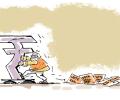
'The economy may not improve unless you admit there are some problems.'
According to the latest estimates released by the Central Statistical Organisation (CSO), the total investment in agriculture has declined from 2.1 per cent in 2002-03 to 1.9 per cent during 2003-04 to 2005-06.
Chandigarh has highest per capita income of Rs 67,370 per annum, followed by Pondicherry (Rs 56,034) and Delhi (Rs 53,976).\n\n
Reserve Bank of India Governor, Y V Reddy presented the Monetary and Credit Policy for 2006-07 on Tuesday.

India's monthly per capita income, the measure of standard of living, is likely to be at Rs 7,378.17.

Among other things, the agenda is likely to focus on increasing private investment, employment generation and giving relief to the farm sector
The US-based agency, however, termed the 7 per cent GDP growth for the October-December quarter as "surprising", a tad lower than 7.4 per cent in the previous quarter.
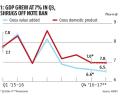
It is difficult to reconcile the GDP numbers with other economic indicators.

The previous high GDP growth of 8.1 per cent was recorded in April-June quarter of 2016-17.

Rajan also said the outlook for agriculture is subdued, in view of both rabi and kharif prospects being hit by monsoon vagaries.
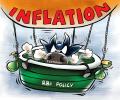
Currently, the retail inflation is well below the RBI's comfort level. The government has asked the central bank to keep inflation in the range of 4 per cent.
It said the money supply recovered to its pre-demonetisation level in mid-2017 and is now increasing steadily, similar to the previous trend.

The panel finds 'discrepancy' in the Annual Survey of Industries data.
