
Through these actions at the WTO, the United States is seeking the prompt provision of detailed information and data from China and India regarding the operation of these subsidy programmes, the USTR said.

The change of mind among Indian experts is based on a recent decision of the UK high court.
India did not yield any major ground on trade facilitation while it managed to successfully push its stand on food security issues through the WTO meeting in Bali, a top official said.

India will press for greater market access for developing countries in the services sector besides highlighting concerns in agriculture and industrial goods negotiations at the World Trade Organisation mini-ministerial on Saturday at Davos.
India topped the table of the countries resorting to anti-dumping investigations between July and December 2008, while Brazil, China and Argentina were other major users of the WTO-compliant trade remedy to protect their domestic industries against cheap imports.

India asks for consultations on rise in professional visa fee that hurts IT companies' interests
Minister for Commerce and Industry Kamal Nath, who arrived in Washington had critical bilateral discussions with senior administration and Congressional leaders on issues related to WTO and bilateral issues.
Developing countries have stressed on evolving a high-level cohesion among themselves for achieving development objectives at the ongoing WTO negotiations.
With China's entry into the WTO, India is likely to make strong gains in food grains and light manufacturing and modest growth in several other sectors but is likely to lose export shares in markets such as the US and EU especially in textiles.
The report was in the context of an objection by the US against India's practice of imposing countervailing duty and SAD on alcoholic beverages. Trade experts said though the trade dispute body ruled in favour of the US, it did not mean much for India as it had withdrawn the CVD on alcoholic spirits in mid-2007.
At the 9th review of the US trade policy regime, many members -- China, Norway, Thailand, the European Union, among others -- sharply criticised Washington for not adopting WTO-consistent policies in several areas.
Agriculture Minister Sharad Pawar on Monday denied that the ministry was unhappy with the WTO Framework Agreement.
India's efforts to include services in the proposed Framework on Agriculture and Non-agriculture Market Access have received a shot in the arm with the European Union showing willingness to extend its support.
The government will convene a meeting of political parties prior to the WTO ministerial in Cancun to elicit their views on issues, especially agriculture subsidy, to be discussed at the conference, Lok Sabha was informed on Friday.
Despite the noise that India is making at the WTO saying that its food security concerns are non-negotiable, back home it is aggressively pushing for dismantling minimum support prices and at the same time limiting the sovereign role of Food Corporation of India in food distribution to the hungry and the needy, says Devinder Sharma.

A day before the informal meeting of the WTO, India, China and South Africa on Friday said the developing countries are being asked to further open their markets without any reciprocity from the rich nations, as per the draft proposals for a multilateral agreement.

India has been opposing the pact as ITA will only benefit the country when its domestic manufacturing is robust.
Releasing its grim forecast for the current year, WTO economists warned about several downside risks as well as rising inflationary pressures because of the increase in commodity prices and lax monetary conditions. "The continued turmoil in financial markets and the downside risks, including inflationary tendencies, are a cause for concern," said Patrick Low, chief economist, WTO.
The European Union on Wednesday said there would not be any dialogue with India on the World Trade Organisation issues when their political heads meet at the India-EU summit this weekend, even though trade issues will figure in the summit.
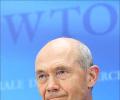
Not the one to give up hope, WTO Director General Pascal Lamy is visiting India next week to find ways for picking up the threads from last month's failed trade talks in Geneva.
India may drag US to the World Trade Organisation for its new "protectionist" move in hiking professional visa fees, a step that will make Indian IT companies less competitive in the American market.
With the Bali deal settled, countries should now focus on long pending issues such as market access and reduction in green goods tariff
In a major trade victory for India and several other countries, the World Trade Organisation has held as violation of global trade rules a controversial USlaw allowing American companies to collect more than $470 million
The US must make substantial cuts in farm subsidies and scale down demands for tariff reductions by developing countries to enable the stalled WTO talks to move forward, India's top trade negotiator said on Thursday.
A last-ditch attempt to rescue the Doha round of world trade talks is likely to be made towards the end of July at a Geneva meeting of 30 trade ministers from among the 150-member countries of the World Trade Organisation (WTO).

The report was jointly prepared by the Paris-based Organisation for Economic Cooperation and Development and the World Trade Organisation.
The government claims to have secured significant gains and succeeded in fully protecting India's interests in agriculture and other key areas.

Talking tough, India on Friday threatened to drag the European Union to the World Trade Organization if the 28-nation bloc did not lift its ban on the import of Indian mangoes and vegetables.
Of the three options on the table, India was likely to agree for a coefficient of 22, which would have required it to reduce tariff on industrial products by about 60 per cent. Under this proposal, India would have been able to shield its products to the extent of 10 per cent.
Services have now become an offensive area for many developing countries like India and that is good news.
