
Equity markets this week will turn their focus on the RBI's interest rate decision, Q1 earnings from several blue-chip firms and tariff-related news for further cues, analysts said. Moreover, trading activity of foreign investors and trends in global equity markets will also drive investors' sentiment.

Religare Enterprises, a financial services firm, has disclosed that the Reserve Bank of India (RBI) turned down its application to appoint Rakesh Asthana as its whole-time director in May this year without citing any reasons. Asthana is a former top official of the Central Bureau of Investigation (CBI). In a notice to the stock exchanges, Religare said that while the company and Asthana were weighing the options of dealing with the letter of refusal by the RBI, it was also busy in preparing for the "herculean task" of making ready multiple applications to regulators.

Facing criticism from the government over the central bank prioritising inflation over growth, the new RBI Governor Sanjay Malhotra on Monday said that prospects of the Indian economy are expected to improve on the back of high consumer and business confidence in 2025. "As we strive to preserve financial stability to support a higher growth path for the Indian economy, our focus remains steadfast on maintaining stability of financial institutions and, more broadly, systemic stability," Malhotra said in foreword to the Financial Stability Report.

The Canara Bank on Thursday informed the Bombay high court that it has withdrawn its order classifying as "fraudulent" the loan account of a firm linked to industrialist Anil Ambani. After the bank's disclosure, a bench of Justices Revati Mohite Dere and Neela Gokhale disposed of the petition filed by Ambani challenging the bank's order, saying nothing survives in it.

Gold buying by central banks surged to 60 tonnes in October, mainly led by the Reserve Bank of India (RBI) which added 27 tonnes of the precious metal to its reserves, the World Gold Council (WGC) said on Thursday. India added 27 tonnes of gold in October, bringing its total gold purchases to 77 tonnes from January to October, according WGC data based on reported monthly data from the International Monetary Fund (IMF).

India's forex reserves dropped by $3.05 billion to $699.74 billion in the week ended July 4, the RBI said on Friday. In the previous reporting week, the overall reserves had jumped by $4.85 billion to $702.78 billion.

'As the team builds, each of them will bring in a different perspective, new thinking.'

Indian government's decision to cut GST rates on various products will increase purchasing power of consumers and boost demand for residential properties in the upcoming festive season, according to realtors' body CREDAI. The association, which has a 13,000 members from across India, said the construction cost is expected to come down because of reduction in GST rates on cement and few other building materials.

Here's what Indian investors diversifying into equities, ETFs, and real estate abroad to manage risk, returns, and currency exposure must watch out for.
The Reserve Bank on Monday said asset quality of banks improved further and their gross non-performing assets (GNPA) or bad loans ratio declined to a 12-year low of 2.6 per cent in September 2024 on the back of falling slippages and steady credit demand. The RBI also flagged concern over a sharp rise in write-offs, especially among private sector banks (PVBs), which could be partly masking worsening asset quality in unsecured lending segment and dilution in underwriting standards.

UPI crossed 20 billion monthly transactions for the first time in August 2025, with a transaction value of Rs 24.85 trillion.

The accused, who duped the woman of Rs 6.60 lakh during the ordeal between September 5 and 8, continued to send messages even after her death on September 8.

'Do exhaustive research and then select the one that best fits your budget and requirements.'

Despite corporate bond yields hardening by 20-25 basis points, Indian corporates are not warming up to bank funding for their capital expenditure needs as bank lending rates remain elevated due to the higher cost of liabilities, compared to current rates in the debt capital market.

State-owned Bank of Baroda (BoB) on Sunday said it has cut its benchmark lending rate linked to repo rate by 50 basis points in line with the RBI's rate reduction. Meanwhile, private sector HDFC Bank reduced its Marginal Cost of Funds-based Lending Rates (MCLR) by 10 basis points across tenure, which will benefit borrowers whose loans are linked to this benchmark.

With inflation comfortably below the Reserve Bank of India's (RBI's) 4 per cent median target and likely to undershoot its 3.7 per cent projection for 2025-26 (FY26), there is room for the monetary policy easing cycle to be sustained, the Finance Ministry said on Monday. The comments, featured in the ministry's Monthly Economic Review for June 2025, assume significance ahead of the Monetary Policy Committee (MPC) meeting of the Reserve Bank of India (RBI) scheduled to begin from August 5.
With concern on food inflation ebbing with the monsoon progressing well, the Reserve Bank of India (RBI) is warming up to the idea of a change in stance to "neutral" from "withdrawal of accommodation", according to economists. In his speech on Thursday during the annual event of the Federation of Indian Chambers of Commerce and Industry-Indian Banks' Association, RBI Governor Shaktikanta Das said: "The balance between inflation and growth is well-poised."

The Asian Development Bank (ADB) on Wednesday lowered India's growth forecast for FY26 to 6.5 per cent from 6.7 per cent on account of trade uncertainty and higher US tariffs that are expected to impact exports and investment. Despite the downward revision from the April 2025 Asian Development Outlook (ADO), India remains one of the fastest-growing major economies in the world.
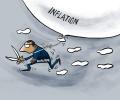
Wholesale price based inflation declined to a 3-month low of 1.89 per cent in November on cheaper food items, and experts predicted a 0.25 per cent interest rate cut by the RBI in the policy review in February. The Wholesale Price Index (WPI) based inflation was 2.36 per cent in October 2024. It was 0.39 per cent in November, last year. In August, 2024, it was 1.25 per cent.

Wholesale price inflation (WPI) declined to (-) 0.13 per cent in June as prices of food articles and fuel saw deflation, along with easing in manufactured product costs, government data showed on Monday. WPI-based inflation was 0.39 per cent in May. It was 3.43 per cent in June last year.
The change in stance to neutral from accommodative in the June monetary policy meeting does not necessarily signal that the Reserve Bank of India's (RBI's) rate setting body - monetary policy committee (MPC) - will go on a prolonged pause on rate cuts going forward, believe experts.
The Reserve Bank of India (RBI) has sought granular data from select non-banking financial companies (NBFCs) on their loan book growth. The details sought are on the outstanding product-wise portfolio and the annualised interest charged on them. The annualised interest slabs mentioned are as follows: less than 10 per cent, 10-20 per cent, 20-30 per cent, 30-40 per cent, 40-50 per cent, and above 50 per cent.

Banks have been borrowing heavily from the Tri-Party Repo (TREPS) market and deploying those funds into the Standing Deposit Facility (SDF) of the Reserve Bank of India (RBI), which is offering higher interest rate than the former, leading to increased volumes in the SDF window. The weighted average TREPS rate was trading at 5.66 per cent on Monday, 9 basis points lower than the SDF rate which currently stands at 5.75 per cent.

The Reserve Bank of India (RBI) on Wednesday issued a draft framework for alternative authentication mechanism for digital payments, wherein it has mandated that all digital payment transactions would have to be authenticated with an additional factor of authentication (AFA), except small value contactless card payments for up to Rs 5,000 at point of sale terminals, e-mandates for recurring transactions, and small value digital payments through offline mode, among others. Additionally, it has said that all digital payment transactions, other than card present transactions, have to ensure that one of the factors of authentication is dynamically created, i.e., the factor is generated after initiation of payment; is specific to the transaction; and cannot be reused.

Senior bankers anticipate discussions on issues related to technology, cyber security, and customer protection.

Why is the RBI harsh on Paytm Payments Bank? Why did it give Rana Kapoor of Yes Bank Ltd such a long rope?Often, it's a long investigation process, but the RBI doesn't discuss this openly since that can threaten financial sector stability, explains Tamal Bandyopadhyay.
The cumulative rate hikes of 2.5 percentage points by the central bank since May 2022 negatively impacted headline inflation by 1.60 per cent, a paper by senior RBI staffers said on Monday. "Policy rate increases have anchored inflation expectations and modulated aggregate demand, generating disinflationary responses," the paper by Deputy Governor Michael Patra, Indranil Bhattacharyya, Joice John and Avnish Kumar, said.

The Reserve Bank on Wednesday imposed business restrictions on Edelweiss Group's lending and asset reconstruction arms on concerns over evergreening of loans. The central bank has asked ECL Finance Ltd (ECL) to cease and desist from undertaking any structured transactions in respect of its wholesale exposures, other than repayment and/or closure of accounts, an official statement said.

Payouts to key management personnel in non-banking financial companies (NBFCs) are under the banking regulator's scrutiny. Top industry officials said this is a follow-through on the Reserve Bank of India's (RBI's) circular of April 29, 2022, which asked NBFCs in the "middle" and "upper" layer of its four-tiered scale-based regulatory (SBR) framework to put in place a board-approved compensation policy.

Wholesale price inflation (WPI) stayed in negative territory for the second consecutive month at (-) 0.58 per cent in July, as prices of food articles and fuel saw deflation, even though prices of manufactured items increased, government data showed on Thursday.

India Inc, which is sitting on cash balances of 13.5 trillion, is using the funds to meet capital expenditure as well as brownfield expansion, resulting in 'anaemic' demand for bank loans, State Bank of India (SBI) chairman CS Setty said at an event on Monday. He added that a slowdown in corporate credit is mainly due to lack of demand.

The Securities and Exchange Board of India (Sebi) has planned a slew of further relaxations to facilitate easier registrations of foreign portfolio investors (FPIs), including a common know-your-client (KYC) and smoother documentation through India digital signature.

Among the 30 Sensex firms, Asian Paints, Infosys, JSW Steel, UltraTech Cement, Power Grid, Larsen & Toubro, HCL Technologies and Tata Steel were the biggest laggards. Tata Motors, HDFC Bank, Bharti Airtel, ITC, IndusInd Bank and Axis Bank were the gainers.
The Reserve Bank is unlikely to ease the benchmark policy rate during 2024 given the uncertainty over food inflation, State Bank of India (SBI) chairman C S Setty has said. The US Federal Reserve's first cut in interest rates in more than four years is expected soon, triggering central banks in other economies to follow suit. "On the rate front, a lot of central banks are taking independent calls.

Bad loans in the agriculture sector remain elevated, with several public-sector banks (PSBs) reporting higher slippages in the April-June quarter of FY26. For many banks, non-performing assets (NPAs) in farm lending were 5 per cent or more, with some nearing double digits.'

'MIB which is a part of retail, will grow in the range of 20 per cent.'

A combination of factors, including heavy investments in US Treasury bonds and dollar sales at a healthy profit, facilitated the Indian central bank in transferring a record surplus of Rs 2.11 trillion to the government for 2023-24 (FY24). The RBI's dollar purchases increased in FY24, supported by robust capital inflows endorsing the economy's health.
