
Indian equity markets experienced a volatile session, with the Sensex and Nifty recovering some ground after a significant plunge the previous day. Gains were driven by PSU bank, IT, and metal stocks, but concerns over rising fuel prices and geopolitical tensions limited the recovery.

'Banking is the only sector that can see double-digit growth in FY27.'

State-owned Bank of Baroda (BoB) reported a 72 per cent year-on-year (Y-o-Y) drop in net profit to 1,278 crore for Q1FY27 due to a $600 million out-of-court settlement related to NMC Health Plc. In contrast, Bank of India (BoI) saw its net profit rise by 36.23 per cent Y-o-Y to 3,068 crore for the same quarter, driven by healthy loan growth and improved asset quality.

>It's not easy to predict the market. But there are at least two positive factors to back the PSU banks, explains Tamal Bandyopadhyay.

Public-sector banks (PSBs) are attracting the attention of investors and the PSU Bank Index has gained nearly 10 per cent in the past month. PSBs have seen return on assets (RoA) climbing to 1 per cent in 2024-2025 (FY25) and margins are believed to have moved up further in the first half of this financial year (H1FY26) with asset quality remaining stable.

Sectoral funds, focused exclusively on public sector banks (PSBs), have delivered the strongest returns among domestic mutual fund (MF) categories over the past six months. However, active banking funds have significantly lagged because of their heavy tilt towards private lenders.

State-owned enterprises in India are projected to significantly increase their overseas borrowings, potentially exceeding $15 billion in FY27, driven by the Reserve Bank of India's new concessional forex swap facility which offers a 3 per cent funding-cost advantage.

Indian benchmark indices, Sensex and Nifty, staged a moderate rebound after a significant correction in the previous session, driven by foreign fund inflows and a largely positive trend in global markets, though geopolitical tensions between the US and Iran continued to foster caution.

Despite rising interest rates, and high inflation, the banking sector is doing well, on the back of a recovering economy. The last couple of quarters indicate credit demand is picking up and Return on Assets (RoA) is more than acceptable at the moment. The PSU bank pack may be more interesting at the moment simply due to being valued at far lower multiples than the private banks.

Opening up the corner office is fine, but will the government be able to attract talent without giving a market-rate salary?, asks Tamal Bandyopadhyay.
Divestment has emerged as a priority for the government following a moderation in direct tax collections.

The Indian government is accelerating its sale of minority stakes in state-owned companies, including a significant offer for sale (OFS) in Life Insurance Corporation of India (LIC) expected "very soon," to meet its 80,000 crore mobilisation target and reduce its holdings to 75 per cent in most listed PSUs by year-end.

Odisha Police's Economic Offences Wing (EOW) has arrested two more individuals in connection with a Rs 9.6 crore bank fraud case, bringing the total number of arrests to six. The accused, Surjit Roy and Sameer Srivastav, were apprehended in Raipur, Chhattisgarh, for allegedly withdrawing funds from the District Mineral Foundation (DMF) trust using forged cheques.

8 out of 12 public sector banks have seen cuts in the number of employees between 2021 and 2025.

The highest number of frauds was reported under the card, Internet, and digital payments categories in FY24 and FY25. 'Advances' accounted for the largest share (85.5 per cent) in FY26.

The banking sector could see better loan growth in the third quarter of financial year 2026 (Q3FY26) with improved net interest margins (NIMs), though the full impact of latest rate cuts will be largely felt in the fourth quarter. There may be lower slippage in unsecured loans and microfinance institutions (MFIs) along with steady recovery trends, which should lower credit cost.

Does the Union government or the RBI see itself as Krishna beheading Shishupal and what will constitute the 101st or indeed the past many sins for which a Sudarshan Chakra will have to be used? More importantly, what are those sins?

PSU bank stocks are witnessing hectic activity these days and are now among the top traded stocks on the bourses.
The government on Wednesday ruled out privatisation of PSU banks but asked them to focus on convergence and opt for mergers and acquisitions to become globally competitive.

The CBSE revaluation portal experienced a cyber attack, affecting the payment system and leading to unauthorised access for approximately 50 students. The incident caused fee display abnormalities, prompting investigations and system enhancements.

Public sector banks have written off loans worth Rs 6.15 lakh crore in the last five and a half years, Parliament was informed on Monday.

Indian benchmark equity indices, Sensex and Nifty, closed lower due to investor caution over rising bond yields, a weaker rupee, and fresh fuel price hikes, which have revived inflation concerns.

The maximum tenure of CEO and MD of public sector banks has been increased to 10 years, a move that will help the government retain the best talent in the banking sector. As per a government notification dated November 17, 2022, the term for the appointment has been extended to 10 years, from the earlier 5 years, subject to superannuation age of 60 years. Earlier, the MD or executive director of a public sector undertaking (PSU) bank was eligible for a maximum tenure of 5 years or 60 years whichever was earlier.

Indian benchmark indices Sensex and Nifty experienced declines due to a sharp rally in crude oil prices, continuous foreign fund outflows, and geopolitical uncertainties. Regulatory developments in the banking sector, particularly the implementation of the Expected Credit Loss (ECL) framework, also contributed to the selling pressure.
The government on Tuesday gave greater autonomy to state-run banks, allowing them make domestic and overseas acquisitions without its approval.

'Investors should not commit fresh money to these stocks right now, unless they can hold for the next three to four years.'

A government mandate requiring central public sector enterprises to use the Trade Receivables Discounting System (TReDS) for settling small business invoices is expected to significantly increase volumes on these platforms.
Even as concerns over PSU Banks' asset quality and growth rates remain, there are few that offer a favourable risk-reward equation.

Indian equity markets closed higher, driven by gains in PSU bank, auto, and financial stocks, following the US Supreme Court's decision on tariffs. Sensex climbed 479.95 points to 83,294.66, and Nifty advanced 141.75 points to 25,713.

Analysts say there is still no visibility of earnings improvement.

The combined market capitalisation of the 21 listed PSU banks declined by about Rs 76,000 crore to Rs 425,800 crore during the month.
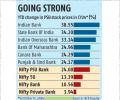
Stock Market News today, PSU banks: The year 2024 was a roller-coaster ride for Indian stock markets, marked by volatility driven by the Lok Sabha elections, Union Budget 2024, a slowdown in corporate earnings, and sticky inflation. Geopolitical tensions - particularly between Israel and Iran in West Asia - along with various stimulus announcements by China and yen carry trade rocked the equity markets throughout the year.

The Indian banking sector could be due for a rise in profitability after several quarters of net interest margin (NIM) compression. The Q2FY26 results suggest NIMs have bottomed out.
To boost the economy, the RBI has taken a slew of measures since September last year, including cuts in the cash reserve ratio and short-term lending (repo) rate, to inject funds into the system and signalled a soft interest rate regime. PSU bankers' meeting is being held in the backdrop of the third quarterly review of monetary policy by the Reserve Bank of India.
Benchmark equity indices Sensex and Nifty extended their gains for the second straight session on Monday, driven by optimism over the India-US trade deal and robust buying in public sector banks, consumer durables, and realty stocks.

Public sector banks (PSBs) have written off bad loans of about Rs 5.82 lakh crore in the last five financial years, Parliament was informed on Tuesday. During 2024-25, the loan write-off of PSBs was at Rs 91,260 crore, compared to Rs 1.15 lakh crore in the previous fiscal, Minister of State for Finance Pankaj Chaudhary said in a written reply to the Rajya Sabha.
Hemendra Hazari of Karvy Stock Broking believes that government banks will be impacted by rising bond yield because they have a much higher proportion of investments and their durations are higher too.

This is the first tranche of capital infusion for the fiscal and more funds would be provided in future depending upon the performance of PSU banks.
Stock markets closed higher for the second straight session on Tuesday, driven by gains in bank, IT and capital goods shares.

Indian equity investors experienced a significant loss of 16.32 lakh crore due to a two-day stock market decline fueled by escalating geopolitical tensions involving the US, Israel, and Iran.
