
The Reserve Bank of India's (RBI's) Payment Systems Report highlighted that between 2019 and 2024, credit card transactions doubled in volume and almost tripled in value. During the same period, however, debit card transactions witnessed a decline, both in volume and value.

'Corporates now have multiple funding sources beyond banks, and many are sitting on large cash reserves.'

The finance ministry is in favour of extending the August deadline for public sector banks (PSBs) as well as insurance companies to increase their minimum public shareholding (MPS) to the mandated 25 per cent, said a senior government official. "The election results will determine the course of action. "Most likely, those who did not receive an extension to meet the minimum shareholding norm will be granted one," the senior government official said.

Beginning next month, a bank customer can opt for up to four nominees in her or his account with a view to ensure uniformity, and efficiency in claim settlement across the banking system. The key provisions relating to Nomination under the Banking Laws (Amendment) Act, 2025 will come into effect from November 1, 2025, a finance ministry statement said on Thursday.

Public sector banks (PSBs) have written off bad loans of about Rs 5.82 lakh crore in the last five financial years, Parliament was informed on Tuesday. During 2024-25, the loan write-off of PSBs was at Rs 91,260 crore, compared to Rs 1.15 lakh crore in the previous fiscal, Minister of State for Finance Pankaj Chaudhary said in a written reply to the Rajya Sabha.

Sectoral funds, focused exclusively on public sector banks (PSBs), have delivered the strongest returns among domestic mutual fund (MF) categories over the past six months. However, active banking funds have significantly lagged because of their heavy tilt towards private lenders.

Merely bringing down the government stake below 51% may not find any taker for the PSBs. The government must bring down its holding to at least 26%, recommends Tamal Bandyopadhyay.

Public sector banks (PSBs) posted 16.1 per cent year-on-year (Y-o-Y) growth in net profit at Rs 39,974 crore during the June 2024 quarter. While net interest income (NII) showed subdued growth of 7.1 per cent, provisions and contingencies declined by 10.5 per cent Y-o-Y. This aided the bottom line to show steady growth.
The finance ministry is considering amending the Banking Companies (Acquisition and Transfer of Undertakings) Act, 1970, which governs public-sector banks (PSBs), to make suitable provisions for allowing PSBs to transfer shares to the Investor Education and Protection Fund (IEPF) when dividends of such shares remain unclaimed by the investors for seven consecutive years. "While Section 10B of the Banking Companies (Acquisition and Transfer of Undertakings) Act, 1970, allows the transfer of unclaimed dividends to the IEPF, it, however, does not mention a provision for transferring unclaimed shares and may now be amended by the next government to allow such transfers to happen," said a person familiar with the matter.

The government is set to earn an equity dividend of nearly Rs 13,800 crore from the listed public-sector banks (PSBs), all 12 of them, for FY23, up 50 per cent from Rs 9,210 crore in FY22. This will be the highest ever dividend for the government from PSBs. The 12 PSBs in our sample are paying an equity dividend of nearly Rs 21,000 crore for FY23, up 53 per cent from Rs 13,710 crore for FY22.

Exuding confidence in sustaining the tempo of credit growth, public sector bankers said on Wednesday that consolidation in the public sector bank (PSB) space has given them a robust base to scale. The privatisation of PSBs can be done through divestment of government stake to a wider base of investors without haste. There is nothing to worry about at this point (high credit offtake) as underwriting standards and risk management are much better.

CPGRAMS -- an online platform available to citizens 24x7 to lodge their grievances to public authorities on service delivery -- has existed for close to two decades. But it has never been this active, points out Tamal Bandyopadhyay.

Each employee is generating more business than before -- driven by cost rationalisation, digital adoption, and better resource utilisation -- signalling a stronger foundation for sustainable growth and profitability.

Public-sector banks (PSBs) in Q3FY23 wrote off bad loans worth Rs 29,000 crore, up from Rs 23,000 crore in the same quarter a year ago, as part of a clean-up exercise. According to estimates by rating agency CARE Ratings, the write-offs by PSBs in April-December 2022, at Rs 81,000 crore, were lower than the Rs 90,000 crore in April-December 2021. Sanjay Agarwal, senior director, CARE Ratings, said a lot of it was driven by regulations, and assets that had 100 per cent provision coverage were written off.

Collectively, the pack of 12 has posted a 50 per cent rise in profits -- Rs 25,685 crore. On a quarter-on-quarter basis (that is, September over June), the rise is 68 per cent. Public sector banks have never had such a stellar performance, explains Tamal Bandyopadhyay.

Commercial banks in India reported 26 per cent year-on-year (Y-o-Y) growth in slippages at Rs 63,000 crore during the first quarter ended June 2025 (Q1FY26). This was predominantly due to stress in microfinance and unsecured retail portfolios of select lenders.

Given that a sizeable part of this money is part of the coveted current accounts and savings accounts, it is surprising that banks are not in a hurry to revive these accounts, notes Tamal Bandyopdhyay.

Bad loans in the agriculture sector remain elevated, with several public-sector banks (PSBs) reporting higher slippages in the April-June quarter of FY26. For many banks, non-performing assets (NPAs) in farm lending were 5 per cent or more, with some nearing double digits.'

The Centre should privatise all public sector banks (PSBs), except the State Bank of India (SBI). This is because private banks have emerged as a credible alternative to PSBs with substantial market share. Also, government ownership hinders the ability of the Reserve Bank of India (RBI) to regulate the sector, according to a report by the National Council of Applied Economic Research (NCAER).

In the past 10 years, over 500 PSB officers have died by suicide. When targets are overwhelming, senior management and customers are both impatient, and there is constant fear, not every banker has the resilience to survive and thrive, warns Tamal Bandyopadhyay.

Batting for further consolidation in public sector banking, the executives of top public sector banks (PSBs) said there should be at least two Indian banking entities among the top 20 global banks.

Infrastructure bonds, which were relied upon the most in 2024-25 (FY25) by commercial banks to raise funds through the domestic debt capital market amid lagging deposit growth, seem to have lost their sheen in FY26. So far in FY26, no bank has tapped the domestic debt capital market to raise funds via infra bonds, and the expectation is that the amount raised through this route will be significantly lower than that last year, unless credit demand picks up.

Reports suggest state-owned banks have lapped up Rs 40,000 crore, so far, using both bonds and equity instruments. The question, though, is whether there will be a perceptional change for PSB stocks.

'Vigilance' is a dreaded term for PSB employees and there are instances where this fear is misused by the higher authorities to tame their subordinate officials. This fear always deters PSB executives from making decisions -- the fewer the decisions, the less the chance of falling into trouble, points out Tamal Bandyopadhyay.

The gap between credit and deposit growth in the banking system is expected to decline sharply to 80 basis points (bps) in the next financial year from an average of 386 bps over the FY22-Q3FY25 period, according to rating agency India Ratings. This would be against the backdrop of sharp moderation in the incremental loan deposit ratio (LDR) of the Indian banking system to 85 per cent in February 2025 from 117-118 per cent in the same month of 2024.
While the government has infused huge capital into PSBs, the same has largely been used to mitigate losses and has failed to contribute meaningfully to credit growth.
Those behind recapitalisation are neither aware nor do they care. After all, they have no skin in this game. And the Lok Sabha elections are round the corner. That's what they care about, points out Debashis Basu.
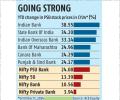
Stock Market News today, PSU banks: The year 2024 was a roller-coaster ride for Indian stock markets, marked by volatility driven by the Lok Sabha elections, Union Budget 2024, a slowdown in corporate earnings, and sticky inflation. Geopolitical tensions - particularly between Israel and Iran in West Asia - along with various stimulus announcements by China and yen carry trade rocked the equity markets throughout the year.

The government can also individually exempt the PSBs, that are to be privatisated from the two Bank Nationalisation Acts. This will bring such lenders under Banking Regulation Act, and make them companies, reports Nikunj Ohri.

It is nearly after 13 years that a foreign brokerage has resumed holistic coverage on stocks of public sector banks (PSBs). To that extent, Morgan Stanley's report dated March 3, where the analysts have listed their order of preference for PSB stocks, is an indication that the state-owned banks may once again be attracting some interest, thanks to three back-to-back quarters of good results in FY21 so far. "State-owned banks' balance sheets have improved, and bad loans formation should moderate going forward," the analysts note and this is the key reason for them to relook at their stance on PSBs. While State Bank of India (SBI) remains their preferred pick, stocks of Bank of Baroda (BOB) and Punjab National Bank (PNB) have been upgraded from 'underweight' to 'equal-weight'. The brokerage maintains its underweight recommendation on Bank of India and Canara Bank.

Finance Minister Nirmala Sitharaman on Monday said the government would infuse Rs 20,000 crore into public sector banks (PSBs) in 2021-22, to meet the regulatory norms. For the current financial year also, the government had made a provision of Rs 20,000 crore for recapitalisation.

The interest rate offered by PSBs like SBI, BoB and BoI hover around 8.9 per cent-10.50 per cent. For private banks, the range is between 10.49 per cent and 12 per cent.
Public sector banks (PSBs) have written off a massive Rs 8 trillion of loans in the seven years of the Narendra Modi government in office. This is more than twice the capital infused by the Bharatiya Janata Party-led government during the period. Between 2014-15 and 2020-21 (FY21), the Centre had infused Rs 3.37 trillion into PSBs. At Rs 1.06 trillion, FY19 saw the highest capital infusion.

Finance Minister Nirmala Sitharaman on Friday chaired a meeting with chiefs of public sector banks and assessed their readiness to tackle any possible disruptions due to the Omicron variant. In a tweet, the finance ministry said during the meeting with CMDs/MDs, held through virtual mode, the minister also reviewed various steps taken by PSBs in implementing pandemic-related measures initiated by the government and RBI.
India has a long way to go before it develops a culture of professional boards accountable to institutional investors. There is, therefore, no realistic alternative to reforming and strengthening PSBs under government ownership, says T T Ram Mohan.

Finance Minister Nirmala Sitharaman is scheduled to meet heads of public sector banks (PSBs) next week to review performance of the lenders and progress made by them to support the economy battered by the COVID-19 pandemic. Banks would be urged to sanction loans for productive sectors to accelerate revival of the economy, sources said. According to sources, the two-day meeting would commence on November 17 and undertake a comprehensive review of various segments, progress in government schemes including Aatmanirbhar Bharat Abhiyan.

Net NPAs increased to Rs 36,260 crore in the December quarter from Rs 34,843 crore in September and Rs 33,116 crore in December 2023, observes Tamal Bandyopadhyay.

UPI has catapulted India into the forefront on the global digital payments landscape. Working hand in hand, the AePS payments system is making life easy for rural folks, notes Tamal Bandyopadhyay.

The training programme will contain thought leadership courses, group exercises, simulations, including role plays and situation analysis and personal explorations workshops

'The PSBs ended up recording Rs 7,709 crore losses in the March quarter compared to the Rs 11,688 crore profits of their private peers,' reveals Tamal Bandyopadhyay.
