
Both the indices closed at five-month highs, led by financial services, IT and metal stocks, amid persistent foreign fund inflows.

In the Sensex pack, Axis Bank, Tata Motors, Infosys, Kotak Bank, HDFC Bank, RIL, Bajaj Auto, SBI, HUL, Tata Steel, Vedanta, HFDC, TCS, ITC and Sun Pharma jumped up to 4.64 per cent.

Tata Steel was the biggest gainer in the Sensex pack, rising 3.36 per cent, followed by Vedanta, Bajaj Finance, TCS, IndusInd Bank, Infosys, ONGC, Kotak Bank, HDFC Bank, HDFC, M&M and ITC.
The overall breadth was negative as 1,539 stocks declined while 1,232 stocks advanced.

Market breadth ended weak with 1,430 losers and 1,339 gainers on the BSE.

Reflecting the bullish mood, all sectoral indices ended with gains, led by auto, oil and gas, FMCG, IT and teck. The broader NSE Nifty, after crossing the 10,600-mark, settled 68.40 points, or 0.67 per cent higher at 10,598.40.

Sensex opened at 25,817 levels, 47 points down.
Nifty crossed the 5,600 mark and finally ended at 5,564 -- up 42 points.

The overall breadth was positive as 1,640 stocks advanced while 1,292 shares declined.

Leading indicators suggest economic activity has been disrupted after demonetisation.

The 30-share S&P BSE Sensex ended up 130 points at 25,400 and the Nifty50 rose 46 points to close at 7,759.
Other losers included HCL Tech, Yes Bank, IndusInd Bank, TCS, ONGC, Bajaj Finance, PowerGrid, Vedanta, Asian Paints, NTPC and Hero MotoCorp, which shed up to 4.07 per cent.

Combined net profit of BSE500 companies at $ 63 bn is 2.3% of GDP; global average is 5%.

NTPC was the top gainer, spurting 4.28 per cent. Other winners were Bajaj Auto, Bajaj Finance, Sun Pharma, ITC, Hero MotoCorp, TCS, Yes Bank, HDFC, HDFC Bank and SBI, rising up to 1.38 per cent.

BSE market breadth was negative. Out of 3,022 stocks traded, 1,694 declined while 1,196 advanced.
The market breadth in BSE ended healthy with 2,019 advancing and 740 shares declining.

The Reserve Bank of India has also expressed concern over rising inflation and said the prevailing level is above its comfort zone.

Out of 30 Sensex shares, 19 ended lower while 11 gained

Interest rate sensitive stocks gain ground post decision

On the other hand, jobs increased for the 10th straight month in the manufacturing sector, albeit only slightly
A weak opening of European bourses weighed on sentiments.

At close, both the benchmark indices clocked in robust gains; the Nifty gained 66 points at 5,480, while the Sensex ended off the day's high at 18,206 up 218 points.

Nifty crossed the 5,100 mark and ended up 108 points at 5,140.

Sectorally, metal and banking stocks rallied the most, while FMCG and realty stocks came under selling pressure.
The Nifty reclaimed the 5,000-mark and ended up 72 points at 5,013.

To sell its 26 per cent stake to the Munjals for $1.2 billion.
The Nifty added 90 points to close at 5,535.
Among the Sensex pack, Yes Bank, L&T, HDFC, RIL, HDFC Bank, PowerGrid and Coal India were the biggest losers -- falling up to 2.43 per cent.

The broad-based Nifty slipped below the 8,600-level by losing 24.60 points, 0.28 per cent, to 8,590.65

The 30-share Sensex ended down 339 points at 28,119 and the 50-share Nifty closed 100 points lower at 8,438.

The Nikkei Markit India Manufacturing Purchasing Managers' Index (PMI) -- an indicator of manufacturing activity -- fell to 49.6, down from 52.3 in November, coming below the crucial 50 threshold which separates contraction from expansion.

The biggest gainers in the Sensex pack in Friday's session were Yes Bank, Bharti Airtel, Tata Motors, Vedanta, SBI and Axis Bank, spurting up to 3.05 per cent. The losers included HCL Tech, TCS, Infosys, Hero MotoCorp, IndusInd Bank and Sun Pharma, falling up to 1.55 per cent.

The broader NSE Nifty rose nearly 124 points to settle just below the psychological 11,000 level.
Japanese auto giant Suzuki Motor Corporation on Tuesday said it plans to make India an export hub for its small cars, mainly for European and African markets.

The broader Nifty of National Stock Exchange scaled the 10,200 mark intra day before closing at 10,184.85, showing a sizeable gain of 38.30 points, or 0.38 per cent.
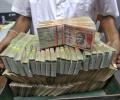
The rupee fell because of fresh demand for dollar from importers.

BSE market breadth was marginally negative. Out of 3,094 stocks traded, 1,541 declined while 1,429 advanced.
