
With new eligibility criteria for futures and options (F&O) coming into effect, Jio Financial Services and Zomato are strong contenders for inclusion in the derivatives segment, according to an analysis by Nuvama Alternative & Quantitative Research. The report suggests that these new F&O inclusions could also propel these two companies into the benchmark National Stock Exchange Nifty 50 during the March rebalancing.

Technical charts indicate a possibility of a meaningful correction in the upcoming months.

The Nifty 50 index is poised for a revamp as the revised futures and options (F&O) stock selection criteria is seen paving the way for newly listed companies to join the benchmark index, which is tracked by passive funds with combined assets under management of more than ~3.5 trillion ($44 billion). For the first time in six years, the market regulator Securities and Exchange Board of India (Sebi) has tweaked the stock selection process for the derivatives segment that clocks a turnover of ~400 trillion daily.

Changes have been made in several indices including Nifty 500, Nifty 200, Nifty 100, Nifty Midcap 150, Nifty Smallcap 250 and host of sectoral indices including FMCG, IT, media, pharma, commodities and services sector.

All the three companies that made their stock market debut on Wednesday delivered huge day-one gains for investors. Shares of digital payment major One Mobikwik Systems surged 90 per cent, while that of fashion retailer Vishal Mega Mart and pharma firm Sai Life Sciences gained around 40 per cent each. These stellar debuts came despite the benchmark indices logging continuous declines since their initial public offerings (IPOs) closed on Friday.

Foreign portfolio investors (FPIs) have net sold domestic shares worth over $10 billion so far this month amid a shift to China, which not only offers attractive valuations compared to India but has also announced several measures to support the economy and the stock market in recent weeks. If the trend doesn't reverse, this will be the first time that overseas funds will yank out more than $10 billion from Indian equity markets in a month.

'Over the next 12 months, it will be difficult to make 15 to 20 per cent return in the markets as the valuations appear stretched.'

'Geopolitics will be the most important driver of financial markets in 2025.'

ITC's move to hive off its hotel business will have implications for passive funds and exchange traded funds (ETFs) similar to that seen during the Reliance Industries-Jio Financial demerger. As ITC is part of popular indices such as Nifty and Sensex, it is held by several index funds and ETFs.

Market reaction to the Union Budget was overall neutral. The income tax "gift" wasn't enough to move the needle. There was some apparent rationalisation of Customs duty structure as well as cuts on import duties of some key components for the telecom and IT industry and duty cuts on vehicle imports. Other proposals related to development of agriculture and rural economy and renewables seem to be generally positive.

Largecap companies are generally less vulnerable to economic slowdowns than their mid- and smallcap counterparts.

Gripped with fear as an investor following a 12 per cent market fall? Here's Radhika Gupta's advice to investors.
The derivatives trading volume has seen a 37 per cent month-on-month decline in December following a slew of measures undertaken by the market regulator Securities Exchange Board of India (Sebi) to curb the frenzy in the derivatives segment. The average daily turnover (ADTV) for the derivatives segment (notional turnover for options segment) so far this month is at Rs 280 trillion - the lowest since June 2023-compared to Rs 442 trillion in November.

The stocks are largely from sectors such as chemicals, finance and cement, which struggled earlier but the worse seems to be behind them.

The majority of active largecap funds are set to outperform for the second year in a row in 2024, thanks to the strong performance of their midcap and smallcap allocations.

Mutual funds (MFs) reinforced their record monthly inflows in October with an investment of Rs 87,000 crore (up to October 29), softening the downside pressure on domestic markets. Their prior record for monthly inflows was Rs 48,139 crore in May. This unprecedented monthly buying partially countered record monthly sales by foreign portfolio investors (FPIs) of Rs 1.1 trillion last month.

''It's crucial to adhere to your trading plan, even when faced with emotional turmoil.' 'The market can be incredibly volatile and it's easy to get swayed by fear and greed.'

The ideal time to invest in sector funds, is during a downturn so that investors can capitalise on a turnaround in 1.5 to 2 years.

Corporate revenues will decline for a third consecutive quarter in March on a YoY basis - one of the worst shows by these companies in many years.

If growth reverts to the pre-Covid level, a lot of people may have to temper their rosy optimism, points out Debashis Basu.
Defying the bearish sentiment in the markets on Monday, ICICI Bank's share price rose by 2 per cent, reaching an intraday high of Rs 1,234.4 per share on the BSE. With a 1.5 per cent gain at the close, the stock emerged as the top performer on both the BSE Sensex and the National Stock Exchange Nifty 50 indices.

The Reserve Bank of India's (RBI's) caution on inflation, highlighted during the recent monetary policy meeting, may put investors' faith in fast moving consumer goods (FMCG) stocks to test, analysts said. They, however, believe FMCG stocks may ride through this near-term investor anxiety as related companies are, typically, well-equipped to handle inflation due to their pricing power and steady demand for essential goods.

The stocks of diagnostic service providers have been standout performers within the healthcare sector over the past year, posting returns between 16 and 80 per cent. In comparison, the Nifty 50 saw returns of 8 per cent. Stable pricing, expectations of gradual volume growth, and market share expansion for the larger players have stoked increased optimism for listed companies.

Dr Reddy's Laboratories (DRL) share price plunged 6.66 per cent to Rs 1,203.50 per share on the NSE during Friday after analysts remained cautious on the company's Q3 performance and differed on its growth outlook. DRL's Q3 performance was viewed as subdued by some analysts when they adjusted it for one-time grants and incomes that the company received during the quarter.

Small and midcaps are leading the charge in the latest market rebound. Since November 21, when the benchmark S&P BSE Sensex and the National Stock Exchange Nifty hit their recent lows and slipped into correction territory, the Nifty Smallcap 100 index has risen by 8 per cent, while the Nifty Midcap 100 has gained 5.7 per cent. Meanwhile, the Nifty 50 index has risen by 4.7 per cent during this period.

Trumponomics, poor growth, and high valuation certainly don't make a bullish recipe for Indian markets, warns Debashis Basu.

'Regardless of whether you invest Rs 100 or Rs 1 crore per month, risk is inevitable.' 'Positive returns at the end of the year can never be guaranteed.' 'This is a fundamental truth every SIP investor must grasp.'
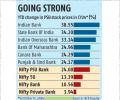
Stock Market News today, PSU banks: The year 2024 was a roller-coaster ride for Indian stock markets, marked by volatility driven by the Lok Sabha elections, Union Budget 2024, a slowdown in corporate earnings, and sticky inflation. Geopolitical tensions - particularly between Israel and Iran in West Asia - along with various stimulus announcements by China and yen carry trade rocked the equity markets throughout the year.

Had you invested Rs 10,000 each in JSW Steel, Titan Company and Bajaj Finance 20 years ago, when they were just penny stocks (trading below Rs 10), you would have become a millionaire by now.

'Market corrections are a natural part of investing, so it's essential to remain focused on long-term financial goals.'

Among the new entries, the largest by market capitalisation are LIC, Avenue Supermarts (DMart), Adani Green Energy, Zomato and Jio Financial Services.

This year, the combined net profit of 24 index companies, which have declared their June-20 numbers, has declined by 37 per cent year on year, while their revenues, including other income, is down by 21 per cent YoY so far.

The sharp pullback in mid and smallcap stocks signals a cooling-off period in segments that previously attracted considerable investor interest.

'Consider 40% to 50% in equities, 10% in gold as a hedge, and the remaining 30% to 40% split between multi-asset funds and hybrid funds.'

A weaker rupee could aid corporate earnings through its positive impact on export intensive sectors such as information technology services, pharmaceuticals and commodity producers such as metal and mining, and oil and gas companies.

Tracking losses in the broader market that has seen the Nifty Smallcap 250 index and the Nifty Midcap 100 indices slip 9 per cent 6.1 per cent in the last three sessions, the frontline Nifty 50 index has remained resilient and registered a fall of 2.2 per cent during this period. Going ahead, can the nervousness in the mid- and small-cap universe spread to the large-cap peers? Most analysts do not think so. They expect a minor dip and a sharp recovery as investors flock to the large-caps in search of safety and value buying as the mid-and small-caps falter.

As regards mid-caps and small-caps, analysts suggest investors buy only those stocks of those companies where there is earnings visibility for at least a few quarters and where the valuations have become reasonable.

'If weak indicators persist, there is a risk that India could slip into a prolonged slowdown similar to the one experienced between 2014 and 2019,' warns Debashis Basu.

'These are capex and infrastructure-linked sectors, PSUs or stocks of some corporate houses.'

The Reserve Bank of India's (RBI's) interest rate decision, West Asia conflict and trading activity of foreign investors are the key factors that will dictate investors' sentiment in the market this week, analysts said. Moreover, quarterly earnings from IT bellwether TCS, domestic macroeconomic data and movement in global oil benchmark Brent crude would also guide trends in the market. Worsening tensions in the Middle East and foreign fund outflows were the major culprits behind the equity markets sharp fall last week.
