
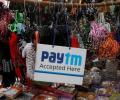
Shares of fintech firms, particularly Paytm, saw significant movement after the Indian government introduced a 0.4 per cent fee on UPI transfers exceeding Rs 2,000 made to merchants, effective October 15.

The Indian government has introduced a 0.4% fee on UPI transfers above Rs 2,000 made to merchants, effective October 15, ending nearly six years of free merchant payments. This move led to initial rallies in fintech stocks like Paytm and Mobikwik, though some later pared gains. Person-to-person transactions and small payments remain free for customers, with the fee being a Merchant Discount Rate (MDR).

WhatsApp has asserted that username reservation relating to well-known public figure names is restricted only to their legitimate account owners, and termed as "false" any claims that people are reserving popular or well-known usernames.

All the three companies that made their stock market debut on Wednesday delivered huge day-one gains for investors. Shares of digital payment major One Mobikwik Systems surged 90 per cent, while that of fashion retailer Vishal Mega Mart and pharma firm Sai Life Sciences gained around 40 per cent each. These stellar debuts came despite the benchmark indices logging continuous declines since their initial public offerings (IPOs) closed on Friday.

As India's biggest Unified Payments Interface (UPI) app PhonePe prepares to list, the updated draft red herring prospectus (DRHP) shows the impact of regulations on the business, and concentration of payments-linked revenue even as UPI lacks MDR (merchant discount rate).

'We are focused on playing on our strengths, which are technology, and building a large profitable business by working with banks as well as non-banks and NBFCs for loans.'

MobiKwik employees exercised their ESOPs (Employee stock ownership) in a recently opened window by selling part of their shares in a secondary sale. "The secondary round was led by ex-Blackstone India head, Mathew Cyriac, who topped up his holding at almost double of his previous price," the sources said.

The Reserve Bank has asked troubled digital wallet firm MobiKwik, which is facing data breach allegations, to get a forensic audit done without any delay. Though the Gurugram-based firm has been claiming that its systems are secure and that there is no basis to the allegations of data breach, a group of hackers on Tuesday said that they accessed personal and financial data of nearly 10 crore MobiKwik customers. On Wednesday, sources in the know of the development told PTI that the RBI has ordered an immediate forensic audit of the company's systems by a certified auditor. When contacted, an RBI spokesperson refused to comment. MobiKwik refused to give a direct answer to a query on whether the RBI has ordered a forensic audit.

With the stock market turning choppy, fintech start-up MobiKwik, which had filed a draft red herring prospectus (DRHP) to raise around $250 million through an initial public offering (IPO), is now looking to raise money from the private market. "We will raise private money but we are not in dire need. "The business was profitable for the first time in the December quarter on a top line of around Rs 150 crore and that will be maintained in the March quarter also. We are generating cash," said Upasana Taku, co-founder of MobiKwik.

The three companies have been issued observations by the watchdog, according to the update on the processing status of draft offer documents as on October 8. An observation letter is mandatory for an initial share sale. In Sebi parlance, the issuance of observations implies its go-ahead for the IPO. One Mobikwik Systems Ltd is a leading mobile wallet (MobiKwik Wallet) and Buy Now Pay Later (BNPL) player in India.

Many people posted screenshots of the alleged MobiKwik user data, which, according to sources, was up for sale for 1.5 bitcoin or about $86,000.

India's 25 venture capital and private equity backed "new-age" companies, that listed between May 2020 and June 2025, reveals a sobering reality behind the hype: barely a third have delivered sustained outperformance against the market.

Fintech firm MobiKwik on Monday filed a draft red herring prospectus (DRHP) with the markets regulator, Securities and Exchange Board of India (Sebi), for its initial public offering (IPO). According to its DRHP, the company plans to raise Rs 1,900 crore, which includes a fresh issue of Rs 1,500 crore and an offer for sale of Rs 400 crore. The selling shareholders include American Express Travel, Bajaj Finance, Cisco Systems and Sequoia Capital India, besides founder Bipin Preet Singh. MobiKwik is the latest among tech majors wanting to list on stock exchanges. Food delivery start-up Zomato will launch its IPO on Wednesday.

If the data breach is found to be genuine, and if the company is found guilty on the grounds of dereliction of duty, or misleading the general public and the RBI about the data breach, actions taken against it will be severe, the person quoted above said.

New entity is likely to get a top-up of $200 million from a Chinese investor

Non-banking entities such as fintech firms will have to tap into use cases beyond peer-to-peer (P2P) and peer-to-merchant (P2M) transactions to scale up the presence of the retail version of the central bank digital currency (CBDC), which is also known as the e, said industry players. These use cases will enable programmable transactions across domains, including the government's direct benefit transfer (DBT) schemes, with subsidies restricted to specific purposes such as food coupons, hospital bills, fertilisers, pesticides, and cross-border remittances.

The IPO market is set to be bustling next week, with 11 companies like Vishal Mega Mart, TPG Capital-backed Sai Life Sciences and fintech firm One Mobikwik Systems gearing up to launch their initial share sales, collectively aiming to raise nearly Rs 18,500 crore. Other mainboard IPOs to be launched during this period are Inventurus Knowledge Solutions Ltd and Blackstone-owned diamond grading firm International Gemmological Institute (India) Ltd.

UPI has catapulted India into the forefront on the global digital payments landscape. Working hand in hand, the AePS payments system is making life easy for rural folks, notes Tamal Bandyopadhyay.
It is not just the secondary market that is witnessing a revival in fortunes. Even the initial public offering (IPO) market have roared back to life, with investors submitting bids worth over Rs 2.2 trillion on the three IPOs that wrapped up on Friday. Fashion retailer Vishal Mega Mart (VMM)'s IPO (fifth largest of the year) garnered 27.3x subscription, with bids exceeding Rs 1.6 trillion.

Accuses foreign-funded competition of 'capital dumping' to capture market, bats for stronger regulations for sector.

The Department for Promotion of Industry and Internal Trade (DPIIT), under the Ministry of Commerce and Industry, has entered into a partnership with the Startup Policy Forum (SPF), a premier industry organisation representing India's leading new-age companies.

In the backdrop of the crisis brewing at Paytm Payments Bank, major fintech companies are ramping up their workforce and inducting new faces in their leadership teams, industry sources said on Wednesday. Users will not be able to add funds to their Paytm Payments Bank Wallet after February 29, though they will still be able to use the services and the existing balance in the wallets, according to the Reserve Bank of India (RBI) diktat. Industry sources said that competitors to Paytm are investing heavily in offline payments while doubling their salesforce.
The primary market will remain abuzz with more than half a dozen companies, including Hyundai Motor India, Swiggy, and NTPC Green Energy, lined up initial public offerings over the next two months to raise around Rs 60,000 crore, merchant bankers said. Apart from these three firms, Afcons Infrastructure, Waaree Energies, Niva Bupa Health Insurance, One Mobikwik Systems, and Garuda Construction are among the companies planning to launch initial public offerings (IPOs) during October-November, they added. Together, these firms are looking to raise Rs 60,000 crore through their IPOs.
Fifteen companies have launched their initial public offerings (IPOs) in December 2024, making it the best month for public offerings since 1996. Collectively, they have raised Rs 25,425 crore, which also made December the best month in terms of the quantum of funds raised. In December 1996, 33 companies had raised Rs 931 crore.

Fundraising by Indian corporates through equity and debt reached all-time high in the calendar year 2024, according to primedatabase.com. The overall public equity fundraising stood at Rs 3.7 trillion in 2024, a rise of 159 per cent from Rs 1.4 trillion in 2023. If Rights Issues of Rs 25,973 crore were to be added, the overall equity fundraising would touch nearly Rs 4 trillion in 2024.

Reserve Bank of India (RBI) on Friday permitted banks and non-banking institutions to issue pre-paid instruments for making payments across various public transport systems. With the introduction of these instruments, commuters will have more options to pay for tickets besides cash mode.

Kunal Shah has funded over 266 startups including Razorpay, Snapdeal, Zetwork, BlueSmart, Unacademy, Bliss Club, and Spinny, amongst others.

All sectoral indices ended lower. BSE Telecommunication tanked 2.18 per cent, metal (1.77 per cent), auto (1.70 per cent), energy (1.64 per cent), oil & gas (1.59 per cent), commodities (1.39 per cent) and financial services (1.37 per cent) were the major laggards.
Fundraising momentum is expected to accelerate further in the New Year, potentially surpassing 2024's record figures

'Given that the market is now demanding disciplined growth, well-run companies should be able to demonstrate profitability with the cash on hand.'

Food delivery major Swiggy has received approval from its shareholders for a $1.25 billion initial public offering (IPO), according to filings made with the Registrar of Companies sourced by Tofler. The Bengaluru-based firm plans to raise as much as Rs 3,750 crore (around $450 million) via a fresh issue and up to Rs 6,664 crore (around $800 million) through an offer-for-sale (OFS) component, the filings stated.

The dealers operating in the space have jumped nearly three times over the past two years.

'The success of one or two IPOs does not dictate whether the upcoming IPOs will be successful or not, but it certainly indicates that the markets and investors are enthusiastic about startup IPOs.'

Get a new QR code from an alternative provider. PhonePe, Google Pay, Pine Labs, etc are some of the other service providers.

Domino's India data that included sensitive customer information such as their names, phone numbers, and credit card details has allegedly been breached and put on sale on the dark web. According to tweets by Israel-based Co-Founder and Chief Technology Officer of cybercrime intelligence firm Hudson Rock, Alon Gal, the data is worth 13 terabytes (TB). He tweeted on Sunday that the data includes as many as 180 million order details, including 1 million credit card details. The data, said Gal, was up for sale on the dark web. The threat actor, he said, was asking for $550,000 for the data.

Funding winter and corporate governance woes separated the men from the boys in the country's startup space in 2023 that saw funds into the segment tapering to just around $8 billion. All said, investors are hopeful of strong growth of the maturing startup ecosystem in the new year. Edtech and health tech segments that grew exponentially during the pandemic plunged into an abyss of financial uncertainties, with several firms shuttering their business, and valuation of prominent players like BYJU'S and PharmEasy plummeting 85-90 per cent.

'We went from zero to about 10 million users in three months. Paytm came out with the wallet play and we came out with the UPI play.'

While players like Paytm, MobiKwik, and PhonePe allow you to buy gold for Rs 1, Amazon Pay has kept the minimum amount at Rs 5. Digital gold is essentially an avenue for investing in physical gold.
The success of recent IPOs and the stability in the secondary market are propelling many firms and investment bankers to remove their IPO plans.
With the arrival of new players such as Amazon Pay, Google Tez and Flipkart's PhonePe, digital money companies are now changing their business pitch.
