
Sluggish urban demand, a high base effect, and weak sales of hatchbacks and sedans weigh down passenger vehicle sales in FY25.

Among Sensex shares, Maruti, Mahindra & Mahindra, Larsen & Toubro, Bajaj Finance, Tata Motors, IndusInd Bank, Asian Paints, Power Grid, HDFC Bank and Axis Bank advanced. Tata Steel, Adani Ports, Zomato, HCL Tech, State Bank of India, Hindustan Unilever and Tech Mahindra were among the laggards.

Maruti Suzuki India (MSI) on Thursday said its new manufacturing facility in Haryana, the company's third in the state, would reach peak production capacity of 10 lakh units per annum in the next eight years entailing a total investment of Rs 18,000 crore. The new facility, which would come at a 800-acre site at IMT Kharkhoda in Sonipat district, will entail total investment of Rs 11,000 crore in the first phase with a production capacity of 2.5 lakh units per annum. The first set of vehicles are expected to roll out from the facility in 2025.

The country's largest carmaker Maruti Suzuki India (MSI) on Thursday said it has appointed Hisashi Takeuchi as the new managing director and CEO with effect from April 1, 2022. The company's board in its meeting held on Thursday, appointed Takeuchi as the managing director and CEO from April 1, consequent to the completion of the term of Kenichi Ayukawa on March 31, 2022, MSI said in a statement. In order to facilitate a smooth transition, Ayukawa will continue as a whole-time Director designated as Executive Vice Chairman till September 30, 2022, and will continue to provide guidance to the auto major, it added.

From Sensex shares, Larsen & Toubro, Tata Motors, Hindustan Unilever, Asian Paints, ITC, Power Grid, NTPC and Reliance Industries were the major laggards. Among the gainers, Bajaj Finance jumped over 5 per cent. Mahindra & Mahindra, Bajaj Finserv, Bharti Airtel and Maruti also ended higher.

Alto, the Maruti brand synonymous with small cars, introduced the new generation K10 on Thursday, aiming to consolidate its position further amid shrinking demand for hatchbacks. With prices starting at Rs 399,000 and going up to Rs 533,500 (for manual transmission), the new model claims fuel efficiency of 24.90 km per litre. The Japanese car maker, which has been selling 100 Altos every hour for the last 22 years, had discontinued the model in February 2020.

Tata Motors, Mahindra & Mahindra and Kia India on the other hand witnessed an increase in their market share based on the retail sales last fiscal. As per the Federation of Automobile Dealers Associations (FADA), the retail sales of country's largest carmaker Maruti Suzuki India rose to 14,79,221 units in 2022-23 fiscal, attaining a market share of 40.86 per cent. It had retailed 12,39,688 units in 2021-22 and grabbed a market share of 42.13 per cent.

Dealers said the discounts this March are higher than the same month in the previous year.

Passenger vehicle dispatches from companies to dealerships witnessed an increase of 1.6 pc year-on-year in January at 399,386 units driven by robust demand for utility vehicles, industry body SIAM said on Thursday. It was the highest-ever passenger vehicle dispatch for the month of January.

Apple Inc's iPhones assembled in India achieved market revenues of Rs 162,000 crore. Tata Steel's revenue for the same period was Rs 162,324 crore.

Bajaj Finance, Bajaj Finserv, NTPC, State Bank of India, Power Grid, HDFC Bank, Tech Mahindra and Asian Paints were the other gainers. However, Zomato, Adani Ports, Tata Consultancy Services, Mahindra & Mahindra, Maruti and Tata Motors were among the laggards.

Equity benchmark indices Sensex and Nifty rallied for the third session on the trot, helped by a rally in global markets after lower-than-expected consumer inflation in the US ignited hopes of more rate cuts by the Federal Reserve. The 30-share BSE index climbed 318.74 points or 0.42 per cent to revisit 77,000 level at 77,042.82.

Among the 30-share Sensex blue-chip firms, NTPC, Hindustan Unilever, Tata Motors, Maruti, Larsen & Toubro, Reliance Industries, Asian Paints and State Bank of India were the biggest laggards. Bharti Airtel, IndusInd Bank, Tech Mahindra, Infosys, Adani Ports and Tata Consultancy Services were among the gainers.

These 10 stocks represent the best mix of value and growth, offering relatively low price-to-earnings and price-to-book ratios, a high return on equity, and sufficiently high potential from current levels.

Indian passenger vehicles market registered record wholesales of 43 lakh units in 2024, with companies like market leader Maruti Suzuki, Hyundai, Tata Motors, Toyota Kirloskar Motor, and Kia posting their best-ever annual domestic sales. The continued growth of SUVs, along with rural markets playing a key role in driving up car sales, helped the industry better the previous best of nearly 41.1 lakh units posted in 2023.

American electric carmaker Tesla has opened recruitment for various roles in India, including business operations analyst and customer support specialist, in what could be a precursor for the company's entry into the country. As per the job postings on the company's website, the posts are for the 'Mumbai Suburban' area.

The country's largest carmaker Maruti Suzuki India on Monday said it will hike prices across models from next month amid rising input costs. In a regulatory filing, the company said, ".... over the past year the cost of company's vehicles continue to be adversely impacted due to increase in various input costs." Hence, it has become imperative to pass on some impact of the additional cost to the customers through a price rise, it added.

From 30 Sensex shares, Bajaj Finserv jumped nearly 8 per cent while Bajaj Finance soared over 6 per cent. Maruti, Titan, Mahindra, Mahindra & Mahindra, Infosys, HCL Tech, Zomato, UltraTech Cement and Kotak Mahindra Bank were the other major gainers. Sun Pharma emerged as the only laggard.

The risk-reward for the Indian markets, Morgan Stanley said, is turning favourable.

IndusInd Bank was the top gainer in the Sensex pack, rising nearly 6 per cent, followed by Axis Bank, SBI, Maruti, Tech Mahindra and Reliance Industries. NSE Nifty surged 183.70 points to close at 17,166.90.

Overseas shipments at auto firms expanded at a brisk pace year-on-year (YoY) in March, bumping up the overall annual exports for FY22 and taking it to a record level for some like Maruti Suzuki India and Bajaj Auto. Amid a semiconductor shortage, a depreciating rupee and a strong demand in various export destinations, passenger vehicle makers diverted capacity meant for the local market in favour of the more-lucrative export market. Among the passenger vehicle makers, market leader Maruti Suzuki led the rally with its overseas shipments touching a record level of 238,376 units in FY22 - the highest for the company in any financial year.

Investors' wealth tumbled by Rs 9 lakh crore on Friday, in tandem with a sharp decline in the domestic equity market, where the benchmark Sensex plunged 1,414 points following a bearish trend in global equities. Fresh tariff threats that ignited global trade war fears and relentless foreign fund outflows dented investor sentiment, analysts said.

Maruti Suzuki India (MSI) and Hyundai posted single-digit growth in domestic sales in June, even as the overall passenger vehicle segment crossed the 20 lakh units sales mark for the first time-ever in the first half this year. Toyota Kirloskar Motor reported a double-digit growth in dispatches to dealers, while Kia saw a dip in wholesales last month. MG Motor India also reported a double-digit increase in retail sales in June 2023 compared to the same month last year.

Equity benchmark indices Sensex and Nifty rebounded sharply on Monday after five days of steep decline amid value buying at lower levels and a rally in global markets. Besides, hectic buying in blue-chip stocks ITC, HDFC Bank and Reliance Industries also helped in market recovery.

From the 30-share Sensex pack, Bajaj Finance, Nestle India, Bajaj Finserv, Asian Paints, UltraTech Cement, Infosys, Maruti, Bharti Airtel and Hindustan Unilever were among the gainers. JSW Steel, Adani Ports, NTPC, State Bank of India, Reliance Industries, Tech Mahindra, Axis Bank, Titan and HDFC Bank were the laggards.

Maruti Suzuki India on Friday reported an over four-fold increase in consolidated net profit to Rs 2,112.5 crore in the second quarter ended on September 30, 2022, riding on record sales. The company had posted a consolidated net profit of Rs 486.9 crore in the same period last fiscal, Maruti Suzuki India said in a regulatory filing. Total revenue from operations was at Rs 29,942.5 crore as against Rs 20,550.9 crore in the year-ago period.
Major Indian carmakers are preparing for sluggish domestic PV sales growth of just 1-2 per cent in FY26.
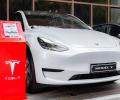
With India's EV penetration at just 2.5 per cent, the market presents an opportunity -- provided Tesla gets its pricing right.

The only silver lining in March's performance -- which otherwise dragged down the financial year's momentum -- was a 6 per cent year-on-year (Y-o-Y) growth compared to March of the previous year. This is largely due to incentives, festival-driven gains, and new launches.

In an eventful week ahead, stock market investors will take cues from major events like the US Federal Reserve's interest rate decision, the upcoming Union Budget and Q3 earnings, analysts said.

From the Sensex pack, Reliance Industries, Bajaj Finserv, HDFC Bank, Adani Ports, Maruti Suzuki India, Axis Bank, Hindustan Unilever, Sun Pharmaceuticals and Asian Paints were among the laggards. Reliance Industries fell the most by 2.38 per cent to close at Rs 1,171.10 apiece.

South Korean carmaker Kia was on Tuesday declared the top mass-market performer in the overall customer experience index (CEI), an annual survey done by the Federation of Automobile Dealers Associations (Fada) to assess and quantify customer experience across 97 parameters related to sales, product, and after-sales quality. Fada conducted this survey in collaboration with consulting firm Frost & Sullivan, with a sample size of 8,685 respondents.

Maruti Suzuki India will launch electric vehicles in the country only after 2025 as demand for such vehicles at the moment is less and it would like to sell around 10,000 units a month whenever it enters the electric mobility space, company chairman RC Bhargava said on Wednesday. Addressing a virtual conference on the company's second quarter earnings, he said under the current circumstances a lot of things in the EV ecosystem such as batteries, charging infrastructure and electric supply are done by other parties and therefore the costing is not in the hands of the company. Also with fuel prices going up, car market leader Maruti Suzuki India is intensifying its focus on more CNG offerings of its models.

Maruti is not an online outlier, of course; other heavyweights have rolled out similar services. But as an analyst pointed out, Maruti's all-India roll-out has significant impact given that it accounts for over half of all cars sold, reports, reports Pavan Lall.

Why is Shailesh Chandra, managing director of Tata Motors Passenger Vehicles and Tata Passenger Electric Mobility, not worried about the competition?
Maruti Suzuki India on Wednesday reported a 42 per cent rise in consolidated net profit to Rs 2,671 crore for the fourth quarter ended March 2023, driven by higher sales, improved realisation and favourable forex movement. The country's largest carmaker logged a net profit of Rs 1,876 crore in the January-March of 2021-22. Net sales during the fourth quarter rose to Rs 32,060 crore compared to Rs 26,749 crore in the year-ago period, Maruti Suzuki India (MSI) said in a regulatory filing.

From the 30-share blue-chip pack, Adani Ports, UltraTech Cement, Larsen & Toubro, Sun Pharma, HDFC Bank, ICICI Bank, NTPC and State Bank of India were the major laggards. Tata Consultancy Services, Reliance Industries, ITC, Asian Paints, HCL Tech and Maruti were among the gainers.
'Bharat has been leading, but it cannot carry India as the bulk of the sales come from India in terms of volume and profitability.'

The recent currency volatility - rupee's depreciation against international currencies - may have given heartburns to automakers that rely on imports or pay royalty to parent companies abroad. But for Maruti Suzuki India, favourable movement of the yen - the currency that matters the most - against the Indian rupee, has given it reasons to cheer. The yen's sharp fall against the rupee and the rupee's depreciation against the US dollar, which in turn will bump up export realisations, are set to give a margin boost to the maker of Baleno and Brezza, said analysts. The softening of commodity prices and slew of new SUV launches in the coming months will also aid margins, they said.

The initial public offer of Hyundai Motor India Ltd, the Indian arm of South Korean automaker Hyundai, got subscribed 2.37 times on the third day of the bidding on Thursday, helped by institutional buyers. This is the largest IPO in the country, surpassing LIC's initial share sale of Rs 21,000 crore. The Rs 27,870 crore initial share sale got bids for 23,63,26,937 shares against 9,97,69,810 shares on offer, translating into 2.37 times subscription, as per NSE data.
