
L&T Technology Services (LTTS) reported a 66.78 per cent increase in consolidated net profit to Rs 548.2 crore for the July-September quarter of FY27, largely due to a one-time gain from the sale of its Smart World and Communication business. Revenue also grew by 12.1 per cent to Rs 3,040.4 crore. The company secured over USD 200 million in large deal wins, with a significant portion in AI-related projects, and launched an Engineering Intelligence Lab in partnership with NVIDIA.
L&T Technology Services (LTTS) reported a 66.78 per cent increase in consolidated net profit to Rs 548.2 crore for the July-September quarter of FY27, largely due to a one-time gain from the sale of its Smart World and Communication business. Revenue also grew by 12.1 per cent to Rs 3,040.4 crore. The company secured over USD 200 million in large deal wins, with a significant portion in AI-related projects, and launched an Engineering Intelligence Lab in partnership with NVIDIA.

Indian states' capital expenditure (capex) utilisation for April-August FY27 fell to 21.21 per cent, slightly below the 21.73 per cent recorded in the same period of FY26, according to a CAG analysis. Despite the dip, this figure remains the third highest in the past six years, with significant variations observed across states.

Indian factories saw an 8 per cent decline in gross fixed capital formation (GFCF) in FY25, marking the first drop since the pandemic, despite achieving record high employment generation, according to the latest Annual Survey of Industries (ASI) data.

The Reserve Bank of India (RBI) has increased its GDP growth forecast for the current fiscal year (FY27) by 40 basis points to 7.1 per cent, acknowledging the resilience of domestic economic activity despite global headwinds and geopolitical tensions.

Tata Trusts, India's largest philanthropic group, disbursed Rs 1,556.31 crore in the year to March 2026 and announced plans to establish a network of 40 to 50 not-for-profit general hospitals, with funding from paying patients supporting care for those who cannot afford it.

Roughly 340-350 such rakes remain to be converted out of around 2,000 rakes.

Indian banks are projected to achieve healthy profit growth in the second quarter of financial year 2027 (Q2FY27), driven by lower credit costs, robust advance growth, and fee income. However, net interest margins (NIMs) are expected to face pressure due to significant mobilisation of foreign currency non-resident (bank) FCNR(B) deposits.

The Centre has spent 28 per cent of its FY27 capital expenditure budget of Rs 12.21 trillion in the first three months against around 24.5 per cent during the corresponding period a year ago.

After a significant 9.9% depreciation in FY26, the Indian rupee has shown comparative stability in the first half of FY27, depreciating by only 1.1%, attributed to regulatory interventions and measures to attract foreign capital, despite ongoing global pressures from rising crude oil prices and foreign investor outflows.

HCLTech announced a robust 21.18 per cent increase in its Q2 FY27 consolidated net profit, reaching Rs 5,132 crore, largely propelled by the strong performance and higher margins from its advanced AI operations and a reduced tax burden.

Indian mutual funds experienced a nearly 5 per cent growth in average quarterly assets under management (QAAUM) in the second quarter of FY27, reaching approximately ~87.2 trillion, despite significant equity market turbulence and corrections in largecap and some debt segments.

Chief Economic Advisor V Anantha Nageswaran stated that the second half of the current fiscal year (FY27) is expected to be challenging due to increased downside risks to global growth and rising interest rates worldwide.

India's private sector capital expenditure is projected to reach approximately 3.2 trillion in the financial year 2026-27, up from 2.6 trillion in FY26, according to a Reserve Bank of India bulletin report, indicating sustained confidence despite global uncertainties.

Non-resident Indian (NRI) deposit schemes witnessed a staggering 678.2 per cent increase, reaching $36.24 billion in the April-July period of FY27, primarily driven by strong FCNR(B) deposit flows and a concessional swap facility introduced by the RBI.

India has achieved its highest-ever annual Foreign Direct Investment (FDI) inflow of USD 94.53 billion in FY 2025-26, with cumulative FDI reaching USD 843 billion since 2014-15, announced Commerce and Industry Minister Piyush Goyal. Production Linked Incentive (PLI) schemes have also significantly boosted investment, production, exports, and job creation.
Private corporations in India invested approximately 30.3 trillion in fixed assets during FY25, marking a 7 per cent increase from the previous year, according to the statistics ministry. This growth in private capital expenditure contrasts with a slowdown in government capital spending.

Samsung India Electronics reported a 36 per cent decline in profit to 7,228.10 crore for the financial year ended March 31, 2026, even as its revenue from operations saw a slight increase of 1.2 per cent to 1.12 lakh crore.
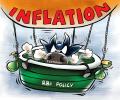
The Reserve Bank of India (RBI) has marginally raised its retail inflation forecast for the current fiscal year (FY27) to 5.2 per cent from 5 per cent, citing increasing price pressures across various commodities. Concurrently, the Monetary Policy Committee (MPC) unanimously decided to hike the key interest rate (repo) by 25 basis points to 5.5 per cent, shifting its stance to 'calibrated tightening'.

India's economy is projected to lose momentum in the second half of fiscal 2026-27, with tighter financial conditions, elevated energy prices, and broadening inflation pressures posing significant risks, according to DBS Bank economist Radhika Rao.

The Indian corporate sector demonstrated strong credit quality in the first half of FY27, driven by robust balance sheets and healthy liquidity, despite facing risks from elevated crude prices, inflation, and global interest rates.

Fitch Ratings has increased India's GDP growth forecast for the current fiscal year (FY'27) to 6.9 per cent, up from 6.4 per cent, attributing the revision to robust economic growth in the June quarter and overall economic resilience. The agency also anticipates the Reserve Bank of India (RBI) will raise interest rates by 0.25 per cent in October.

Reserve Bank of India (RBI) Governor Sanjay Malhotra stated that surplus liquidity in the banking system is expected to drain within the current financial year, utilising tools like currency leakage, sell-buy swaps, open market operations (OMOs), and variable rate operations.

The GST Council has approved a proposal allowing pharmaceutical companies to claim Input Tax Credit (ITC) on free samples and goods destroyed or written off due to expiry, effective from the next fiscal year. This move aims to support manufacturing, liquidity, and exports within the sector.
Moody's Ratings has sharply increased India's GDP growth forecast for fiscal 2026-27 to 7 per cent, making it the fastest among G20 economies, driven by economic resilience despite the Middle East conflict. However, the agency flagged significant inflation risks stemming from elevated oil prices and potential El Nino disruptions.

Domestic telecom gear maker HFCL reported its highest-ever quarterly consolidated net profit of Rs 394.22 crore for the second quarter ended September 30, 2026, a multi-fold increase from Rs 72 crore a year ago, primarily due to strong demand for optical fibre cables from AI data centres.

Finance Minister Nirmala Sitharaman stated that India is likely to sustain economic growth of 7 per cent or more in 2026-27, continuing the pace recorded since the Covid-19 pandemic, despite geopolitical uncertainties and supply-chain disruptions.

The International Monetary Fund (IMF) has increased India's growth forecast to 7 per cent for 2026-27, up from 6.4 per cent, attributing this robust outlook to resilient domestic demand and strong services activity, positioning India as one of the fastest-growing major economies.

Maruti Suzuki India has significantly increased its capital expenditure (capex) outlay to Rs 77,500 crore for the five-year period ending FY31, aiming to boost capacity, develop new models, and enhance R&D, as announced by MD and CEO Hisashi Takeuchi.

Fintech company Cashfree Payments India Private Limited has significantly reduced its consolidated net losses to Rs 118.5 crore in FY26 from Rs 154 crore in FY25. The firm also saw a substantial revenue growth of over 51 per cent, reaching Rs 967.4 crore. Co-founder & CEO Akash Sinha highlighted achieving EBITDA profitability in March 2026 and outlined plans for full-year profitability in FY27, driven by growth in SMB and cross-border payments.

Icra predicts that the top seven Indian cities will see an 8-11 per cent year-on-year growth in housing sales value by FY27, reaching approximately 7.9 trillion, primarily driven by the ongoing trend of premiumisation and a favourable product mix.

A working paper by the Economic Advisory Council to the Prime Minister (EAC-PM) reveals a continuous decline in the rate at which foreign-owned firms invest in fixed assets in India since the FY20 peak, contrasting with a steady increase from Indian business groups.

Coal India Ltd (CIL) has refuted claims by NTPC Ltd regarding critically low coal stocks, stating it has met and exceeded its contractual supply commitments to the power producer. CIL reported supplying 97 million tonnes to NTPC and its joint ventures during April-September of FY27, a 5% increase year-on-year.

Maharashtra recorded the highest sales for passenger and commercial vehicles in the first quarter of fiscal year 2027, while Uttar Pradesh led the two and three-wheeler segments, according to data released by the Society of Indian Automobile Manufacturers (SIAM).

India's entry-level passenger vehicle market is experiencing a significant recovery, with mini car wholesales surging 86.3 per cent year-on-year in the first half of FY27, driven by improved affordability and stronger overall demand.

The fiscal consolidation path and Rs 1 trillion stabilisation fund provide room to absorb mild shocks, but sustained oil-price increases pose risks.

'We are open to all countries around the world as long as we get a fair deal, as long as we are ensured continuity in the engagement.'

India has exhausted 58.04 per cent of its FY27 fertiliser subsidy budget in under five months, primarily due to a significant surge in global urea prices following the conflict in West Asia, necessitating potential additional government expenditure.
Inflows into non-resident Indian (NRI) deposit schemes decreased by 23.24 per cent to $2.78 billion during the first quarter of FY27, down from $3.61 billion in the previous year, according to Reserve Bank of India (RBI) data.

Indian mutual fund holdings in overseas equity securities increased by 37.5 per cent year-on-year to approximately '93,602 crore by March-end, according to RBI data. This growth is attributed to mark-to-market gains from a global market rally and heightened investor interest, with the US remaining the primary destination for these investments.
