
Indian equity benchmark indices extended losses for a second consecutive session, with the Sensex dropping 143 points, driven by a sell-off in power, banking, and financial stocks, coupled with elevated crude oil prices and persistent FII selling.

Indian benchmark equity indices, Sensex and Nifty, closed lower for the fourth consecutive session, driven by a surge in crude oil prices above USD 114 per barrel due to escalating tensions in West Asia, coupled with broad-based selling and FII outflows.

Indian benchmark stock indices, Sensex and Nifty, rallied significantly, with Sensex jumping over 1,500 points and Nifty reaching a nearly three-week high, driven by strong buying in banking, IT, and Reliance Industries stocks, alongside easing crude oil prices.

Equity mutual fund schemes recorded a net inflow of Rs 38,306 crore in September, a 31 per cent increase from the previous month, driven by strong investor interest in mid-cap and small-cap funds despite stock market volatility and foreign portfolio investor (FPI) sell-offs.

Indian benchmark indices Sensex and Nifty closed higher for the second consecutive day, primarily driven by robust buying in IT stocks following strong quarterly results and positive global trends. Tech Mahindra notably surged over 8% after reporting a significant jump in net profit.

Rising bond yields in the US and other advanced economies are making it increasingly difficult for Indian equities to attract foreign portfolio investors (FPIs), leading to pressure on valuations and potentially lower returns for domestic investors.

Indian equities, particularly the Nifty 50, have significantly underperformed their Asian and global counterparts over the past year, with the index down 10.6 per cent. This lag is attributed to factors like rising global oil prices, rupee depreciation, and a lack of participation in the global chipmaker rally that boosted markets like South Korea and Taiwan.

Indian benchmark stock indices, Sensex and Nifty, experienced a significant drop on Monday, with the Sensex falling by nearly 548 points, primarily due to a fresh spike in crude oil prices, persistent foreign fund outflows, and rising bond yields.

Indian mutual funds experienced a nearly 5 per cent growth in average quarterly assets under management (QAAUM) in the second quarter of FY27, reaching approximately ~87.2 trillion, despite significant equity market turbulence and corrections in largecap and some debt segments.

Foreign Portfolio Investors (FPIs) have withdrawn Rs 44,166 crore from Indian equities in October, pushing the total outflows for the year past Rs 3 lakh crore, driven by elevated crude oil prices, a stronger US dollar, higher US bond yields, and the allure of AI-led rallies in North Asian markets.

Foreign Portfolio Investors (FPIs) became net sellers in September, withdrawing Rs 35,860 crore from Indian equities due to global uncertainties, high US interest rates, and elevated crude oil prices, with outflows continuing into October.

India's semiconductor sector has garnered USD 1.4 billion in total equity funding across 281 companies, with a substantial USD 701 million raised since 2025 alone, according to Tracxn data.
Foreign Portfolio Investors (FPIs) have withdrawn Rs 20,974 crore from Indian equities in September, driven by global uncertainties, higher US interest rates and bond yields, elevated crude oil prices, and a weakening rupee.

Smallcap funds topped the net inflow chart for the second consecutive month, as investors poured record Rs 7,973 crore into one of the best-performing MF categories.

At a valuation of around Rs 10 trillion, Tata Sons would rank among India's 10 largest listed companies and could qualify for inclusion in key indices such as the Nifty 50, Sensex and the Nifty 100.

Indian benchmark indices, Sensex and Nifty, experienced a significant downturn, with Sensex tanking 778 points and Nifty closing at a five-month low, driven by surging crude oil prices, geopolitical tensions, and fears of further interest rate hikes by major central banks.

Higher US Treasury yields, particularly the 10-year yield approaching 5 per cent, pose a significant near-term risk to global equity markets, including India, potentially triggering a 'big correction' according to market strategists.

Indian benchmark equity indices, Sensex and Nifty, closed lower due to persistent geopolitical tensions in the Middle East and elevated crude oil prices, with investors remaining cautious ahead of fresh US sanctions on Iran.

Indian benchmark indices, Sensex and Nifty, experienced a sharp decline, with the Sensex tumbling 1,247.71 points and the Nifty settling below 23,100, primarily driven by a significant spike in crude oil prices and weak global market trends.
Foreign portfolio investors (FPIs) turned net sellers in the first week of September, withdrawing Rs 7,443 crore from Indian equities, driven by rising crude oil prices, increasing US bond yields, and a strong dollar.

Foreign Portfolio Investors (FPIs) withdrew Rs 13,138 crore from Indian equities in the first half of September, driven by heightened global uncertainty, rising crude oil prices, firm US bond yields, and a strong dollar, impacting risk appetite.
Equity mutual fund schemes in India attracted a net inflow of Rs 29,329 crore in August, marking the highest in four months, primarily fuelled by strong investor interest in mid-cap and small-cap funds.
Indian benchmark indices, Sensex and Nifty, ended marginally lower after recovering from sharp intraday losses, driven by cooling crude oil prices and buying interest in HDFC Bank and IT sector stocks.

Indian benchmark equity indices extended their losing streak for a fourth consecutive day, with the Sensex tumbling 417 points due to rising crude oil prices and a significant sell-off in IT stocks, impacting overall investor sentiment.

Indian stock markets, including the Sensex and Nifty, experienced their third consecutive day of declines, driven by a global selloff, escalating tensions in West Asia, and a subsequent rise in crude oil prices.
Indian benchmark indices, Sensex and Nifty, closed lower on Wednesday, reversing early gains due to profit-taking and weakness in sectors like IT, FMCG, and consumer durables, despite support from lower crude oil prices.

Indian benchmark indices, Sensex and Nifty, closed nearly flat on Thursday, influenced by the US Federal Reserve's interest rate hike and indications of further monetary tightening. Despite some intraday gains, caution prevailed, with foreign institutional investors continuing to offload equities. Meanwhile, the National Stock Exchange of India's (NSE) mega initial public offering opened for subscription, garnering 39 per cent subscription on its first day.
Indian equity benchmarks Sensex and Nifty extended their losses for a third consecutive session, with the Sensex declining 460.30 points and the Nifty dropping 123.70 points, primarily due to surging crude oil prices driven by escalating tensions in West Asia and weak global cues.

The Indian rupee depreciated by 43 paise to close at 94.81 against the US dollar, influenced by a negative trend in domestic equity markets, surging crude oil prices, and significant foreign institutional investor outflows.

Net inflows into smallcap funds surged 39 per cent M-o-M to a record Rs 7,768 crore, while midcap fund inflows rose marginally to Rs 6,192 crore.

Indian equity benchmarks Sensex and Nifty rallied up to 1 per cent in early trade, driven by strong performance in IT stocks, Reliance Industries, and favourable global market sentiment, rebounding from previous losses.

Foreign portfolio investors (FPIs) have injected Rs 30,919 crore into Indian equities in August, marking their second consecutive month of net buying. This follows a Rs 20,200 crore investment in July, indicating a potential reversal after four months of significant outflows, driven by improving corporate earnings, resilient economic activity, and a stable rupee.

Indian mutual fund holdings in overseas equity securities increased by 37.5 per cent year-on-year to approximately '93,602 crore by March-end, according to RBI data. This growth is attributed to mark-to-market gains from a global market rally and heightened investor interest, with the US remaining the primary destination for these investments.
Foreign Portfolio Investors (FPIs) have significantly increased their investment in Indian equities, infusing Rs 23,544 crore in August, driven by improving quarterly earnings, a stable rupee, and positive market prospects.
Indian benchmark equity indices, Sensex and Nifty, ended sharply lower, with the Sensex tumbling 876.37 points and the Nifty dropping below 22,900, primarily due to a decline in private bank stocks like HDFC Bank and Axis Bank, alongside weak global market trends.

Leading Indian stock exchanges, NSE and BSE, will conduct a special Muhurat trading session on Sunday, November 8, from 2:20 pm to 3:30 pm, to mark Diwali and the beginning of the new Hindu calendar year.
Indian benchmark equity indices, Sensex and Nifty, significantly recovered from sharp early losses, driven by buying in State Bank of India and Reliance Industries, alongside fresh foreign fund inflows, despite declines in Axis Bank and HDFC Bank.

'The Indian market has struggled over the past two years.' 'It peaked in September 2024, and although it has moved up and down since then, investors have not really made money.'
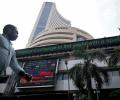
Indian equity benchmarks, the Sensex and Nifty, opened higher on Friday, driven by a strong rally in IT stocks, despite a significant overnight decline in US technology shares and broader Asian markets. Experts anticipate further market support from falling US bond yields, a strengthening rupee, and a substantial liquidity inflow following the Jio Platforms IPO allotment. Track

A foreign brokerage predicts that private investments in Indian AI startups are rapidly growing, with potential listings adding up to USD 100 billion to India's market capitalisation over the next two to five years. Goldman Sachs reported a tripling of PE investment in Indian AI startups in 2025 and highlighted India's rising global rank in AI funding and new AI companies.
