
The total market valuation of all listed firms at the BSE had first hit Rs 100 trillion level on November 28, 2014.

The mutual fund industry in June invested in companies like Piramal Healthcare, Reliance Petroleum, IFCI and Ashok Leyland. Interestingly, there was not much redemption pressure on them despite the Sensex skidding by another 2,570 points in June.

The benchmark index on Wednesday surged 314.92 points or 1.05 per cent to close at 30,248.17 on widespread buying spurred by forecast of a normal monsoon this year.
The BSE's 30-share barometer index continued its slide on Friday, fifth straight day, with a fall of 687.12 points led by sharp losses in blue-chips like RIL, DLF, ICICI Bank, Reliance Energy and Reliance Communications. The Sensex has lost 1,813.75 points in last five trading sessions, while investors' wealth -- measured in terms of cumulative market capitalisation of all the listed companies -- has declined by Rs 5,21,310 crore (Rs 5,213.1 billion).
The stock market barometer Sensex on December 11 won over the 20,000-point mark after flirting with it for as many as 45 days -- the third longest courtship for a thousand-point milestone.
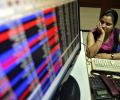
The BSE 30-share index after a positive opening stretched to 31,772.41, but could not stay there for long buffeted by the selling pressure. It hit a low of 31,562.25 before settling lower by 79.68 points, or 0.25 per cent, at 31,592.03.

However, on the NSE, both ITC and Infosys had equal weight of 8.77 per cent.
Why sub-prime mortgage in the US is lashing Indian stocks markets

The cumulative m-cap of the companies listed on the BSE soared to a new peak of Rs 82,02,907 crore at 1200 hours.
The NSE Nifty sank by 159 points at 3491 points.
Now that everyone on the Dalal Street is 'revising' the target for the benchmark BSE-30 upwards, especially after a good Budget, the premise of the same has to be questioned.

In the Sensex pack, M&M was the biggest loser, tumbling by 6.66 per cent, followed by TCS dropping 4.14 per cent.
The headline numbers may reflect that the stock markets are down very sharply. But look deeper and you will find that the major reason why the stock market has declined in the recent past was on account PSUs!

The much-awaited upturn in the stock market on Thursday added more than Rs 1.17 lakh crore to investor wealth, which had plunged by over Rs 4.35 lakh crore in the past four days amid heavy sell-offs.
Although there still exists some upside for Indian stock markets, one has to come to terms with the fact that the surge in indices from hereon will not be as strong as was witnessed in 2003.

ONGC, RIL, ITC, CIL, HDFC Bank, SBI and ICICI Bank saw erosion in their m-cap
The market staged a smart recovery on Tuesday following bargain hunting in stocks at lower levels, after six straight sessions of losses. \n\n
The market valuation of top seven Sensex companies fell by Rs 24,783.44 crore last week in an overall weak stock market.

As per data compiled by capital markets regulator Securities and Exchange Board of India, net investment by FIIs into Indian equities in May was Rs 14,006 crore ($2.35 billion), while in the debt markets it stood at Rs 19,772 crore ($3.34 billion) taking the total to Rs 33,778 crore ($5.7 billion).

SBI had a bad day, sliding the most by 5.36%. Others that dragged the key indices down were M&M, Reliance Industries and L&T.

The 30-share Sensex ended down 69 points at 28,192 and the 50-share Nifty closed 20 points lower at 8,551.

On the sectoral map, consumer durables stayed in the lead by surging 2.39 per cent, followed by realty index, oil and gas and infra.

The NSE Nifty settled the day 93.20 points or 0.88 per cent lower at 10,452.30 after shuttling between 10,612.90 and 10,434.05.
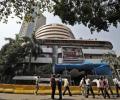
The broader markets closed in tandem with their large counter parts- BSE Midcap and Smallcap indices lost 0.065 and 0.10%, each.

Bajaj Auto was the top gainer in the Sensex pack, surging 3.95 per cent followed by Maruti Suzuki at 2.69 per cent.
Slowing economy, election-related uncertainty and tighter monetary conditions pose risks for Indian markets and the BSE index, Sensex, is likely to hover around 20,250 by the end of this year.

Does the rally reflect expectations of improving fundamentals or they are likely to correct?

This surpassed its previous record close of 29,974.24, reached on April 5.

'There is no question of diverting funds. This government is pro-poor, pro-worker and pro-progressive.'
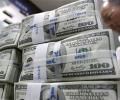
It is a sharp depreciation in rupee valuation against the US dollar that has led to this steeper fall in the Dollex.

Nifty 50 firms' net profit estimated to grow by a modest 3.1% in Q2, reports Krishna Kant.

According to technical analysts, the Nifty could trade in the range between 7,400 and 7,700.
.jpg)
Bank stocks have underperformed in the second quarter of FY'14 with the BSE Bankex declining 18 per cent compared to fall of 1 per cent in the BSE 30-stock index, Sensex, during this period.

'EPFO's investments this financial year should be Rs 1 lakh crore'

India Inc will report good set of numbers in Q4.

Companies from the capital goods space will under-perform.
