
The Asian Development Bank (ADB) has revised down India's GDP growth forecast for fiscal year 2026-27 (FY27) to 6.6 per cent from an earlier 6.9 per cent, primarily attributing the change to elevated energy prices stemming from the Middle East conflict. Despite this moderation, India is still expected to remain the world's fastest-growing major economy.

Asian Development Bank (ADB) on Friday warned that India's limited crude oil reserves of about 100 million barrels - sufficient for only 40-45 days of consumption - leave the country particularly vulnerable to supply disruptions through the Strait of Hormuz amid the ongoing war in West Asia.

The Indian rupee depreciated by 32 paise to close at 92.83 against the US dollar, influenced by escalating global tensions, particularly the US-Iran conflict, and the deadline for the RBI's instructions to banks to curb overnight positions.

The Indian rupee depreciated by 52 paise to settle at 93.35 against the US dollar, driven by failed US-Iran peace talks, surging crude oil prices due to a potential US blockade of Iranian ports, and a global flight to the greenback. This geopolitical uncertainty is also leading to foreign capital withdrawal from domestic equities.

The Sri Lankan government attributes the sharp depreciation of the rupee against the US dollar to the ongoing conflict in West Asia, citing increased costs for essential imports like gas, fertiliser, and oil.

'Once the currency goes out of the hand, then possibly your major challenge is that it will not come back.'
Despite a strong 7.8 per cent growth in the first quarter, the Indian economy is expected to grow at 6.5 per cent in the current financial year as the impact of US tariffs on Indian exports will reduce prospects, particularly in the second half, ADB said on Tuesday.

The Asian Development Bank (ADB) on Wednesday lowered India's growth forecast for FY26 to 6.5 per cent from 6.7 per cent on account of trade uncertainty and higher US tariffs that are expected to impact exports and investment. Despite the downward revision from the April 2025 Asian Development Outlook (ADO), India remains one of the fastest-growing major economies in the world.

The magnitude of the economic losses will depend on how the outbreak evolves, which remains highly uncertain.

Fitch Ratings on Wednesday raised India's GDP growth forecast to 6.9 per cent for current fiscal year, from 6.5 per cent earlier, citing strong June quarter growth and domestic consumption-led demand.
Asian Development Bank (ADB) has kept its outlook for India's economic growth unchanged at 7 per cent for the current fiscal year while forecasting a weaker-than-previously expected pace for developing Asia. ADB's 7 per cent growth projection for fiscal 2022-23 (April 2022 to March 2023), unchanged from its September forecast, compares to 8.7 per cent GDP growth in 2021-22. For 2023-24, the GDP growth has been kept unchanged at 7.2 per cent.
Indian growth in the rest of this fiscal year and next will be propelled by robust domestic consumption as consumer confidence improves, and by investment, including large increases in government capital expenditure, according to the Asian Development Outlook September 2023. "As slowing exports could foment headwinds for the economy, and erratic rainfall patterns are likely to undermine agricultural output, the growth forecast for FY2023 is revised down marginally to 6.3 per cent," ADB said.

India has decided to submit a dossier at the upcoming Financial Action Task Force (FATF) meeting, calling for Pakistan to be placed back on the grey list of the global money laundering and terrorist financing watchdog.

With economic activity still to reach pre-pandemic levels, the RBI may slow down the pace of rate hikes until next year to quell soaring inflation while supporting growth, the Asian Development Bank (ADB) says in its latest report. The Manila-based multilateral funding agency has raised the inflation forecast for the current fiscal year ending in March 2023 to 6.7 per cent from its earlier projection of 5.8 per cent. For the next fiscal year too, the forecast has been revised upwards to 5.8 per cent from 5 per cent earlier.

The Asian Development Bank (ADB) on Wednesday slashed India's GDP growth forecast for FY23 to 7 per cent from the earlier estimate of 7.2 per cent mainly on account of higher inflation and a tight monetary policy. India's economy grew 13.5 per cent year-on-year in the first quarter of 2022-23, reflecting strong growth in services, ADB said in its second supplement to Asian Development Outlook Report 2022 (ADO 2022). "However, GDP growth is revised down from ADO 2022's forecasts to 7 per cent for FY2022 (ending March 2023) and 7.2 per cent for FY2023 (ending March 2024) as price pressures are expected to adversely impact domestic consumption, and sluggish global demand and elevated oil prices will likely be a drag on net exports," ADB said.

The 25 per cent US tariffs, plus a penalty for Russian imports, could dent India's GDP growth by 30 basis points in the current fiscal, but the higher duty is unlikely to significantly affect India's domestic demand-driven economy, Barclays said on Thursday. If the 25 per cent tariff, announced by US President Donald Trump on Wednesday, is implemented from August 1, the effective average US import tariff on Indian goods will rise to 20.6 per cent in trade-weighted terms, as per Barclays estimates.
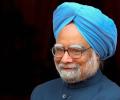
Former Prime Minister Manmohan Singh's 1991 budget unshackled India's economy, significantly enhancing the economic prospects for hundreds of millions of Indians, first deputy managing director of the International Monetary Fund (IMF) Gita Gopinath said on Friday.

Asian Development Bank on Wednesday lowered India's economic growth forecast for FY2019 to 5.1 per cent on slowing job prospects, rural distress exacerbated by poor harvest and credit crunch. Growth in FY2020 is likely to recover thanks to this support, low oil prices, and a weakening rupee, but risks to the projections remain tilted to the downside, it said on India.

The Asian Development Bank (ADB) on Monday lowered India's growth forecast for the current fiscal to 5.6 per cent, from 7 per cent projected earlier, citing falling global demand and impact of delayed monsoon on agricultural production.

India's GDP is poised to accelerate to 5.5 per cent in 2014-15 on the back of improved performance in industry and services but it may take some time for the country to reach its potential growth rate, says an Asian Development Bank (ADB) report.
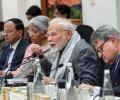
Job creation, improving farm productivity, and mobilising public funds for infrastructure development were some of the issues that figured during the interaction between Prime Minister Narendra Modi and economists ahead of the 2025-26 Union Budget. The prime minister on Tuesday met eminent economists and sectoral experts at NITI Aayog to hear their views and suggestions for the upcoming Budget. Union Finance Minister Nirmala Sitharaman is scheduled to present the Budget for 2025-26 in the Lok Sabha on February 1, 2025.

China's GDP growth this year is expected to be around 8.5 per cent, down from 9.2 per cent in 2011, as the economy slowed down due to declining exports and global downturn, the Asian Development Bank (ADB) said in its annual report.

Growth forecast has been lowered owing to tepid growth in the first half of 2017-18, the lingering effects of demonetisation, transitory challenges of GST, and some risks to agriculture stemming from a spotty monsoon.

India's GDP is likely to grow at 6.5 to 7 per cent in the current fiscal year amid global challenges which may impact exports, said Economic Survey 2023-24 tabled in Parliament on Monday. The growth projected for 2024-25 is lower than the economic growth rate of 8.2 per cent estimated for the previous financial year. The Reserve Bank has projected the GDP growth for the fiscal year ending March 2025 at 7.2 per cent.

The minister would be accompanied by Finance Secretary Arvind Mayaram and other finance ministry officials.
The World Bank on Tuesday raised the growth forecast for the Indian economy to 7 per cent for the current fiscal year on the back of recovery in agri sector and rural demand. World Bank had in June projected India to grow at 6.6 per cent for FY24. According to the World Bank Report released on Tuesday, India's growth continues to be strong despite a challenging global environment.

Projecting economic recovery, ADB on Wednesday said India is likely to record 4.7 per cent growth in current fiscal which will improve to 5.7 per cent next year.

A study, commissioned by ADB and titled 'Policy Changes for Asia after the Global Recession: Impact of the Global Economy and Policy Implications', found Asian economies are poised for accelerated growth as the global economic crisis recedes.

The recent rupee depreciation and capital outflows could adversely impact the country's economy.

The Chinese yuan has the potential to be an alternative to the US dollar and help create a multi-currency global reserve system, says an Asian Development Bank report.
Asian Development Bank on Monday warned that job reservation in private sector could lead to swift flight of skilled labour from India.

Fitch Ratings on Tuesday raised India's growth forecast for the current fiscal to 7.2 per cent, from 7 per cent projected in March, saying elevated consumer confidence will drive spending, besides increased investments. In June update to its global economic outlook report, Fitch said it expects inflation to decline to 4.5 per cent by end of this year and RBI to cut policy interest rates by 25 basis points to 6.25 per cent.

Global recovery following the economic downturn is still tentative and fragile, Asian Development Bank's managing director general Rajat Nag said in Ahmedabad on Friday.
In its global economic forecast update for 2009, the World Bank projected a growth rate of 4 per cent for India during 2009-10, while the ADB, in its outlook, expects the economy to expand by 5 per cent. A separate outlook by the Organisation for Economic Cooperation and Development, a club of developed countries, has forecast a 4.3 per cent growth rate for India. India had last grown below this level in 2002-03, when the economy expanded by 3.8 per cent.

Revising India's GDP upwards by 0.3 per cent to 6.3 per cent in 2015, Asian Development Bank (ADB) has said the economy shows a new promise of turnaround after the election brought a stable government in May.
Meanwhile, an ADB report presented at the seminar said this year could prove crucial for the global economy as financial tensions in Europe could escalate further and there remains concern over fledgling economic recovery in the US.

ADB's calculations imply almost half of India's population (47.7 per cent) was below the line in 2010. Both these estimates are based on the year 2005's purchasing power parity rates.
The engines of Asia's re-emergence - India, China and five other economies -- will account for 45 per cent of the global GDP by 2050, according to a report by the Asian Development Bank (ADB).
The Reserve Bank of India on Friday raised the GDP growth projection for the current fiscal to 7 per cent from 6.5 per cent earlier on buoyant domestic demand and higher capacity utilisation in the manufacturing sector. Announcing the bi-monthly monetary policy, RBI Governor Shaktikanta Das, however, flagged protracted geopolitical turmoil and global economic fragmentation as risks to the growth outlook. The RBI kept interest rates unchanged at 6.5 per cent in Friday's monetary policy statement.
Deloitte India on Friday said it estimates India's GDP growth at 6.6 per cent in the current fiscal helped by consumption expenditure, exports rebound and capital flows. In its India's economic outlook report, Deloitte said the rapid growth of the middle-income class has led to rising purchasing power and even created demand for premium luxury products and services. With the expectation that the number of middle-to-high-income segments will be one in two households by 2030/31, up from one in four currently, we believe this trend will likely become further amplified, driving overall private consumer expenditure growth, it said.
