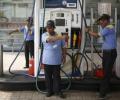
CARE Ratings, in a report, said it foresees an increase in the retail prices of petrol and diesel in the coming few days, depending on how the oil markets react in the reduction in supply from the cartel.

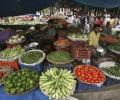
Potato, a daily consumable vegetable, witnessed maximum inflationary pressure at 60.58 per cent

A Kotak research report expects RBI to cuts rates by 50 basis points in the first half of 2019. RBI will announce its sixth bi-monthly monetary policy on February 7.
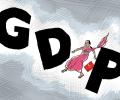
India's Gross Domestic Product (GDP) is expected to expand by 9.2 per cent in the current financial year, according to the Economic Survey 2021-22 tabled in the parliament on Monday. "Advance estimates suggest that the Indian economy is expected to witness real GDP expansion of 9.2 per cent in 2021-22 after contracting in 2020-21. "This implies that overall economic activity has recovered past the pre-pandemic levels," Economic Survey noted. Almost all indicators show that the economic impact of the "second wave" in Q1 was much smaller than that experienced during the full lockdown phase in 2020-21 even though the health impact was more severe, it said.

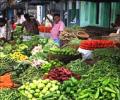
Overall the inflation in vegetable segment was 8.57 per cent as compared to about 4 per cent in February.
Wholesale inflation shot up to a 30-month high of 5.25 per cent in January as rising global crude oil prices spiked domestic fuel cost, even as food prices moderated.
According to the global research firm, though a sharp fall in WPI inflation and negative growth in Industrial production is exerting pressure on the RBI to cut rates, the quantum of rate cut will be more important than the timing.

The excise duty cut will translate into a reduction of Rs 9.5 a litre on petrol and Rs 7 a litre in diesel after taking into account its impact on other levies.
Inflation for the month of August stood at 8.51 per cent, according to the new Wholesale Price Inflation (WPI) series.
WPI inflation even breached psychological level of 0% in Nov.
India's macroeconomic situation is certainly better than what it was a year ago, eminent economist Pinaki Chakraborty said on Monday, while expressing hope that the country will be back on the path of economic growth if there is no major third wave of the COVID-19 pandemic. In an interview with PTI, Chakraborty, who is the director of the National Institute of Public Finance and Policy (NIPFP), said that inflation may remain at an elevated level as there was a significant fiscal and monetary expansion in the last 18 months. "The current macroeconomic situation is certainly much better than what it was one year back. We are seeing recovery in most sectors," he said. Chakraborty noted that COVID-19 vaccination has been going on at a very fast rate in India.

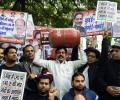
'The signal is crude oil prices will rise, I am cutting my subsidy. Be prepared, prices will rise.'
Declining inflation may present a case for further monetary policy easing.
The rate of price rise for food articles stood at 11.51 per cent during January as against 2.41 per cent a month earlier, while for non-food articles it rose nearly three-fold to 7.8 per cent from 2.32 per cent in December, the data released by the ministry of commerce and industry on Friday showed.
Inflation rose to 4.86 per cent in June, driven mainly by rising prices of food articles, especially vegetables including onion.

Continuing decline in food prices, including vegetables, pulled wholesale price inflation to a five year low of 1.77 per cent in October.
Food prices rose 8.64 per cent year-on-year last month, slower than an annual rise of 9.90 per cent in March.
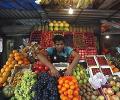
Softening of global commodity prices might not help much

The price rise measured in terms of Wholesale Price Index rose for the second straight month, to 5.79 per cent in July, on account of double digit rise in prices of food articles, mainly vegetables, including onion.

With decline in number of fresh COVID-19 cases and easing of restrictions, the country's gross domestic product (GDP) will grow at 8.5 per cent in FY2021-22, according to credit rating agency Icra Ratings. It expects the gross value added (GVA) at basic prices (at constant 2011-12 prices) to grow at 7.3 per cent in FY2022. "The impact of the second wave of COVID-19 and the ensuing state-wise restrictions was seen across a variety of high frequency indicators in April-May 2021.
.jpg)
A section of the market believes RBI should hold rates as negative real rates will hurt savings and investment.
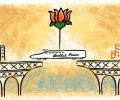
The projects - Delhi-Varanasi, Mumbai-Nagpur, Delhi-Ahmedabad, Chennai-Mysore, Delhi-Amritsar, Mumbai-Hyderabad, and Varanasi-Howrah - are expected to cost around Rs 10 trillion.

Despite admitting to price pressures both from food items and input prices, RBI Governor Shaktikanta Das on Wednesday hoped that a normal Southwest monsoon will have a "soothing impact" on inflation pressures and ruled out any wide variations in medium-term inflation forecast from what was given in April. In an unscheduled address earlier in the day amidst the raging pandemic, Das said the overall outlook for the economy is highly uncertain and is clouded with downside risks. He offered a slew of relief and liquidity measures to individuals and small businesses apart from a Rs 50,000 crore special liquidity window to the healthcare sector.

'The robust tax collections give the finance minister a fair amount of headroom for an expansionary fiscal policy.'


Total debt for listed Indian companies excluding financials fell only 4 per cent to $368 billion in the year ended in March 2015.

Disagreeing with Reserve Bank's projection on the price situation, former RBI Governor and PM's Economic Advisory Council chairman C Rangarajan said WPI and CPI may not be as high as being projected by the central bank.
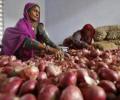
In case of onions, inflation skyrocketed to 127.04 per cent, while for the eggs, meat and fish segment the rate of price rise was 5.76 per cent.

The RBI's projection for WPI inflation for this fiscal is 5.5 per cent.
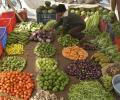
Onion prices, however, continued to rule high with 79.78 per cent increase in September.

People can afford to buy more food. So, the demand is up and so are prices.
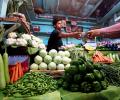
This could be the reason why Prime Minister Narendra Modi mentioned tomato, onion, and potato as his government's 'TOP' priority, in an election rally on February 5 in poll-bound Karnataka.
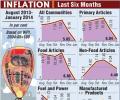
This is the second straight month of decline in wholesale price based inflation.

Debt returns are always negative for investors in India, unless they are willing to take huge risk
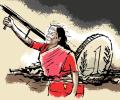
If Nirmala Sitharaman does indeed present a 'never-before' like Budget on February 1, going by her promise, she would create a new benchmark for post-contraction Budgets, observes A K Bhattacharya.

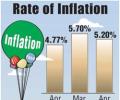
India's annual rate of inflation, based on its monthly Wholesale Price Index, climbed to 6.01 per cent for the month of May 2014, as against 5.20 per cent for May and 4.58 per cent during the corresponding month of the previous year, which has set off alarm bells.
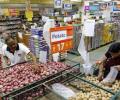
A comprehensive technical framework needed, from which a more convincing policy could be demonstrated
The food-price segment in the WPI has been growing at 8.3 per cent, much higher than the rise in the index for manufactured articles. In fact, segments like minerals and fuel have witnessed a decline in the WPI and have pulled the inflation down. The rise in food prices affects the common man more than the increase in prices of any other item.
There is little to suggest inflation levels will come down since you hardly see the same levels of seasonality in prices that were there earlier.

RBI has cut policy rate thrice during 2015.
