
Indian-origin tech companies cornered a fifth of all H-1B visas issued by the US with Infosys and Tata Consultancy Services leading the pack, an analysis of data from the US immigration department showed. According to data from the US Citizenship and Immigration Services, in April-September 2024 period, out of the total 1.3 lakh H-1B visas issued to different employers, about 24,766 visas were issued to Indian-origin companies.

The Insurance Regulatory and Development Authority of India (Irdai) has asked at least 10 general and life insurance companies to submit a detailed road map for their listing strategies by the end of this month, according to multiple sources with direct knowledge of the matter. "The regulator met four life and six general insurers last month and asked them to provide their listing strategies by the end of February," said one of the sources.

The Department for Promotion of Industry and Internal Trade (DPIIT), under the Ministry of Commerce and Industry, has entered into a partnership with the Startup Policy Forum (SPF), a premier industry organisation representing India's leading new-age companies.

According to Tirupati district superintendent of police L Subbarayudu, Nagaraju (24), who is the victim's maternal uncle, lured the girl to a secluded place in AM Puram village by offering her snacks on Friday evening and committed the crime.

Foreign portfolio investors (FPIs) have invested Rs 25,300 crore through the anchor book for IPOs in 2024, surpassing the Rs 20,351 crore invested by domestic mutual funds (MFs). FPIs accounted for 46.6 per cent of shares sold in the anchor category, the highest share since 2021, according to PRIME Database.

Asset management companies launched 239 new fund offerings (NFOs) mobilising Rs 1.18 lakh crore in 2024, with sectoral or thematic equity funds emerging as the top choice of investors, according to a report by Germinate Investor Services Research. This was higher than 212 NFOs collecting Rs 63,854 crore in 2023 and 228 NFOs garnering Rs 62,187 crore in 2022.

A home insurance policy covers damage from earthquakes, fires, explosions, floods, landslides, cyclones, storms, aircraft damage, and acts of terrorism.

The new business premium (NBP) of life insurance companies dropped 21.7 per cent year-on-year (Y-o-Y) to Rs 30,218.71 crore in December 2024 on the back of a steep fall in business. According to data published by the Life Insurance Council, LIC's premium dropped 41.15 per cent Y-o-Y to Rs 13,523.87 crore while private insurers reported 7 per cent growth in NBP to Rs 16,694.85 crore as the industry absorbs the impact of the revised surrender value norms.

In Debasish Panda's last board meeting as chairperson of the Insurance Regulatory and Development Authority of India (Irdai), the regulator approved the "R2" licence for Kamlesh Goyal and Prem Watsa-backed Value Attics Reinsurance, making it the first private-sector Indian reinsurer after GIC Re, the public-sector reinsurer. "The authority reviewed and approved the R2 application of Value Attics Reinsurance, making it the first private-sector reinsurer after GIC Re, the public-sector reinsurer.

Corporate earnings from blue-chips like HDFC Bank, ICICI Bank, Donald Trump's swearing-in as the US President, and trading activity of foreign investors are the key factors to drive equity markets this week, analysts said. Trump will be sworn in as the US president for a second term on Monday. This week, several key Nifty-50 companies, including BPCL, HDFC Bank, Hindustan Unilever, Dr Reddy's, UltraTech Cement, JSW Steel and ICICI Bank are scheduled to announce their financial results.
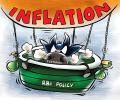
Retail inflation slipped to seven-month low of 3.61 per cent in February mainly due to easing prices of vegetables, eggs, and other protein-rich items, creating space for the RBI to go for another cut in interest rate next month.

Neo banks, along with mid-sized banks, are establishing global capability centres (GCCs) in India, mirroring the expansion strategies of larger global counterparts. This trend is being seen as the next major wave in the country's banking, financial services, and insurance (BFSI) sector.

Shares worth over Rs 50,000 crore (or approximately $6 billion) are set to become freely tradable between now and April 10. Historically, such substantial volumes have been absorbed by a buoyant block-deal market.

State Bank of India, HDFC Bank and ICICI Bank have again been named as Domestic Systemically Important Banks (D-SIBs) by the Reserve Bank of India. The Reserve Bank on Wednesday came out with the list of D-SIBs.

The government on Tuesday announced a new centrally-sponsored scheme for skilling 20 lakh youth over the next five years. The announcement was made by Finance Minister Nirmala Sitharaman in the Union Budget 2024-25. The minister said that model skilling loan scheme will be revised to facilitate loans up to Rs 7.5 lakh.

Indian pharmaceutical companies may have units abroad as part of "distributed manufacturing" across various locations, according to industry veterans. This may come about over the next five to 10 years.

Investor confidence in value mutual funds remains robust, with the category witnessing an inflow of Rs 1,556 crore in January, indicating a shift in their focus towards fundamentally strong yet undervalued stocks.

Gross GST collections grew 8.5 per cent to over Rs 1.82 lakh crore in November on account of increased sales spurred by the festive season.

The Indian economy is expected to be "a little weaker" in 2025 despite steady global growth, IMF managing director Kristalina Georgieva has said. Georgieva also said she expects quite a lot of uncertainty in the world this year mainly around the trade policy of the US. In her annual media roundtable with a group of reporters on Friday, she said global growth is expected to be steady in 2025, but with regional divergence.
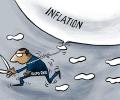
'As the Budget has taken some measures to spur growth, similar action from the MPC may be expected.'

A trends study conducted by India's Financial Intelligence Unit (FIU) has expressed suspicion that cryptocurrency is being used across the country in serious criminal acts like terrorist financing, fuelling secessionist activities, cybercrime, narcotics trafficking, illegal betting and gambling. The report, which was based on suspicious transaction reports and operational analysis, shared these trends and credible intelligence with law enforcement agencies.

From the 30-share blue-chip pack, Adani Ports jumped over 5 per cent. NTPC, Tata Steel, Bajaj Finserv, Zomato, Bajaj Finance, Tata Motors, State Bank of India, IndusInd Bank and Maruti were among the other big gainers. From the 30-share pack, Hindustan Unilever, Titan, Tata Consultancy Services, Infosys and UltraTech Cement were the other laggards.

The weaker rupee will push the country's import bill due to higher payments for crude oil, coal, vegetable oil, gold, diamonds, electronics, machinery, plastics, and chemicals, economic think tank GTRI said on Friday. Citing an example, it said the depreciating domestic currency will increase India's gold import bill, especially as global gold prices have jumped 31.25 per cent, rising from $65,877 per kg in January 2024 to $86,464 per kg in January 2025.

The recent selloff in the Indian equity market has been far more painful for mid and smallcap stocks compared to largecap stocks. The benchmark BSE Sensex is now down 9.5 per cent from its record monthly closing of 84,300 at the end of September last year. In the same period, the BSE MidCap has lost 17 per cent of its value, while the BSE SmallCap has corrected by 17.1 per cent.

Finance Minister Nirmala Sitharaman on Saturday said the government will arrange identity cards and registration on the e-Shram portal to assist 1 crore gig workers. Presenting the Union Budget 2025-26, the finance minister also said a scheme for the socio-economic upliftment of urban workers will be implemented.

Information technology (IT) stocks ended at their lowest in nearly nine months after a fresh bout of selling, triggered by concerns over a recession in the US, the key market for domestic software exporters. A report by Morgan Stanley citing risks to growth also weighed on sentiment.

To ease the potential liquidity stress, the Reserve Bank on Friday slashed Cash Reserve Ratio (CRR) by 50 basis points to 4 per cent, a move that would unlock Rs 1.16 lakh crore bank funds. The RBI on May 4, 2022 had raised CRR to 4.5 per cent from 4 per cent in an off-cycle Monetary Policy Committee (MPC) meeting, with effect from May 21 the same year.

Inflows into mutual funds' equity schemes increased by over 14 per cent on-month to Rs 41,156 crore in December, even as market volatilities continued. The small and midcap schemes of mutual funds continued to attract investor interest with inflows touching record highs during the month, despite the concerns being expressed about the two segments for the risk they portend, industry body Amfi said.

The last time this happened was in 1996.

ICICI Bank, Tata Motors, Tata Steel, NTPC, JSW Steel, State Bank of India and Adani Ports were the other big gainers. Asian Paints, Nestle, Tech Mahindra, HCL Technologies, Hindustan Unilever, Infosys and ITC were the other big laggards.

Foreign portfolio investors (FPIs) withdrew Rs 14,790 crore ($1.8 billion) from financial stocks in the first half of August, driven by global risk aversion sparked by US recession fears. Additional factors contributing to the decline in banking stocks included subdued earnings growth in the June quarter, concerns about slowing deposit growth, and stricter liquidity norms imposed by the Reserve Bank of India.

Ask rediffGURU and PF and MF expert Janak Patel your mutual fund and personal finance-related questions.

The Centre on Wednesday increased the Dearness Allowance (DA) by 3 percentage points effective from July 1 this year, benefitting more than 1 crore employees and pensioners ahead of the Diwali festival. The Union Cabinet has approved to increase Dearness Allowance (DA) to central government employees and Dearness Relief (DR) to pensioners by three percentage points of the basic pay/pension ahead of Diwali, Union Minister Ashwini Vaishnaw said after the Cabinet meeting.

'I now see rates rising again, particularly after recent losses - especially the January wildfires in Los Angeles.'

India's healthcare and pharmaceutical sectors raised Rs 14,811 crore through initial public offerings (IPOs) in 2024, the largest since 2019, driven by strong domestic demand amid expanding global opportunities. According to data, key contributors to the record fundraising included Sai Life Sciences (Rs 3,043 crore), IKS Health (Rs 2,498 crore), and Sagility India (Rs 2,107 crore).

'By extending the definition of 'personal' to include institutions and not just individuals, the State has equipped itself with a tool to block access to most kinds of information.'

Alternative investment funds (AIFs) - investment vehicles favoured by the affluent - have topped $50 billion (Rs 4.3 trillion) in total investments for the first time during the April-June quarter, according to the latest data from the Securities and Exchange Board of India. The industry's commitments have approached Rs 12 trillion ($140 billion), marking a 40 per cent increase over the past year. The amount raised and deployed stood at Rs 4.74 trillion ($56 billion) and Rs 4.32 trillion ($51 billion), respectively, the data shows.

Foreign direct investment in India jumped 47.8 per cent to $16.17 billion in April-June this fiscal on healthy inflows in services, computer, telecom and pharma sectors, according to government data. FDI inflows were at $10.94 billion in April-June 2023-24. The data showed that overseas inflows in May rose to $5.85 billion and in June to $5.41 billion from $2.67 billion and $3.16 billion, respectively, in the year-ago period.

Why try to time the market when time in the market works better? History shows that patient investors who stay the course often walk away with the real rewards, says Ramalingam Kalirajan.
Value mutual funds have witnessed robust investor interest, garnering Rs 22,757 crore in inflows in 2024, nearly double the amount seen in 2023, fueled by impressive returns generated by the segment. This surge reflects a shift in investor focus towards fundamentally strong yet undervalued stocks.
