
China appears determined to upgrade Pakistan's military capabilities, sufficient to ensure local parity with India, alerts former foreign secretary Ambassador Shyam Saran.
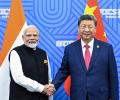
The Galwan clash occurred six months after the Doklam disengagement and two high-profile meetings. India should not be caught by surprise once again, asserts former foreign secretary Shyam Saran.

As India's stock rises, the resolution of the border row may become even more difficult, warn Harsh V Pant and Kalpit Mankikar.

'Why did your generals try to grab a few square kilometres of Indian territory in Ladakh?' 'And what happened to the hard work that you and Prime Minister Modi put into the Wuhan and Mamallapuram meets?' Claude Arpi writes a letter to Xi Jinping, China's self-styled supreme leader, who turns 68 today, June 15.
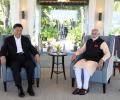
'China physically occupies about 45,000 sq km of J&K as claimed by India, including 3,000 sq km captured in the 1962 War and never returned; and 5,180 sq km ceded to China by Pakistan in 1963.' 'It is hard to justify remaining silent about the return of China occupied Ladakh,' observes Ajay Shukla.

A genuine attempt was made to reset relations in a positive way, signalling a stepping back from the brink of conflict, much to the relief of the world, observes Ambassador T P Sreenivasan.

Xi does not want to risk any political or economic crisis complicating his bid to remain in office, observes Ambassador Shyam Saran, the former foreign secretary.
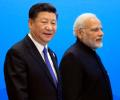
'There is a compulsion to look hard, decisive, and risk-taking; start something; and then conclude it in a way you can claim victory.' 'That is not such an easy option against China,' notes Shekhar Gupta.

Heading G20 will give India a foreign affairs year like it has never had in history. You can trust Narendra Modi to exploit this to India's benefit. And, of course, to his own in his election year, explains Shekhar Gupta.

Rumours that Mr Xi was a market reformer appear to have been exaggerated.

Instead, increases in foreign-direct-investment levels; and reforms to make labour, land and capital more mobile.

'China was a relationship from which Mr Modi had expected the most it seems.' 'It showed in a string of summits, and somewhat breathless celebration of Xi Jinping.' 'It was hasty and simplistic,' observes Shekhar Gupta.

'The border stand-off and the uncertainties that come with it should be a wake-up call on what makes for real rather than illusory power,' observes T N Ninan.

Another sobering number is that the total Chinese investment in India in the past 10 years amounts to $400 million.

India looks less equal to China than 5 years ago, the strategic alliance with the US is hobbled by trade, and Pakistan is looking anything but chastened by Balakot. What has gone wrong? asks Shekhar Gupta.

'The need of the hour is to build on the positives and control the negatives,' says Colonel (Dr) Anil A Athale (retd).

The entire gamut of China's activities is aimed at keeping India on tenterhooks, cause fatigue to its troops and keeping its security system unstable, so that it cannot play a meaningful role in international geopolitics as an effective partner of the US and Japan, observes Lieutenant General Syed Ata Hasnain (retd).

Prime Minister Modi made a strategic blunder of Nehruvian proportions -- presuming no war can happen now, and the Chinese won't be a military threat and risk their economic interests, observes Shekhar Gupta.

'I told all those Indians in Cheen there are some netas who go on holiday and don't work. Here I am, working and working, going on so many yatras, shaking hands with all big world netas till my hands feel they will fall off' 'Hai Hai, so much remains to be done, so many countries still to be visited...'

'It is nobody's contention that uncomfortable questions regarding national security should not be raised. But that is a topic for another day and another time when the immediate threat has faded,' argues Vivek Gumaste.
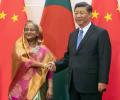
'Beijing is comfortable with Hasina's pragmatism -- perceived as 'pro-India', but staying out of Indian orbit and receptive to forging close ties with China and yet, siding with neither neighbour,' says Ambassador M K Bhadrakumar.

The leaders of China and Taiwan met on Saturday for the first time since the formerly bitter Cold War foes split amid civil war 66 years ago.

New Delhi can strengthen its leverage by having better relations with the two than they have with each other.

PM Modi's China visit may strengthen ties between both the countries.

'The men in black suits and hair dye in Beijing have not only completely blown the cover story of "peaceful rise," but have managed to antagonise regional powers in the Indo-Pacific.'

'Is Xi's China stable?'
'No one can say whether the regime will fall all at once or if its leaders are devising a new solid and competitive -- anything but democratic -- model.' A fascinating excerpt from Francois Bougon's Inside The Mind of Xi Jinping.
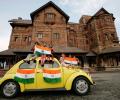
Though growth in China is unlikely to slow down soon, India should prepare to take advantage of a shifting of gears there.

The biggest lesson China can teach India is that when it comes to sustaining a love affair with investors, nothing works better than an undervalued currency and its by-product: a current-account surplus.
 © 2026 Rediff.com - Investor Information - Advertise with us - Disclaimer - Privacy Policy - Sitemap - Feedback - About us - Terms of use - Grievances